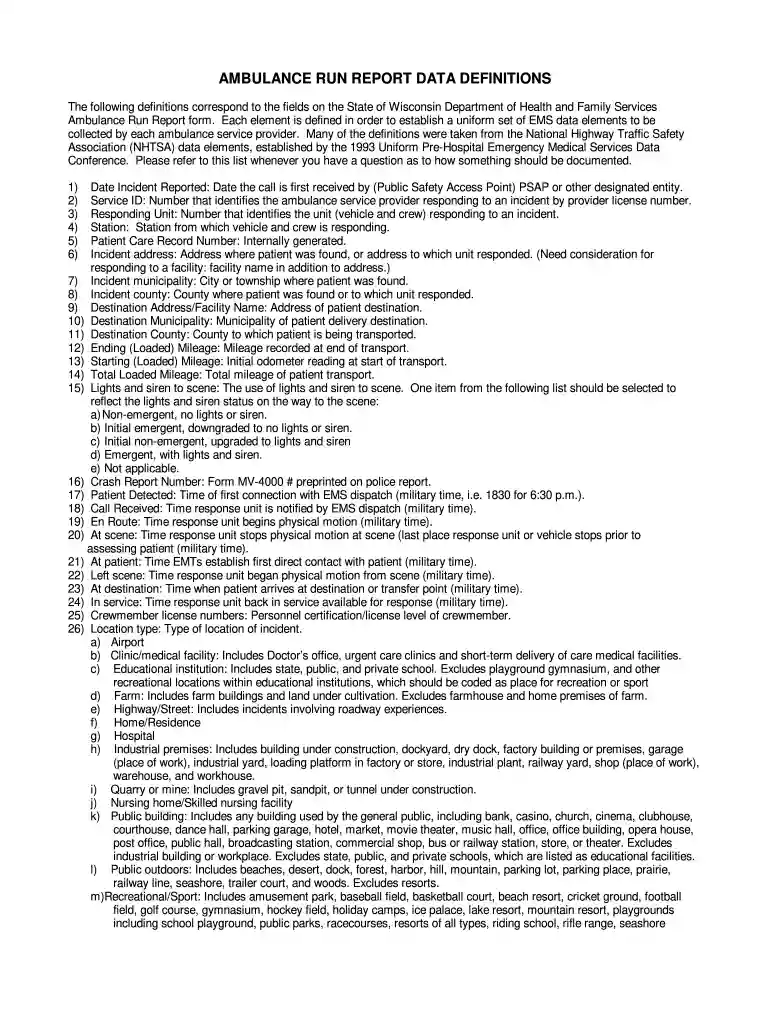
Dhs ambulance data form 2026

Get Form
dhs ambulance data form Preview on Page 1

Here's how it works

01. Edit your form online
Type text, add images, blackout confidential details, add comments, highlights and more.

02. Sign it in a few clicks
Draw your signature, type it, upload its image, or use your mobile device as a signature pad.

03. Share your form with others
Send it via email, link, or fax. You can also download it, export it or print it out.

How to use or fill out dhs ambulance data form with our platform

Form edit decoration
9.5
Ease of Setup
DocHub User Ratings on G2
9.0
Ease of Use
DocHub User Ratings on G2
  1. Click ‘Get Form’ to open the dhs ambulance data form in the editor.
  2. Begin by entering the 'Date Incident Reported'—this is when the call was first received. Ensure accuracy as this sets the timeline for the report.
  3. Fill in the 'Service ID' and 'Responding Unit' fields, which identify your ambulance service provider and unit responding to the incident.
  4. Complete the 'Incident Address' and 'Incident Municipality' sections, providing precise locations where assistance was rendered.
  5. Document patient details such as name, address, date of birth, and insurance information in their respective fields to ensure comprehensive patient records.
  6. For clinical assessments, accurately select symptoms and pre-existing conditions from the provided lists to reflect the patient's status during transport.
  7. Finally, review all entries for completeness before saving or sharing your report. Utilize our platform's features for easy editing and signing.

Start using our platform today to streamline your dhs ambulance data form completion for free!

be ready to get more

Complete this form in 5 minutes or less

Get form

Got questions?

We have answers to the most popular questions from our customers. If you can't find an answer to your question, please contact us.
Contact us

Yes, electronically drawing your signature is acceptable, but only if you use a tool that complies with industry laws and regulations. Consider DocHub, which ensures eSignature validity under ESIGN and UETA requirements. All you need to approve your dhs ambulance data form electronically is an account with DocHub and an internet connection. Once you open your file in our editor, click Sign and choose the Draw tool.

If you are using Chrome, there are two simple ways to edit your dhs ambulance data form online. First, go to the DocHub website, add your file, and edit it using our toolbar. You can also set up our Chrome extension and edit any document by dragging and dropping it in your web browser window.

Contact Your Local Area Agency on Aging (AAA) Local Area Agencies on Aging (AAA) often offer programs or can direct you to resources that provide free or discounted LifeStation medical alert systems.
The EMS-ID is a unique 12-digit identification number (####-####-####) issued to all EMS professionals by the National Registry. An individuals EMS ID can be located by logging into your account on the National Registry website or contacting your State EMS Office.
A medical alert form is a form used by an agent to report the status of a patient and the need for medical assistance. A caretaker will use this form to check on the health and well-being of a patient. The medical alert form will also be used to request assistance in the event of an emergency.

Security and compliance

At DocHub, your data security is our priority. We follow HIPAA, SOC2, GDPR, and other standards, so you can work on your documents with confidence.

Learn more
ccpa2
pci-dss
gdpr-compliance
hipaa
soc-compliance
be ready to get more

Complete this form in 5 minutes or less

Get form

People also ask

While its hard to pinpoint an average cost of medical alert systems, monthly fees generally start around $20 and can go up to $60 or more. Were here to help you navigate the variables and understand the bottom-line costs so you can choose the most affordable medical alert system for your needs.
Medical alert bracelets are most commonly recommended for the following chronic medical conditions: Asthma. Diabetes. Down Syndrome. Epilepsy. Heart conditions. Seizure disorders.

Related links