




01. Edit your arrt ct log sheet online
Type text, add images, blackout confidential details, add comments, highlights and more.

Type text, add images, blackout confidential details, add comments, highlights and more.

Draw your signature, type it, upload its image, or use your mobile device as a signature pad.

Send arrt ct competency checklist via email, link, or fax. You can also download it, export it or print it out.
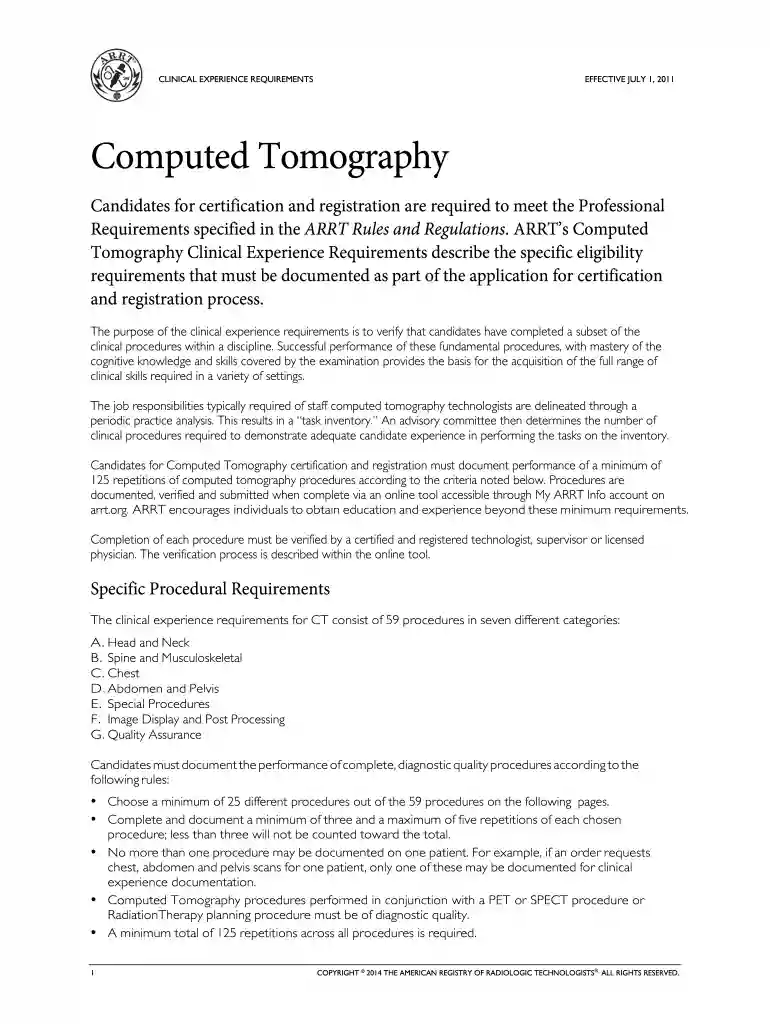
The ARRT CT log sheet is a critical document designed for candidates pursuing certification in Computed Tomography (CT) through the American Registry of Radiologic Technologists (ARRT). It serves as a systematic record of the candidate's clinical experience and competencies in various CT procedures. The log sheet captures essential information about the performance of specific imaging exams, ensuring that candidates meet the eligibility prerequisites outlined by the ARRT.
The significance of utilizing the ARRT CT log sheet lies in its role in maintaining rigorous standards within the field. By accurately documenting clinical hours and competencies, candidates demonstrate their preparedness for the ARRT CT exam. This documentation is not merely a formality; it provides evidence that candidates have completed the required number of procedures — at least 125 — across a range of categories. Moreover, it helps promote a high level of diagnostic quality in imaging, which is paramount for patient safety and care.
Utilizing the ARRT CT log sheet involves several steps to ensure that records are maintained accurately and comprehensively.
Obtaining the Log Sheet: Candidates can access the log sheet from the ARRT website or affiliated resources, ensuring they use the most up-to-date version.
Documenting Clinical Procedures: As candidates perform CT procedures, they should record key details such as the date, type of procedure, and the supervising technologist's name. This will include a variety of CT competencies across multiple categories, ensuring a well-rounded experience.
Maintaining Accuracy: It is crucial that the information entered is both accurate and complete. Any discrepancies can lead to complications during the application process. Therefore, candidates should regularly review the entries to confirm completeness and correctness.
Utilizing Structured Fields: The log sheet is typically organized into specific rows and columns designed to capture particular details. Candidates should ensure they fill out every applicable field as required.
Final Review and Submission: Before submitting evidence to the ARRT, candidates should perform a final review of their log sheets, confirming that all necessary competencies are documented and that they meet the requirements for submission.
To obtain the ARRT CT log sheet, candidates can follow these steps:
Visit the Official ARRT Website: Start by conducting a search on the ARRT’s official website, where candidates can typically find various documents, including the log sheet.
Download the Document: Often available in a PDF format, candidates can download the log sheet directly. It’s advisable to save this document in a secure location for ongoing use.
Check for Updates: Since requirements and formats may change, candidates should ensure they are using the latest version of the log sheet by checking for updates periodically.
Contact Professional Training Programs: For those enrolled in formal training programs, instructors may provide the log sheet as part of the curriculum, highlighting critical features and instructions for completion.
Completing the ARRT CT log sheet requires attention to detail and adherence to specific guidelines. The following steps outline the process:
Log Detailed Information: Each entry should include the date, procedure type, and duration, as well as any patient identifiers if required by the practice setting.
Document Competencies: Candidates must account for different competencies by including procedures such as non-contrast CT, contrast-enhanced CT, and interventional CT, providing a comprehensive overview of skills.
Supervisor Verification: To add credibility, entries should be verified and signed by a supervising radiologic technologist or physician who confirms the candidate's participation in the procedure.
Regular Updates: Candidates should update their log sheets consistently after each procedure, ensuring that their clinical experience is reflected in real time rather than accumulating records to complete later.
Assemble Supporting Evidence: Depending on the ARRT requirements, candidates may need to compile additional documentation that substantiates their clinical experiences beyond the log sheet.
The ARRT CT log sheet is essential for several reasons:
Credentialing Requirement: It serves as the foundational document for verifying clinical experience, which is crucial for candidates seeking eligibility to sit for the ARRT CT exam.
Quality Assurance: By requiring detailed documentation, the ARRT enforces standards that ensure candidates are adequately trained, which helps maintain high-quality patient care.
Tracking Progress: Candidates can track their progress toward meeting certification requirements. This structured approach aids in identifying any gaps in their clinical experience.
Facilitating Communication: It provides a formal means of communication between candidates and their educators or supervisors, fostering a clearer understanding of what is expected throughout the training process.
Familiarity with specific terminology helps candidates effectively manage their ARRT CT log sheets. Important terms include:
Competency: A demonstration of proficiency in specific procedures or skills necessary for practice in computed tomography.
Clinical Experience: The practical application of knowledge gained during training, which involves patient interaction and performing actual imaging procedures.
Verification: The process by which a supervising professional confirms a candidate's performance of a procedure, providing credibility to the entries made on the log sheet.
ARRT Certification: The process through which the American Registry of Radiologic Technologists grants official recognition that an individual has met the necessary qualifications to practice in the field of CT.
By adequately understanding these terms, candidates can navigate the requirements and expectations associated with the ARRT CT log sheet with greater confidence.
At DocHub, your data security is our priority. We follow HIPAA, SOC2, GDPR, and other standards, so you can work on your documents with confidence.
The ARRT Progress Sheet is due in Week 6; however, faculty may ask to see the students progress sheet at any time during the semester. The student isRead more
The following pages identify the specific procedures for the clinical competency requirements. Candidates may wish to use these pages, or their equivalent, toRead more
sheet of CIC which should be printcd out and kept in the account holders Log h. (specimen # 61). After rehll process at the ATM, use Supervisor CardRead more


