




01. Edit your form 4835 online
Type text, add images, blackout confidential details, add comments, highlights and more.

Type text, add images, blackout confidential details, add comments, highlights and more.

Draw your signature, type it, upload its image, or use your mobile device as a signature pad.

Send cash rent via email, link, or fax. You can also download it, export it or print it out.
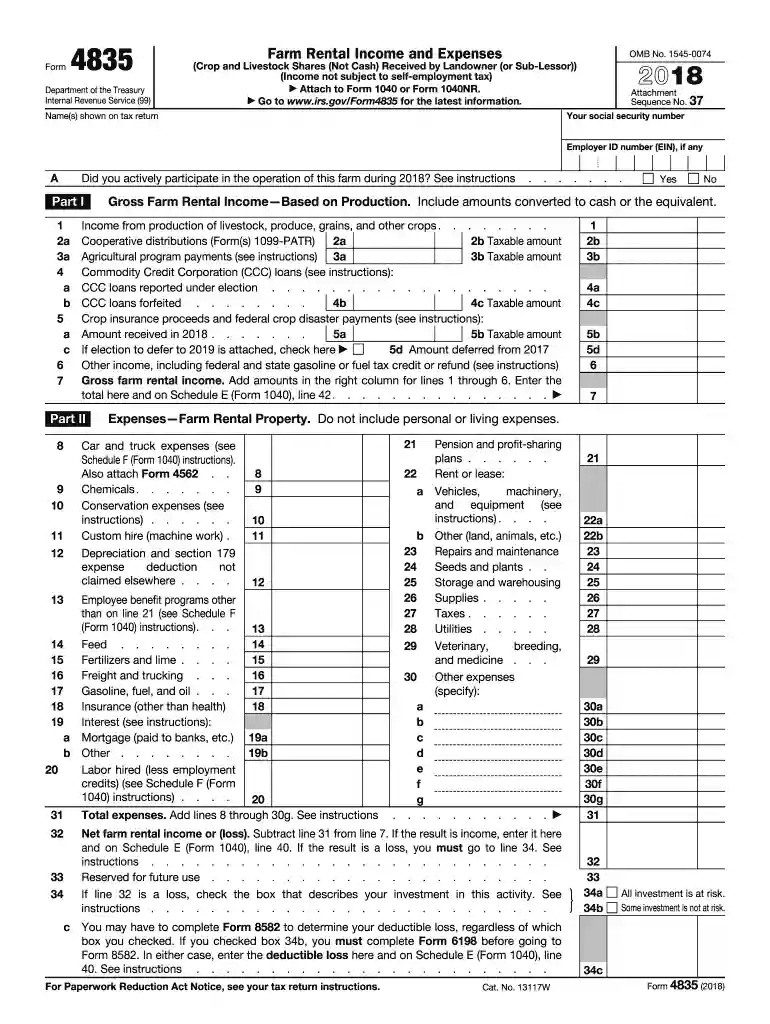
Form 4835, commonly referred to as the IRS farm rental form 2017, is designed for individuals who own or sublease farmland. It is used to report income based on farm production, specifically when the landowner does not actively participate in farm management. This form captures rental income and associated expenses derived from agricultural endeavors carried out by tenants or producers.
To complete Form 4835 effectively, follow these steps:
Gather necessary documents: Collect all records related to farming income, expenses, and relevant agreements with tenants or lessees.
Section-by-section guidance: Follow the form's instructions meticulously, ensuring that all income and expenses are accurately documented.
Review for accuracy: Double-check each entry for accuracy and consistency, especially numbers that will affect taxable income.
Let's say you lease out 100 acres for corn production. You'll note rental income, detail expenses such as seed costs, fertilizer, and maintenance charges, and summarize these on the form to deliver an accurate financial picture.
Identify your role: Confirm that you qualify as a landowner or sub-lessor who does not actively participate in farming activities.
Complete Personal Information: Fill out personal identifiers such as your name, address, and taxpayer identification number.
Record Income: Enter the total cash or crop value received as rent during the tax year.
Detail Expenses: Break down deductible expenses by category, ensuring expenses directly correlate to farm rental activity.
Calculate Net Income: Subtract total expenses from total income to find the net rental income.
Conform to IRS Regulations: Ensure the form complies with IRS rules, possibly using resources like IRS publications for additional guidance.
Form 4835 is traditionally used by:


If you inherited farmland and lease it out without any involvement in daily farming tasks, Form 4835 would be your reporting tool to declare such rental income for tax purposes.
Understanding the terminology within the form enhances accuracy and compliance. Key terms include:
The distinction between active farming involvement and passive income is crucial as it influences the applicable tax treatment and deductibility of expenses.
Each section is purposefully arranged to help filers methodically account for income and expenses, ensuring the final computation reflects true taxable income.
Ensure timely submission to avoid penalties or interest on any underpayments or late payments of taxes due.
Embracing digital tools simplifies processing, offering automatic calculations, error checks, and integration with other tax-related software, enhancing efficiency and accuracy in filing.
We've got more versions of the form 4835 form. Select the right form 4835 version from the list and start editing it straight away!
| Versions | Form popularity | Fillable & printable |
|---|---|---|
| 2025 | 4.6 Satisfied (47 Votes) | |
| 2024 | 4.6 Satisfied (31 Votes) | |
| 2023 | 4.8 Satisfied (51 Votes) | |
| 2022 | 4.1 Satisfied (49 Votes) | |
| 2021 | 4.8 Satisfied (188 Votes) | |
| 2020 | 4.4 Satisfied (251 Votes) | |
| 2019 | 4.1 Satisfied (32 Votes) | |
| 2018 | 4.2 Satisfied (49 Votes) | |
| 2017 | 4.4 Satisfied (159 Votes) | |
| 2016 | 4.2 Satisfied (122 Votes) | |
| 2015 | 4.3 Satisfied (70 Votes) | |
| 2012 | 4.7 Satisfied (61 Votes) | |
| 2011 | 4 Satisfied (47 Votes) |
At DocHub, your data security is our priority. We follow HIPAA, SOC2, GDPR, and other standards, so you can work on your documents with confidence.
Dec 1, 2017 Farmers and fishermen. Pay your esti- mated tax for 2017 using Form 1040-ES. You have until April 17 to file your 2017 income tax return (FormRead more
Aug 23, 2017 What is Self-Rental? Self-rental rules apply when a taxpayer materially participates in a pass through entity and rents that entitysRead more
For Paperwork Reduction Act Notice, see your tax return instructions. Cat. No. 13117W. Form 4835 (2017). Page 2. Form 4835 (2017). Page 2. General Instructions.Read more


