




01. Edit your form 4835 online
Type text, add images, blackout confidential details, add comments, highlights and more.

Type text, add images, blackout confidential details, add comments, highlights and more.

Draw your signature, type it, upload its image, or use your mobile device as a signature pad.

Send 4835 via email, link, or fax. You can also download it, export it or print it out.
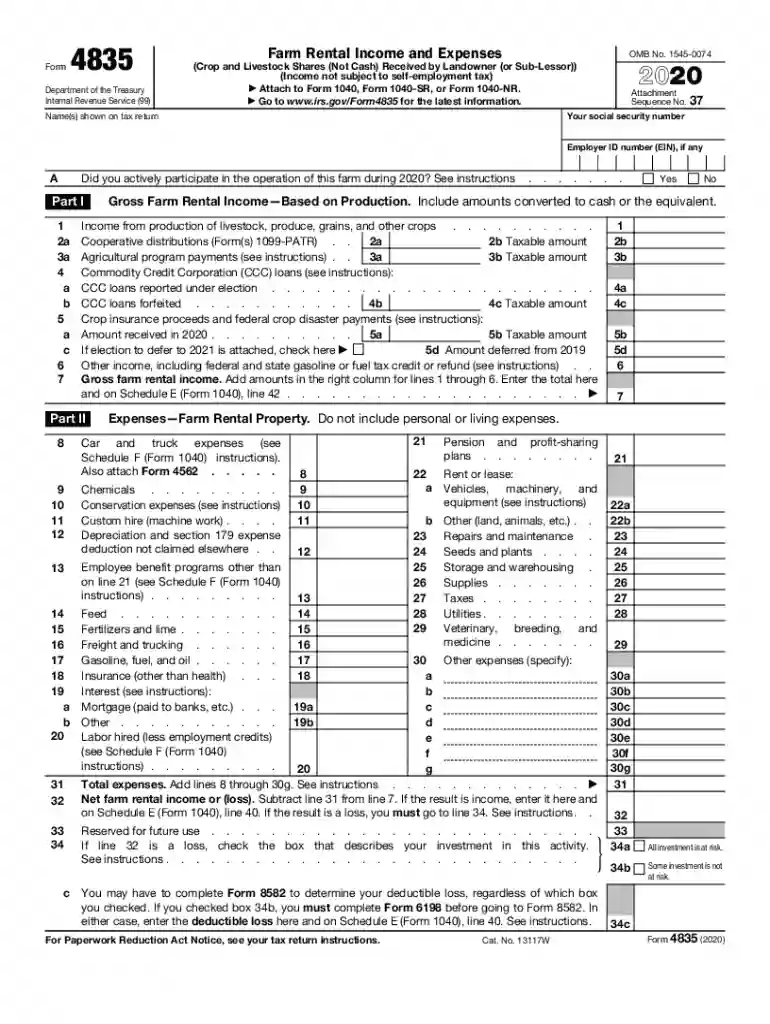
Form 4835, officially titled "Farm Rental Income and Expenses," is a document used by landowners or sub-lessors who receive rental income based on crop or livestock production but do not materially participate in the farming operations. This form is essential for detailing income and expenses related to rental agreements, ensuring proper tax reporting and compliance. It is particularly relevant for individuals who lease out their farmland to tenants and wish to report the resulting financial activities without being actively involved in the operational aspects of farming.
Form 4835 specifically applies to scenarios where the landowner is not actively engaged in the management or day-to-day operations of the farm. Unlike those who materially participate and fill out Schedule F, this form caters to passive income arrangements. Understanding this distinction is crucial for accurate tax filing and avoiding potential IRS penalties.
The core components of Form 4835 include sections to report gross farm rental income and itemized expenses associated with the farm property. These elements are critical for calculating the net income or loss from farm rental activities.
Supporting documentation, such as lease agreements or receipts for expenses, may be necessary to substantiate the information provided on Form 4835. It helps in auditing processes and reinforces the accuracy of the reported figures.
Filling out Form 4835 requires careful attention to detail to ensure compliance with IRS standards. Below is a step-by-step guide to assist in the accurate completion of the form.
Errors in this form often stem from improper expense categorization or inaccurate income reporting. Landowners should maintain detailed records and seek professional advice if needed to mitigate these issues.
Understanding specific terminology associated with Form 4835 is vital for accurate completion and comprehension of its requirements.
Familiarity with these terms aids in recognizing applicable conditions for Form 4835. It ensures that taxpayers appropriately classify their income, aligning with the IRS’s definitions and criteria.
The IRS provides detailed instructions for completing Form 4835, specifying how rental income and expenses should be treated under tax regulations. These guidelines are pivotal for avoiding errors that could result in discrepancies or audit triggers.
For complex scenarios, the IRS advises consulting with a tax professional to navigate intricate tax laws and ensure compliance.
Exploring real-world examples provides clarity on how Form 4835 is utilized by different stakeholders in the agricultural industry.
Adhering to tax deadlines is crucial to avoid penalties and maintain good standing with the IRS. Form 4835 is typically included with the annual tax return submissions.
Advance preparation and organizing all necessary documents can ease the process, helping meet deadlines swiftly.
Failing to comply with the filing requirements of Form 4835 can result in financial penalties and other legal implications from the IRS.
Timely tax planning and thorough record-keeping are effective strategies to minimize risks associated with non-compliance. Additionally, regular consultations with tax professionals can provide preemptive guidance.
We've got more versions of the form 4835 form. Select the right form 4835 version from the list and start editing it straight away!
| Versions | Form popularity | Fillable & printable |
|---|---|---|
| 2025 | 4.6 Satisfied (47 Votes) | |
| 2024 | 4.6 Satisfied (31 Votes) | |
| 2023 | 4.8 Satisfied (51 Votes) | |
| 2022 | 4.1 Satisfied (49 Votes) | |
| 2021 | 4.8 Satisfied (188 Votes) | |
| 2020 | 4.4 Satisfied (251 Votes) | |
| 2019 | 4.1 Satisfied (32 Votes) | |
| 2018 | 4.2 Satisfied (49 Votes) | |
| 2017 | 4.4 Satisfied (159 Votes) | |
| 2016 | 4.2 Satisfied (122 Votes) | |
| 2015 | 4.3 Satisfied (70 Votes) | |
| 2012 | 4.7 Satisfied (61 Votes) | |
| 2011 | 4 Satisfied (47 Votes) |
At DocHub, your data security is our priority. We follow HIPAA, SOC2, GDPR, and other standards, so you can work on your documents with confidence.
File this form to report farm rental income based on crops or livestock produced by the tenant. Current Revision Form 4835 PDFRead more
May 1, 2023 This form is used to report income received from cash rents, crop shares, and other forms of farm rental arrangements. Farmers report theirRead more
Welcome to the growing group of value-conscious people who drive Toyotas. We are proud of the advanced engineering and quality construction of each vehicleRead more


