




01. Edit your form 4835 online
Type text, add images, blackout confidential details, add comments, highlights and more.

Type text, add images, blackout confidential details, add comments, highlights and more.

Draw your signature, type it, upload its image, or use your mobile device as a signature pad.

Send it via email, link, or fax. You can also download it, export it or print it out.
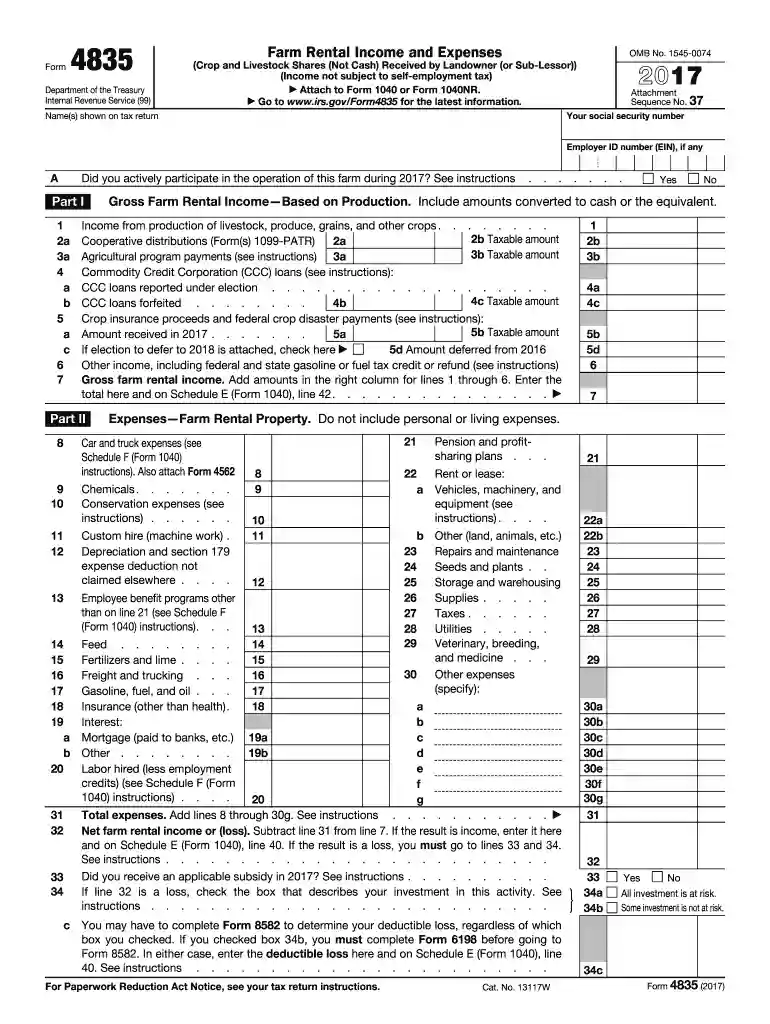
IRS Form 4835 is used by landowners who do not actively participate in farming operations to report farm rental income based on tenant production. Typically not involved in day-to-day farming decisions, these owners must report income from crops or livestock produced by their tenants. This form is essential for complying with U.S. tax regulations, as it helps document and calculate rental income and allowable expenses, like mortgage interest and property taxes. The form aids in ensuring that farm income is accurately reported on individual tax returns, specifically on Form 1040 or Form 1040NR.
In 2017, IRS Form 4835 facilitated accurate reporting of farm rental income for tax purposes. Users would fill it out to report rental income from agricultural properties when they were not materially involved in the farming activities. By doing so, landowners ensured compliance with tax laws, as this form determined the proper tax obligations associated with their agricultural rental income. Its structured format guided users in categorizing income streams and expenses, thus supporting the accurate calculation of net income related to their land ownership.
To obtain IRS Form 4835 for the year 2017, users could access the IRS website, which provided downloadable PDF versions. The form was also obtainable through tax preparation software, facilitating ease of use and integration into electronic filing systems. Additionally, physical copies were available at local IRS offices, or they could be mailed upon request. These options ensured that users could access the form through their preferred means, reflecting an adaptive approach to tax form distribution.
To complete IRS Form 4835, users needed to:
Adhering to a systematic approach ensured proper reporting and compliance with tax regulations.
By using IRS Form 4835, landowners ensured that they were fulfilling their tax obligations accurately. The form was pivotal for avoiding potential penalties that could arise from inaccurately reported income or omitted deductions. Additionally, it provided a clear financial overview of farm rental activities for both landowners and the IRS, contributing to transparent financial disclosure. This form also aided landowners in tracking income and expense patterns over time, fostering informed future decision-making.
Typically, individuals who use IRS Form 4835 include landowners or sub-lessors not actively farming their properties but collecting rental income from tenants engaged in farming activities. These individuals are often investors in agricultural properties or heirs who have inherited farmland but choose to rent it out, thus requiring a means to report income and expenses associated with such rental agreements.
The essential components of IRS Form 4835 include:
These elements guided users in comprehensive income and expense reporting.
The IRS provided guidelines on filling out Form 4835, highlighting deductions available, such as property management fees, interest expenses, and taxes. Taxpayers were advised to keep detailed records to substantiate claims. The guidelines emphasized understanding the difference between active and passive involvement in farm operations, which determined eligibility to use this form. It also explained pertinent deadlines to ensure timely submission and avoid penalties.
The filing deadline for IRS Form 4835 coincided with the deadline for individual tax returns, typically April 15th annually. Timely submission was crucial, as the form was a critical part of the overall tax return process for landowners reporting farm rental income. In cases where extensions were obtained for filing personal tax returns, the same extended deadline applied to Form 4835 submissions.
Failure to accurately complete or timely submit IRS Form 4835 could result in penalties, including late payment fees and interest charges on outstanding amounts due. Moreover, inaccuracies could trigger audits or requests for further documentation by the IRS, creating unnecessary complications. Therefore, proper adherence to the form's requirements ensured compliance and minimized the risk of incurring punitive measures.
We've got more versions of the form 4835 form. Select the right form 4835 version from the list and start editing it straight away!
| Versions | Form popularity | Fillable & printable |
|---|---|---|
| 2025 | 4.6 Satisfied (47 Votes) | |
| 2024 | 4.6 Satisfied (31 Votes) | |
| 2023 | 4.8 Satisfied (51 Votes) | |
| 2022 | 4.1 Satisfied (49 Votes) | |
| 2021 | 4.8 Satisfied (188 Votes) | |
| 2020 | 4.4 Satisfied (251 Votes) | |
| 2019 | 4.1 Satisfied (32 Votes) | |
| 2018 | 4.2 Satisfied (49 Votes) | |
| 2017 | 4.4 Satisfied (159 Votes) | |
| 2016 | 4.2 Satisfied (122 Votes) | |
| 2015 | 4.3 Satisfied (70 Votes) | |
| 2012 | 4.7 Satisfied (61 Votes) | |
| 2011 | 4 Satisfied (47 Votes) |
At DocHub, your data security is our priority. We follow HIPAA, SOC2, GDPR, and other standards, so you can work on your documents with confidence.
For Paperwork Reduction Act Notice, see your tax return instructions. Cat. No. 13117W. Form 4835 (2017). Page 2. Form 4835 (2017). Page 2. General Instructions.Read more
This report combines the annual reports on Form 10-K for the year ended December 31, 2020 of CubeSmart (the Parent Company or. CubeSmart) and CubeSmart,Read more
Jun 29, 2017 This fact sheet[1] provides a brief overview of several key tax considerations associated with farmland leases, as they apply to individual landowners.Read more


