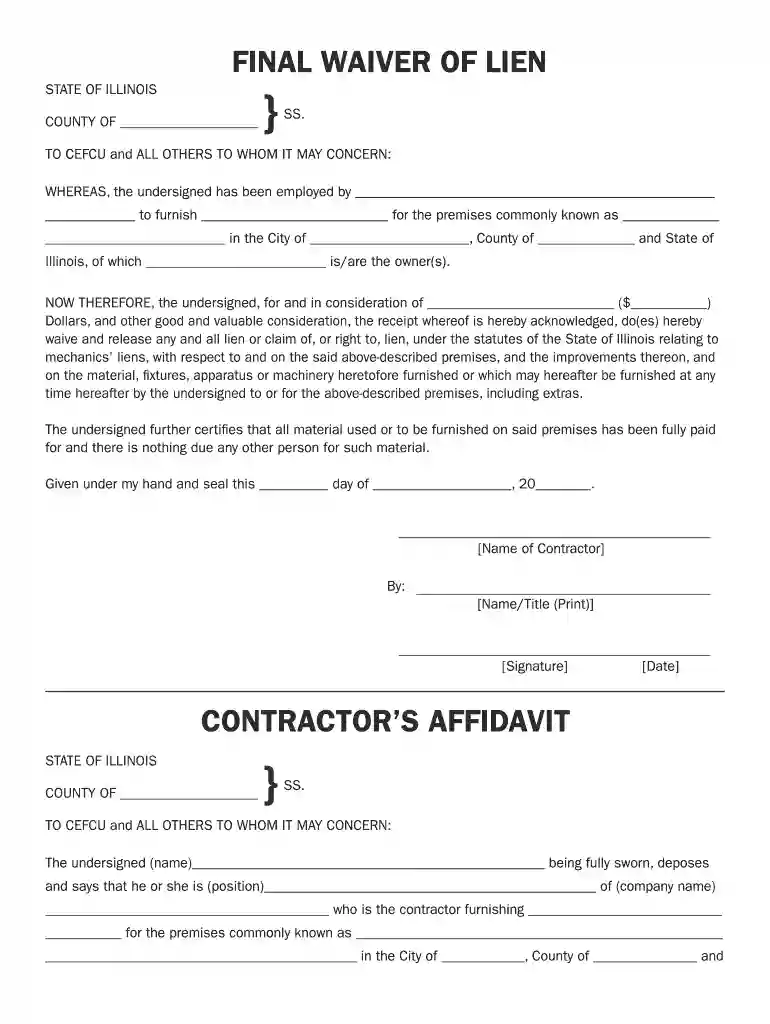
Final Waiver of Lien & Contractor's Affidavit. Final Waiver of Lien for Illinois and Contractor's Affidavit form 2026

Get Form
final waiver of lien and contractor's affidavit Preview on Page 1

Here's how it works

01. Edit your final waiver of lien and contractor's affidavit online
Type text, add images, blackout confidential details, add comments, highlights and more.

02. Sign it in a few clicks
Draw your signature, type it, upload its image, or use your mobile device as a signature pad.

03. Share your form with others
Send final waiver of lien form illinois pdf via email, link, or fax. You can also download it, export it or print it out.

Definition and Meaning of Final Waiver of Lien & Contractor's Affidavit

A Final Waiver of Lien and Contractor's Affidavit serves as a crucial document in construction and contracting that protects property owners from any potential claims by contractors, subcontractors, or material suppliers for unpaid services or materials. Specifically for Illinois, this document states that the contractor has received full payment for their work and waives any lien rights, thereby confirming that no further claims can be made against the property for the work done.

  • Final Waiver of Lien: This is a legal release whereby the contractor acknowledges that they have received payment in full for all services rendered and materials supplied, and agrees not to file any lien against the property related to that project.
  • Contractor’s Affidavit: An affidavit wherein the contractor swears that all parties involved have been paid, and no liens remain on the property. This is critical for the property owner to ensure they are not liable for any unpaid services post-completion.

This document is often requested by property owners, lenders, or title companies as part of a project’s final closeout, ensuring all financial obligations are fulfilled.

How to Complete the Final Waiver of Lien & Contractor's Affidavit

Completing the Final Waiver of Lien and Contractor's Affidavit requires careful attention to detail to ensure all necessary information is accurately documented.

  1. Gather Required Information:

    • Project details: name, address, and description of the work.
    • Contractor information: name, address, and contact details.
    • Payment details: total contract amount and amount paid to date.
  2. Fill Out the Form:

    • Begin by entering the project specifics and contractor’s details at the top of the form.
    • Include the total amount due and the amount received.
    • Indicate that this is the final waiver and that payment has been received in full.
  3. Sign Off:

    • The contractor must sign the affidavit, affirming the accuracy of the information provided.
    • Consider having the signature notarized to add an extra level of legal validity to the document.
  4. Distribute Copies:

    • Once signed, provide copies to all relevant parties, including the property owner and any financial institutions involved.

Who Typically Uses the Final Waiver of Lien & Contractor's Affidavit

The Final Waiver of Lien and Contractor's Affidavit is widely used by various stakeholders in the construction industry.

  • Contractors and Subcontractors: They use this document to confirm that they have been paid for their work and can protect themselves against future claims.
  • Property Owners: Homeowners and commercial developers use this to ensure that they are cleared of financial liabilities related to construction liens.
  • Lenders and Title Companies: Financial institutions rely on this document to confirm that there are no outstanding liens before disbursing loan funds or issuing title insurance.
  • Attorneys: Legal professionals may use it to protect their clients’ interests in construction-related disputes or during property transactions.

Understanding who utilizes this document helps streamline the construction payment process and mitigate risks associated with unpaid services or materials.


decoration image ratings of Dochub

Legal Uses of the Final Waiver of Lien & Contractor's Affidavit in Illinois

In Illinois, the Final Waiver of Lien and Contractor's Affidavit has specific legal implications and is essential for ensuring compliance with state law.

  • Legally Binding Confirmation: This document serves as a legally binding confirmation that the contractor has received full payment and agrees not to pursue future claims against the property owner regarding the specific project.
  • Protection Against Liens: By providing a final waiver, property owners protect themselves from the possibility of contractors or suppliers later claiming a lien against the property after payment has been made.
  • Adherence to State Laws: Illinois law mandates certain requirements regarding the waiver of lien, including language to be included in the document and the necessity for the contractor’s signature, often providing grounds for enforcing the affidavit in courts if disputes arise.
  • Record Keeping for Title Issues: Lenders and title companies use this document as part of the due diligence process during real estate transactions to confirm that all financial obligations have been resolved before closing.

The legal enforceability of this document underscores its importance in managing financial and legal risks in construction projects.

Key Elements of the Final Waiver of Lien & Contractor's Affidavit

Understanding the key elements of the Final Waiver of Lien and Contractor's Affidavit form is essential for proper completion and use.

  • Identification of Parties: Clear identification of the contractor, subcontractors, and property owner, including their legal names and addresses.
  • Project Information: A detailed description of the project, including the location and nature of the work performed.
  • Financial Details: Precise figures that state the total contract amount, amounts paid to date, and affirmation that all payments have been satisfied.
  • Waiver Clause: A specific clause that explicitly waives the right to file a lien against the property related to the project upon receipt of full payment.
  • Signature and Notarization: The contractor’s signature is required, and notarization is often recommended for additional validation.

Focusing on these key elements ensures that the document serves its intended purpose effectively and holds up under legal scrutiny.

be ready to get more

Complete this form in 5 minutes or less

Get form

Got questions?

We have answers to the most popular questions from our customers. If you can't find an answer to your question, please contact us.
Contact us

Electronic document signing requires a software solution that works in compliance with data protection and eSignature standards. DocHub is a perfect tool for that, since it meets all the above mentioned requirements. Whatever method you prefer to sign your final waiver of lien and contractor's affidavit illinois in DocHub, your eSignature will be legally binding and court-admissible.

You can easily edit and complete your Final Waiver of Lien & Contractor's Affidavit. Final Waiver of Lien for Illinois and Contractor's Affidavit form on any iOS gadget. Open an internet browser of your liking, visit the DocHub website, authorize or create a new account, upload your file for editing, and make your required changes. Our service is mobile-friendly, so utilizing its functions on your smartphone will be a no-brainer, even on the first try.

In short, a lien waiver is a document executed by a lien holder stating that they give up their right to file a construction lien on the subject property. Typically, a subcontractor has mechanics lien rights under Florida law; however, some projects mandate that the property remain lien free from start to finish.
An unconditional release is different from a conditional release because once you sign the document, youve immediately removed your right to file a mechanics lien or youre required to promptly remove an existing lien. An unconditional release means that there are no restrictions on the release of the lien.
Conditional Waiver and Release Upon Progress Payment This form is useful when the claimant is not yet paid, but will be paid out of a progress payment that is not the final payment. This conditional waiver and release is only effective if the claimant is actually paid. This release does not cover all items.

Security and compliance

At DocHub, your data security is our priority. We follow HIPAA, SOC2, GDPR, and other standards, so you can work on your documents with confidence.

Learn more
ccpa2
pci-dss
gdpr-compliance
hipaa
soc-compliance
be ready to get more

Complete this form in 5 minutes or less

Get form

People also ask

This il final conditional waiver (also called a final conditional lien release) should be used when the final payment for a project is expected but has yet to be received on a project in the state of il. Signing this waiver signifies that no further payments are expected following the payment described in the waiver.
Lien waivers generally come in two forms: conditional and unconditional. In a nutshell, conditional lien waivers show how much money is owing through a particular date, and unconditional lien waivers show how much money has been paid for work through a particular date.
Once an unconditional lien waiver is signed, it is fully effective and enforceable. While using an unconditional lien waiver will certainly protect your property, it wont guarantee that the signor actually receives payment, since unconditional waivers are typically enforceable even if signor never gets paid.
This Conditional Waiver and Release of Lien Upon Final Payment is for use on construction projects in Florida. Signing this waiver signifies that the final payment is expected but has not yet been received. Once payment is received, this waiver gives up the signers right to file a mechanics lien.
Notarization Not Required Illinois lien waivers are not required to be docHubd in order to be effective.

Related links