



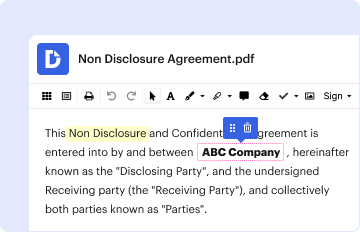
01. Edit your 2848 online online
Type text, add images, blackout confidential details, add comments, highlights and more.

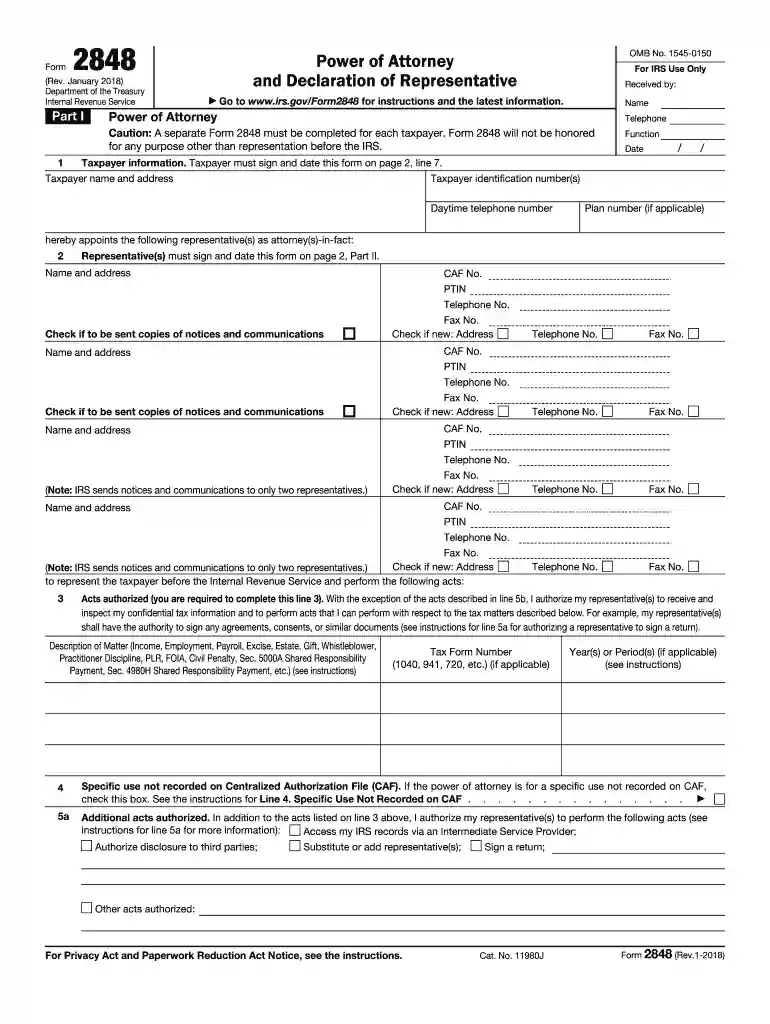
Type text, add images, blackout confidential details, add comments, highlights and more.

Draw your signature, type it, upload its image, or use your mobile device as a signature pad.

Send form 2848 fillable via email, link, or fax. You can also download it, export it or print it out.
Form 2848, also known as Power of Attorney and Declaration of Representative, is an official IRS document that allows taxpayers to authorize individuals, often tax professionals, to represent them in dealings with the Internal Revenue Service (IRS). This representation can cover a range of activities, including negotiating payment plans, responding to IRS notices, and attending audits on behalf of the taxpayer. By completing this form, taxpayers ensure that their representative has the legal authority to act in specific tax matters specified within the form.
Using Form 2848 involves a few essential steps. First, a taxpayer must decide what kind of authority they wish to grant, which is then specified on the form. Common authorizations include the ability to discuss specific tax years or types of taxes. Once the scope of representation is defined, the taxpayer fills out their personal information as well as that of their chosen representative. Both parties must then sign the form, confirming that they agree to the terms and powers assigned. Once completed, it must be submitted to the IRS for processing. This process is straightforward but requires attention to detail to ensure it is filled correctly.
Form 2848 is easily accessible and can be obtained through various methods. The IRS website is the most straightforward option, where the form can be downloaded in PDF format. Taxpayers can also request a physical copy via mail by contacting the IRS directly. Additionally, tax professionals might have copies available for their clients. For those using tax software like TurboTax or QuickBooks, the form may be integrated into the software’s system, allowing for a more seamless process.
Form 2848 is crucial for individuals who need representation in tax matters but are unable, or prefer not, to handle these affairs personally. By assigning a trusted representative, taxpayers can ensure their interests are properly advocated when engaging with the IRS. This is particularly important in complex situations such as audits or significant tax disputes where professional expertise can significantly influence outcomes. Moreover, using Form 2848 provides a legal method to authorize representation, protecting both the taxpayer and the representative.
Several critical components make up Form 2848, each requiring careful attention:
Understanding these elements ensures that the form serves its intended purpose effectively, without errors or omissions.
The IRS provides comprehensive guidelines for completing and submitting Form 2848, ensuring it is processed efficiently. These guidelines emphasize accuracy, such as using exact taxpayer identification information and making sure all necessary fields are completed. The IRS advises taxpayers to keep a copy of the form for their records once it is submitted. Checking the IRS website for any updates or changes in submission procedures is also recommended, as these can affect how quickly the form is processed.
Taxpayers have multiple options to submit Form 2848, making it flexible for different needs:
Each method comes with its pros and cons, and taxpayers should choose based on convenience and urgency.
While Form 2848 is a federal IRS document, its use and acceptance may vary slightly by state, especially regarding additional filing requirements or complementary state-level forms for local taxes. It is advisable to check state tax guidelines to understand any additional documentation needed. In some cases, states may offer their equivalents of Form 2848, which must be filled alongside the federal form for comprehensive representation.
Tax professionals can benefit from keeping updated on these variations to provide accurate assistance tailored to both federal and state requirements.
We've got more versions of the 2848 online form. Select the right 2848 online version from the list and start editing it straight away!
At DocHub, your data security is our priority. We follow HIPAA, SOC2, GDPR, and other standards, so you can work on your documents with confidence.


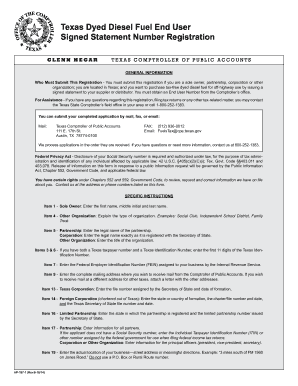

Part I. Power of Attorney. Caution: A separate Form 2848 must be completed for each taxpayer. Form 2848 will not be honored.Read more
1. Taxpayer information. Taxpayer must sign and date this form on page 2, line 7. Taxpayer name and address. Taxpayer identification number(s).Read more
Jan 23, 2018 A childs legal representative making the request should include a copy of his or her Power of Attorney, such as Form 2848, or proof of legalRead more


