Dv 120 2026

Get Form
dv 120 instructions Preview on Page 1

Here's how it works

01. Edit your dv 120 instructions online
Type text, add images, blackout confidential details, add comments, highlights and more.

02. Sign it in a few clicks
Draw your signature, type it, upload its image, or use your mobile device as a signature pad.

03. Share your form with others
Send it via email, link, or fax. You can also download it, export it or print it out.

How to use or fill out dv 120 with our platform

Form edit decoration
9.5
Ease of Setup
DocHub User Ratings on G2
9.0
Ease of Use
DocHub User Ratings on G2
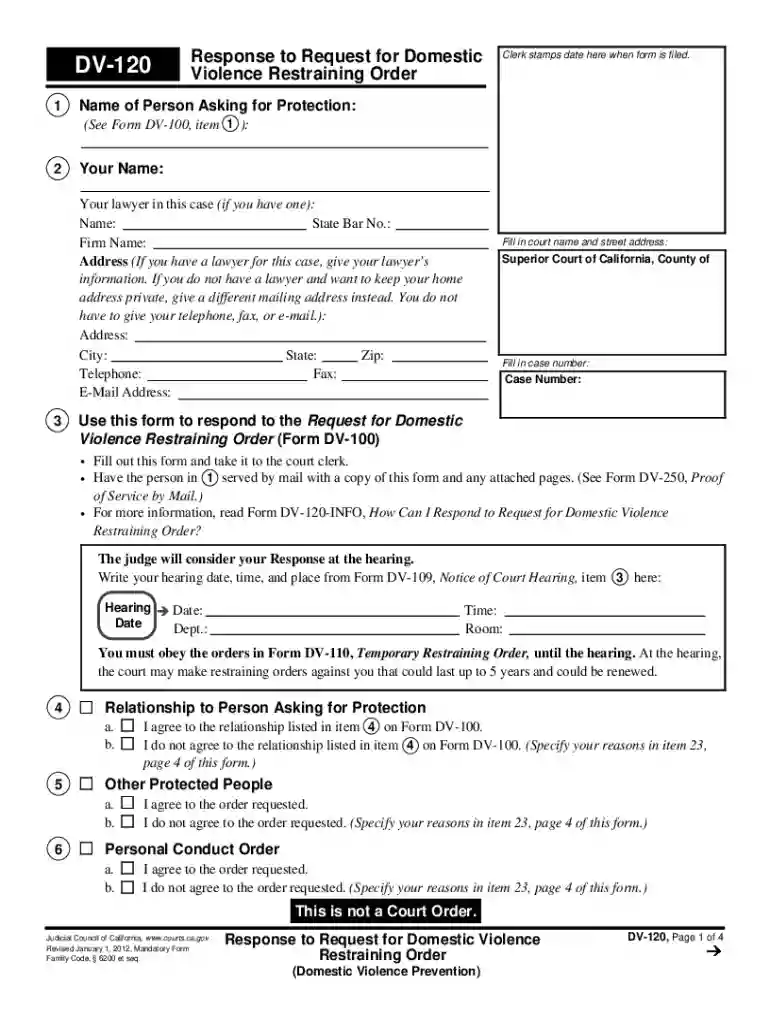
  1. Click ‘Get Form’ to open the DV-120 in the editor.
  2. Begin by entering your name and the name of the person asking for protection in the designated fields. Ensure accuracy to avoid any issues during processing.
  3. Fill in the court name, address, and case number as indicated. This information is crucial for proper filing.
  4. In section 4, specify your relationship to the person asking for protection. This helps establish context for your response.
  5. Review each order requested in sections 6 through 22. Indicate whether you agree or disagree with each order, providing reasons where necessary in item 23.
  6. Once completed, save your form and print it directly from our platform. Make sure to press 'Clear This Form' after printing to protect your privacy.

Start using our platform today to fill out your DV-120 form easily and for free!

be ready to get more

Complete this form in 5 minutes or less

Get form

Got questions?

We have answers to the most popular questions from our customers. If you can't find an answer to your question, please contact us.
Contact us
Domestic violence is when someone in a close or family relationship hurts or controls another person to scare or dominate them. Domestic violence can include physical, emotional, sexual or financial abuse. Anyone can experience domestic violence, whatever their background.
Step-by-Step Guide to Filing a Domestic Violence Case in India Step 1: Recognizing Domestic Violence. Step 2: Documenting Evidence. Step 3: Seeking Medical Attention. Step 4: Contacting the Authorities. Step 5: Filing a Domestic Violence Case. Step 6: Legal Remedies Available. Step 7: Attending Court Hearings.
In California, you face domestic violence (DV) charges for allegedly physically harming an intimate partner. According to Penal Code 13700, intimate partners include your current or former: spouse, fianc(e), or registered domestic partner, co-parent, or. boyfriend or girlfriend, whether you live together or not.
Domestic assault/battery is similar to regular assault and battery. But it occurs within intimate relationships and is a form of domestic violence. States differ in how they define relationships that qualify for domestic violence charges.
Domestic violence and child custody. If theres a history of domestic violence in a family, judges use special laws to help protect children when making decisions about child custody.

Security and compliance

At DocHub, your data security is our priority. We follow HIPAA, SOC2, GDPR, and other standards, so you can work on your documents with confidence.

Learn more
ccpa2
pci-dss
gdpr-compliance
hipaa
soc-compliance

People also ask

Evidence: Evidence can include pictures, emails, medical records showing injuries, police reports, etc. If you have evidence, you will need to make it available to the judge and other side to see. Sometimes the judge cannot look at or consider certain documents.

Related links