Phs 398 2590-2026

Get Form
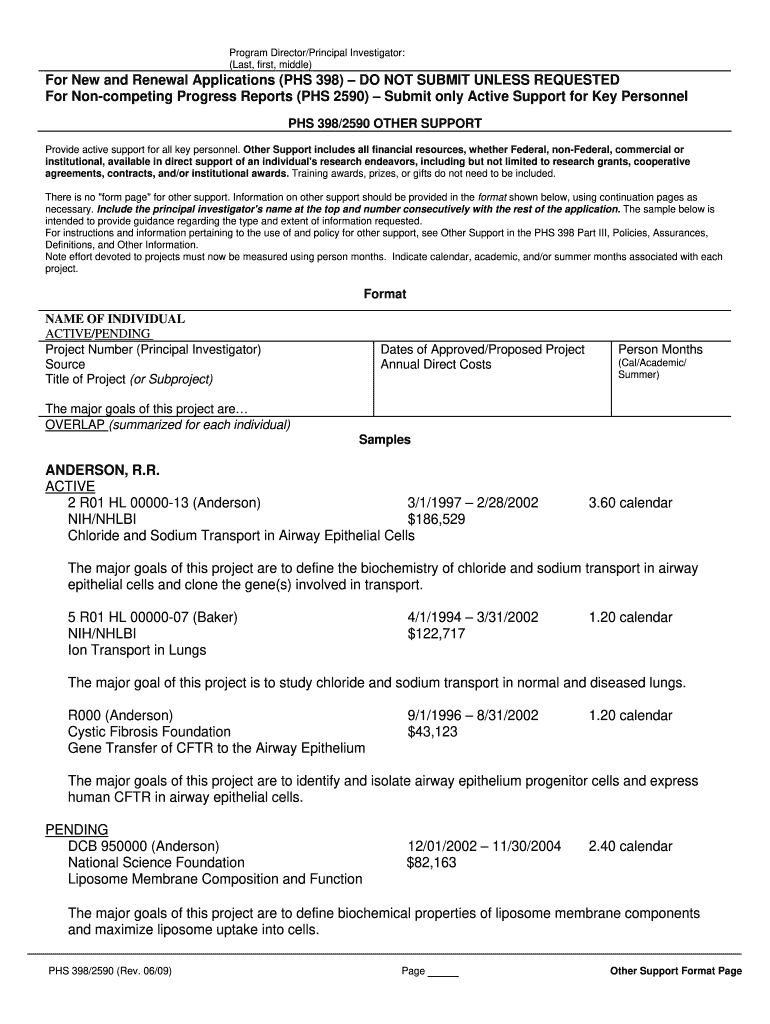
phs 2590 Preview on Page 1

Here's how it works

01. Edit your phs 2590 online
Type text, add images, blackout confidential details, add comments, highlights and more.
02. Sign it in a few clicks
Draw your signature, type it, upload its image, or use your mobile device as a signature pad.
03. Share your form with others
Send phs 398 via email, link, or fax. You can also download it, export it or print it out.

How to use or fill out phs 398 2590 with our platform

Form edit decoration
9.5
Ease of Setup
DocHub User Ratings on G2
9.0
Ease of Use
DocHub User Ratings on G2
  1. Click ‘Get Form’ to open the phs 398 2590 in the editor.
  2. Begin by entering the Program Director/Principal Investigator's name in the designated field at the top of the form.
  3. For each key personnel, provide their active and pending project details. Include project numbers, sources, titles, dates, annual direct costs, and person months associated with each project.
  4. Ensure to summarize any overlap for each individual clearly. This includes detailing any scientific overlap between projects and how budgets will be adjusted if both are funded.
  5. Review all entries for accuracy and completeness before saving your work. Utilize our platform’s features to easily modify or add information as needed.

Start using our platform today to streamline your phs 398 2590 form completion for free!

be ready to get more

Complete this form in 5 minutes or less

Get form

Got questions?

We have answers to the most popular questions from our customers. If you can't find an answer to your question, please contact us.
Contact us
PHS 2590 Forms. From the NIH site: These forms are for Non-Competing Continuation Progress Reports.
NRSA for individual fellows (F32): Requires that you apply very early in your postdoc (sometimes within your first year as a postdoc). Little to no preliminary data required. Mentored research career award (K01): Intended for more experienced postdocs with a solid research history.
Research Grants (R series) Provides limited funding for a short period of time to support a variety of types of projects, including: pilot or feasibility studies, collection of preliminary data, secondary analysis of existing data, small, self-contained research projects, development of new research technology, etc.
Block grants permit a broader array of services and activities, but are generally confined to a specific substantive policy area such as community development, health, or employment and training. General purpose grants provide unrestricted assistance to recipient jurisdictions.
The PHS 398 Cover Page Supplement Form is used for all grant applications except fellowships. This form collects information on human subjects, vertebrate animals, program income, human embryonic stem cells, inventions and patents, and changes of investigator/change of institution.

Security and compliance

At DocHub, your data security is our priority. We follow HIPAA, SOC2, GDPR, and other standards, so you can work on your documents with confidence.

Learn more
ccpa2
pci-dss
gdpr-compliance
hipaa
soc-compliance
be ready to get more

Complete this form in 5 minutes or less

Get form

People also ask

The NIDDK supports several types of K awards: Only US citizens or permanent residents are eligible for the K01, K08, K23, and K25; the K99/R00 is open to citizens or non-citizens. If you are a clinician and are doing basic research, you are eligible for a K08.
The PHS 398 Research Plan form is used only for research, multi-project, and SBIR/STTR applications. This form includes fields to upload several attachments, including the Specific Aims and Research Strategy.
The activity codes differentiate between the grant types; for instance, R-series denotes the research project grant; K-series is intended for researchers yearning independent career. Both R- and K-grants support independent investigators.

Related links