




01. Edit your form online
Type text, add images, blackout confidential details, add comments, highlights and more.

Type text, add images, blackout confidential details, add comments, highlights and more.

Draw your signature, type it, upload its image, or use your mobile device as a signature pad.

Send it via email, link, or fax. You can also download it, export it or print it out.
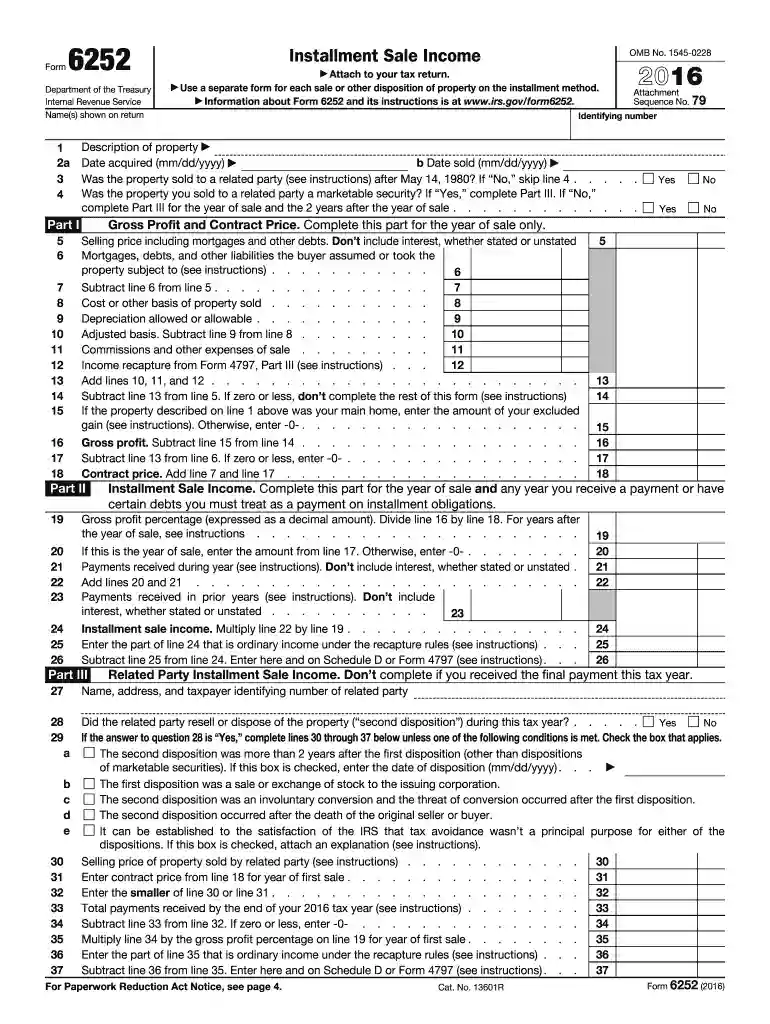
IRS Form 6252 is utilized to report income from installment sales where at least one payment is received after the tax year of the sale. It specifically helps taxpayers calculate gross profit, contract price, and installment sale income, ensuring adherence to tax regulations around these transactions. This form is crucial for those who sell property or assets on terms that spread payments across multiple years, allowing them to report income when it is received rather than all at once. By using Form 6252, taxpayers can better manage their taxable income and ensure compliance with IRS requirements regarding installment sales.
To appropriately use IRS Form 6252, it is important to understand the installment sale method. This method calculates gain on property sales received over time. The form is filled out annually to report payments received within that tax year. Taxpayers should begin by computing the gross profit percentage, which is then applied to each installment received to determine the taxable portion. Next, report the interest received as it is considered ordinary income. It's important to follow the step-by-step sections of the form, ensuring that each entry reflects accurate and precise data based on real transactions.
IRS Form 6252 can be obtained via several methods. The most straightforward is downloading it from the IRS's official website at IRS.gov. For those who prefer paper forms, contacting the IRS directly to request a mailed copy is an option. Additionally, tax software services that comply with federal tax filing requirements often include the form within their documentation suite. Tax professionals or local IRS offices may also provide assistance with obtaining and completing the form.
Gather Required Information: Collect all relevant sale agreements, property details, payment schedules, and any past completed forms.
Calculate Gross Profit: Determine the difference between the selling price and your basis in the property to find your gross profit.
Determine Contract Price: Set your contract price, which is usually the full selling price unless specific circumstances apply.
Compute Gross Profit Percentage: Divide the gross profit by the contract price to establish the percentage for reporting.
Fill Out Installment Income Details: Calculate and enter the installment income for the year by multiplying the percentage from step four by the payments received.
Report Interest Income: Include any interest income received, as this is taxable as ordinary income.
Complete the Form: Fill out all remaining applicable sections, ensuring accuracy.
Form 6252 is usually utilized by individuals or businesses that enter into installment sale agreements for properties, including real estate, personal property, or other asset classes. This form is crucial for both individual taxpayers and businesses that wish to defer payments to align with cash flow and tax planning strategies. Sellers looking to manage capital gains tax implications and those engaged in seller-financed property sales will particularly benefit from using this form.
The primary elements of Form 6252 include sections for:
Each section must be completed with accurate data to comply with IRS standards.
The IRS provides detailed guidelines on the use and requirements of installment sale reporting. According to these guidelines, taxpayers can recognize gain only as they receive payments, allowing them to spread taxable income over several years, thus potentially reducing their tax burden in any given year. The guidelines also outline exceptions, such as dealer sales and inventory, which do not qualify for installment sale reporting.
Form 6252 must be filed as part of the annual tax return, aligning with the standard individual or business tax filing deadline, typically April 15th. Extensions may be available, but the installment sale income must still be reported within the same annual tax return period. Ensuring this form is part of your submitted documentation is crucial to avoid compliance issues with the IRS.
We've got more versions of the 2016 irs form 6252 form. Select the right 2016 irs form 6252 version from the list and start editing it straight away!
| Versions | Form popularity | Fillable & printable |
|---|---|---|
| 2025 | 4.6 Satisfied (54 Votes) | |
| 2024 | 4.2 Satisfied (37 Votes) | |
| 2023 | 4.4 Satisfied (36 Votes) | |
| 2022 | 4.2 Satisfied (52 Votes) | |
| 2021 | 4.8 Satisfied (56 Votes) | |
| 2020 | 4.4 Satisfied (125 Votes) | |
| 2019 | 4.4 Satisfied (233 Votes) | |
| 2018 | 4.2 Satisfied (49 Votes) | |
| 2017 | 4.4 Satisfied (171 Votes) | |
| 2016 | 4.4 Satisfied (436 Votes) | |
| 2015 | 4.1 Satisfied (42 Votes) | |
| 2014 | 4.2 Satisfied (57 Votes) | |
| 2013 | 4 Satisfied (34 Votes) |
At DocHub, your data security is our priority. We follow HIPAA, SOC2, GDPR, and other standards, so you can work on your documents with confidence.
Form 6252 (2016). Page 3 refinanced debt immediately before the refinancing. Form 6252 (2016). Page 4. Line 21. Enter all money and the FMV of any propertyRead more
On Williams 2016 Form 6252, his gain of $4,000 ($9,000 selling price $4,400 basis $600 selling expenses) is reported on lines 14 and 16. The contract priceRead more
Apr 15, 1976 Increased section 179 deduction dollar limits. The maximum amount you can elect to deduct for most sec- tion 179 property you placed inRead more


