




01. Edit your form online
Type text, add images, blackout confidential details, add comments, highlights and more.

Type text, add images, blackout confidential details, add comments, highlights and more.

Draw your signature, type it, upload its image, or use your mobile device as a signature pad.

Send it via email, link, or fax. You can also download it, export it or print it out.
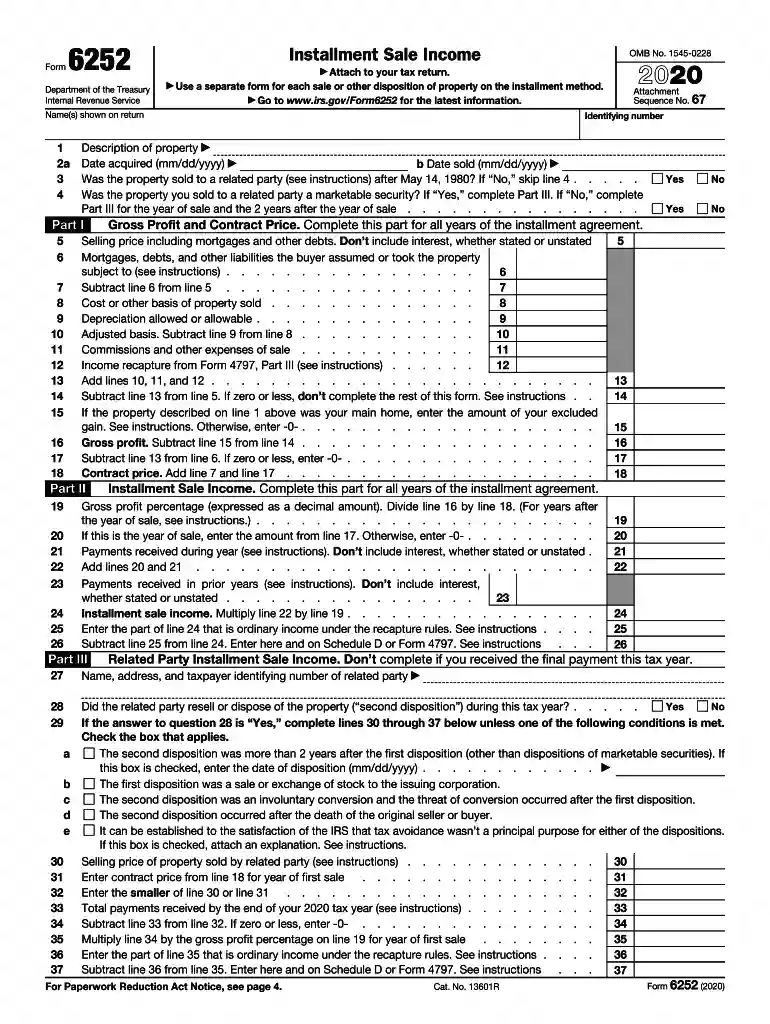
Form 6252, "Installment Sale Income," is a tax form used to report income from installment sales where at least one payment is received after the tax year of the sale. The IRS requires this form to report details such as the gross profit from the sale, the contract price, and total payments received during the year. It's crucial for taxpayers engaging in installment sales, providing a structured way to spread income tax payments over the period the payments are received. This method is beneficial for managing cash flow and tax liabilities effectively over time.
Completing Form 6252 involves several key steps:
Determine Eligibility: Verify if the sale qualifies for installment sale reporting.
Fill Out Part I: Calculate the gain and determine the contract price. Include the selling price, adjusted basis, and selling expenses.
Fill Out Part II: Report payments received for the current year, including down payments and any payments made towards principal.
Calculate Gross Profit Percentage: Determine the percentage by dividing the gross profit by the contract price. This percentage helps in calculating taxable income for each year.
Complete Part III: Report interest received, if applicable, which should not be included in the gross profit percentage but reported separately.
Review for Accuracy: Double-check all calculations and the entries against supporting documents before submission to avoid errors.
Form 6252 is particularly used by taxpayers involved in installment sales. These can include individuals, small business owners, and real estate investors. The form allows sellers to defer a portion of their tax liability until the payments are actually received. By spreading out tax payments, individuals and businesses engaged in large sales, such as real estate transactions, can better manage their income tax obligations across multiple years. This is especially useful in scenarios involving large capital gains.
Several critical terms are associated with Form 6252 that users should understand:
The IRS provides specific guidelines to ensure proper compliance with installment sales. Form 6252 must accurately reflect the taxpayer’s gain and payment terms. The IRS may require verification if the sale appears unfavorable to the tax liability. Detailed record-keeping of all transactions related to the sale is necessary. Taxpayers must adhere to IRS documentation and reporting standards to avoid penalties or audits. The guidelines emphasize accuracy in computing the gross profit percentage and in reporting each year's payments.
Form 6252 must be filed annually with your federal tax return for each year of the installment agreement. The typical deadline is the same as your IRS tax return, usually April 15. If you file for an extension on your federal return using Form 4868, the deadline for Form 6252 would also be extended. Being aware of these timelines is essential to ensure timely submission and avoid late filing penalties, which could include interest charges on unpaid taxes.
When preparing to file Form 6252, you should gather specific documents:
These documents ensure accurate reporting and support claims in case the IRS requests further information.
Imagine you sold a property for $100,000 more than the cost basis and received $20,000 upfront. You’d use Form 6252 to recognize only a portion of the gain in the year of sale and defer the rest over the installment payments. Business owners converting large transactions to installment sales can also apply Form 6252. For example, selling a business unit on installments enables cash flow alignment with tax obligations, making Form 6252 a valuable tool for strategic financial planning.
While Form 6252 applies federally, some states might have specific rules. For instance, California requires its equivalent form to be filed along with state tax returns. These variations necessitate understanding both federal and state tax codes for installment sales. Consulting with tax professionals can provide clarity on any unique state filing requirements or variations from federal guidelines, ensuring compliance across different jurisdictions.
We've got more versions of the 6252 form. Select the right 6252 version from the list and start editing it straight away!
| Versions | Form popularity | Fillable & printable |
|---|---|---|
| 2025 | 4.6 Satisfied (54 Votes) | |
| 2024 | 4.2 Satisfied (37 Votes) | |
| 2023 | 4.4 Satisfied (36 Votes) | |
| 2022 | 4.2 Satisfied (52 Votes) | |
| 2021 | 4.8 Satisfied (56 Votes) | |
| 2020 | 4.4 Satisfied (125 Votes) | |
| 2019 | 4.4 Satisfied (233 Votes) | |
| 2018 | 4.2 Satisfied (49 Votes) | |
| 2017 | 4.4 Satisfied (171 Votes) | |
| 2016 | 4.4 Satisfied (436 Votes) | |
| 2015 | 4.1 Satisfied (42 Votes) | |
| 2014 | 4.2 Satisfied (57 Votes) | |
| 2013 | 4 Satisfied (34 Votes) |
At DocHub, your data security is our priority. We follow HIPAA, SOC2, GDPR, and other standards, so you can work on your documents with confidence.
6252. Form. ▷ See separate instructions. ▷ Attach to your tax return. Department Form 6252 (1994). For Paperwork Reduction Act Notice, see separateRead more
Use this form to report income from an installment sale on the installment method. Generally, an installment sale is a disposition of property.Read more


