




01. Edit your form online
Type text, add images, blackout confidential details, add comments, highlights and more.

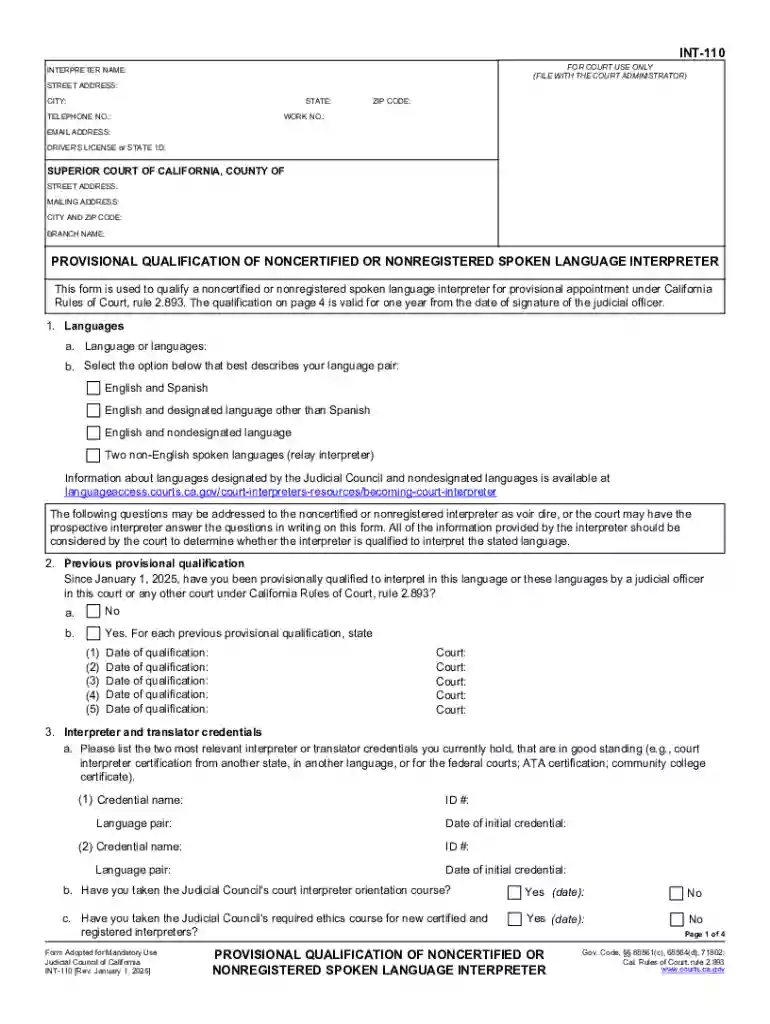
Type text, add images, blackout confidential details, add comments, highlights and more.

Draw your signature, type it, upload its image, or use your mobile device as a signature pad.

Send it via email, link, or fax. You can also download it, export it or print it out.
The INT-110 Qualifications of a Noncertified or Nonregistered Spoken is a form used predominantly by the Superior Court of California. This document is critical for provisionally qualifying spoken language interpreters who lack certification or registration. Its primary purpose is to collect comprehensive information about the interpreter's language proficiency, previous qualifications, and adherence to ethical standards. The form is valid for one year and includes a mandate for interpreters to work toward achieving certified status if they intend to renew their qualifications.
Obtaining the INT-110 form involves several steps which can typically be initiated through official court websites or in-person visits to the Superior Court of California. Here’s a step-by-step guide:
Visit the Superior Court of California Website: Navigate to the court’s official site and search for the INT-110 form.
Inquire at the Court Clerk's Office: Visiting the court in person can provide additional assistance and clarify any queries about the form.
Download and Print: If available online, download the PDF version of the form for physical submission.
Request a Copy: In cases where online access is limited, a physical copy can be requested at the court office.
Filling out the INT-110 form requires attention to detail to ensure compliance with court requirements:
Personal Information: Enter your full legal name, contact information, and identification details accurately.
Language Proficiency: Document the languages you are proficient in, specifying reading, writing, and speaking capabilities.
Previous Qualifications: List any relevant previous qualifications or experiences that support your proficiency as an interpreter.
Training History: Include records of any interpreter training sessions attended, along with certifications received.
Ethical Compliance: Detail your adherence to any ethical standards or training completed, as the court mandates this for provisional qualification.
Signature and Submission: Conclude with a signature to validate your information, then submit the form per the court’s guidelines.
Several sections of the INT-110 form are pivotal for proper submission and approval:
The INT-110 form is legally binding once submitted, and it requires full compliance with California court mandates. The implications of this compliance are multifaceted:
The eligibility for qualifying through the INT-110 form is dictated by certain non-negotiable criteria:


The INT-110 form is particularly relevant to the State of California, with details intrinsically linked to its judicial system:
Submitting the INT-110 form must be accompanied by certain important documents:
Each section is integral to accurately presenting your capabilities and ensuring the court can make a well-informed decision regarding your provisional qualification as a noncertified interpreter.
We've got more versions of the INT-110 Qualifications of a Noncertified or Nonregistered Spoken form. Select the right INT-110 Qualifications of a Noncertified or Nonregistered Spoken version from the list and start editing it straight away!
At DocHub, your data security is our priority. We follow HIPAA, SOC2, GDPR, and other standards, so you can work on your documents with confidence.




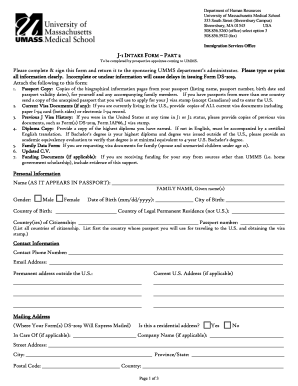
Qualification of Noncertified. Language Interpreter (INT-110) Courts use this to provisionally qualify an interpreter for a six-month period in a single
by D Blanton Part 110, 110.3-110.110, Current Good Manufacturing Practice in Manufacturing, Processing, Packing, or Holding Human Food.


