




01. Edit your anatomy of a wave worksheet online
Type text, add images, blackout confidential details, add comments, highlights and more.

Type text, add images, blackout confidential details, add comments, highlights and more.

Draw your signature, type it, upload its image, or use your mobile device as a signature pad.

Send anatomy of a wave worksheet answer key via email, link, or fax. You can also download it, export it or print it out.
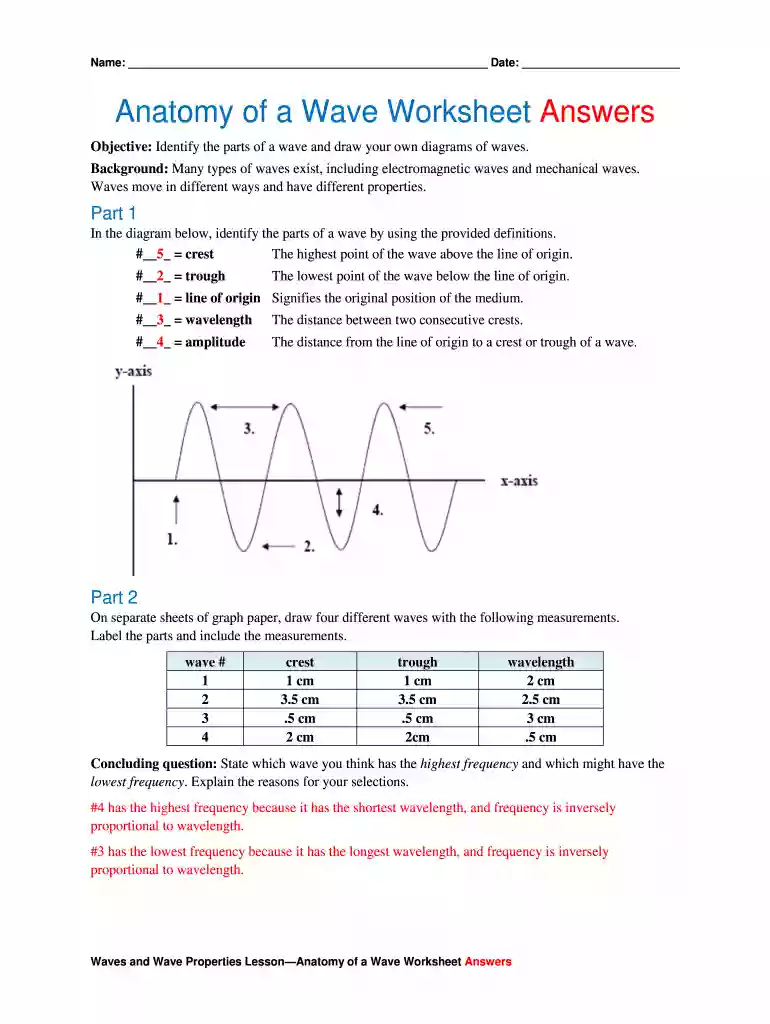
The anatomy of a wave worksheet is an educational tool designed to help students understand the fundamental components and properties of waves. This worksheet typically includes sections focusing on essential wave parts, such as crest, trough, wavelength, and amplitude. Each component is defined with clear explanations, allowing learners to grasp their significance in wave mechanics.
Understanding wave anatomy is crucial in various scientific fields, including physics, engineering, and environmental science. Waves can be classified into different types, such as mechanical and electromagnetic, each with its distinctive characteristics and applications. Through the anatomy of a wave worksheet, students engage with these concepts more interactively, reinforcing theoretical knowledge with practical exercises.
Using the anatomy of a wave worksheet involves several steps that guide students through wave identification and characteristics.
This structured activity helps reinforce theoretical concepts through practical application, ensuring a comprehensive understanding of wave mechanics.
Various essential elements contribute to the utility of the anatomy of a wave worksheet. These elements typically include:
This structured format aids educators in teaching key wave concepts effectively while promoting student engagement through interactive learning.
Several examples showcase how the anatomy of a wave worksheet can be effectively utilized in educational settings:
These applications demonstrate how the worksheet serves as a versatile tool for enhancing understanding of wave anatomy and its principles across various settings.
Utilizing the anatomy of a wave worksheet comes with numerous advantages for learners and educators, including:
Incorporating this tool into educational curricula supports effective learning outcomes related to wave mechanics.
The anatomy of a wave worksheet is primarily used by:
These groups benefit significantly from the structured format and educational value of the anatomy of a wave worksheet.


Managing your documents with DocHub this way is extremely simple once you have downloaded its extension for Google Chrome. Navigate to the Chrome Web Store and set up DocHub - Sign PDF from Gmail to get it. Give our tool access to your Google account, and then open an email containing anatomy of a wave worksheet answers as an attachment and point to the file with your cursor - the DocHub extension key will automatically show up there. Click on it to open your file in our editor. Make any essential adjustments, complete the blanks, and click Sign to create your legally-binding electronic signature.
As a comprehensive document editing service, DocHub is available on mobile devices. Open DocHub in your choice of mobile browser and employ our smart mobile-friendly toolset to complete your anatomy of wave worksheet.
At DocHub, your data security is our priority. We follow HIPAA, SOC2, GDPR, and other standards, so you can work on your documents with confidence.
Parts of a wave worksheet are essential educational tools that help students understand the fundamental concepts of wave physics. Waves are a critical part
Through a structured worksheet, students engaged in interactive discussions that clarified how genetic information is converted into proteins. This foundationalRead more
Extension of What are Waves: student figure out Anatomy of a Wave worksheet | Anatomy of a Wave worksheet Key from this site: 8th Grade Waves Unit Information.Read more


