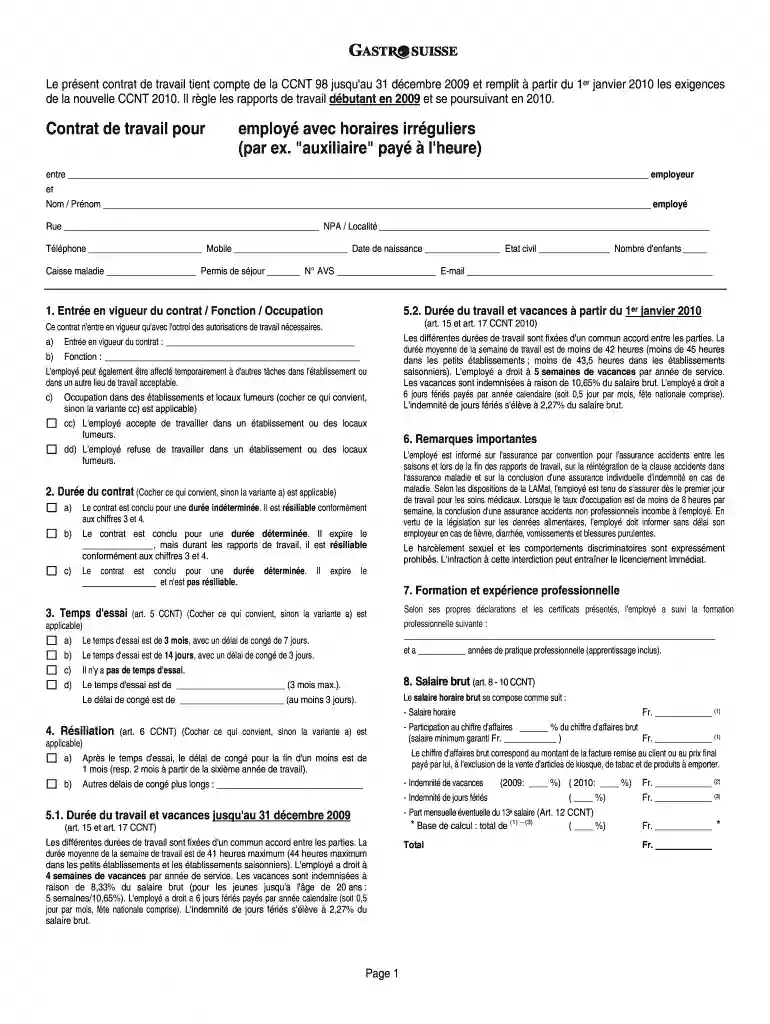
Definition and Meaning of Gastrosuisse Contrat de Travail
The term "gastrosuisse contrat de travail" refers to a specific employment contract framework applicable in the Swiss hospitality sector, particularly governed by Gastrosuisse, the umbrella organization representing the interests of restaurants, hotels, and catering services in Switzerland. This contract is designed to standardize employment conditions, ensuring fair labor practices, compliance with labor laws, and adequate protections for both employers and employees in the gastronomy industry.
This contract encompasses various roles within the hospitality sector, detailing job responsibilities, working conditions, compensations, and rights associated with employment. Its structure is essential for fostering a transparent and equitable work environment, providing clarity for both parties regarding expectations and obligations.
Key Features of the Gastrosuisse Contrat de Travail
- Job Functions: Specific roles and responsibilities are outlined, catering to the varied positions in the hospitality industry, such as servers, cooks, and managers.
- Contract Duration: It can be fixed-term or indefinite, providing clarity on employment stability and conditions for termination.
- Working Hours: Clarification of expected work hours, overtime regulations, and rest periods to comply with labor laws.
- Compensation and Benefits: A detailed salary structure, including pay schedules, bonuses, and additional benefits like vacation days and sick leave.
- Employee Rights: Coverage on workplace rights, health insurance, and measures against workplace harassment and discrimination.
How to Use the Gastrosuisse Contrat de Travail
Using the gastrosuisse contrat de travail effectively involves understanding its components and applying them properly in your employment situation. This includes recognizing your rights and responsibilities under the contract, as well as those of your employer.
Steps to Utilize the Contract
- Review the Contract: Thoroughly read the document to understand job responsibilities, salary, working conditions, and termination clauses.
- Clarification of Terms: Seek clarity on any terms or conditions that are not fully understood. Communication with the employer is essential for mutual understanding.
- Sign the Contract: Ensure all discussed points are included and agreed upon before signing. Both parties should keep a signed copy for their records.
- Follow Employment Obligations: Adhere to the terms outlined in the contract, such as punctuality, obligations, and adherence to workplace policies.
- Seek Legal Guidance When Necessary: If disputes arise or if there are concerns regarding compliance with the contract, consult legal professionals for advice.
Important Terms Related to Gastrosuisse Contrat de Travail
Understanding specific terms related to the gastrosuisse contrat de travail can enhance comprehension and application. Here are some crucial terms to note:
- Indeterminate Contract: A type of employment contract with no fixed end date, providing ongoing employment until terminated.
- Fixed-Term Contract: A contract that provides employment for a specific time period, often used for seasonal work in hospitality.
- Probation Period: A defined period at the start of employment where performance is evaluated, usually ranging from one to three months.
- Collective Bargaining Agreement (CBA): An agreement between employer groups and trade unions that outlines working conditions and employment terms.
Legal Use of the Gastrosuisse Contrat de Travail
The legal framework governing the gastrosuisse contrat de travail involves adherence to various labor regulations, including the Swiss Code of Obligations and specific industry standards. Employers must ensure that the contract complies with national and federal labor laws to avoid legal repercussions.
Key Legal Considerations
- Fair Labor Standards: Contracts must reflect fair wage practices, the right to a safe work environment, and protection against discrimination and harassment.
- Compliance with Health Insurance: It is a requirement for employers to ensure that employees are adequately covered under health insurance, with provisions clearly stated in the contract.
- Dispute Resolution: The contract should include mechanisms for resolving disputes, which may involve mediation or arbitration procedures.
Examples of Using the Gastrosuisse Contrat de Travail
Practical examples illustrate the applicability of the gastrosuisse contrat de travail in real-world scenarios within the hospitality sector.
Example Scenarios
- Seasonal Employment: A restaurant hires staff for a summer season under a fixed-term contract, outlining the roles, expected work hours, and specific salary provisions relevant to the seasonal nature of the job.
- Management Positions: A hotel manager is offered an indeterminate contract that details responsibilities for overseeing staff, managing budgets, and ensuring compliance with health regulations, alongside an agreed-upon salary and bonuses based on performance.
- Collaborative Work Environment: A café utilizes the contract to foster a collaborative atmosphere by allowing employees to provide input on work hours and shift patterns, encouraging a more flexible approach to staffing.
State-Specific Rules for the Gastrosuisse Contrat de Travail
Each state may have varying regulations that influence how the gastrosuisse contrat de travail is implemented, including stipulations regarding minimum wage, employee rights, and working conditions.
Points to Consider
- Minimum Wage Standards: States may have specific minimum wage laws that exceed federal requirements, impacting salary agreements.
- Health Regulations: Some states may enforce stricter health and safety regulations that should be integrated into the contract to ensure compliance with local laws.
- Discrimination Policies: Local laws may expand upon federal anti-discrimination laws, requiring additional clauses in the contract to protect employees.
Conclusion
Understanding the gastrosuisse contrat de travail is essential for both employers and employees in the hospitality sector. By familiarizing oneself with its legal framework, key terms, and practical applications, one can navigate employment conditions effectively, ensuring a fair and equitable working environment.