




01. Edit your car show judging form template online
Type text, add images, blackout confidential details, add comments, highlights and more.

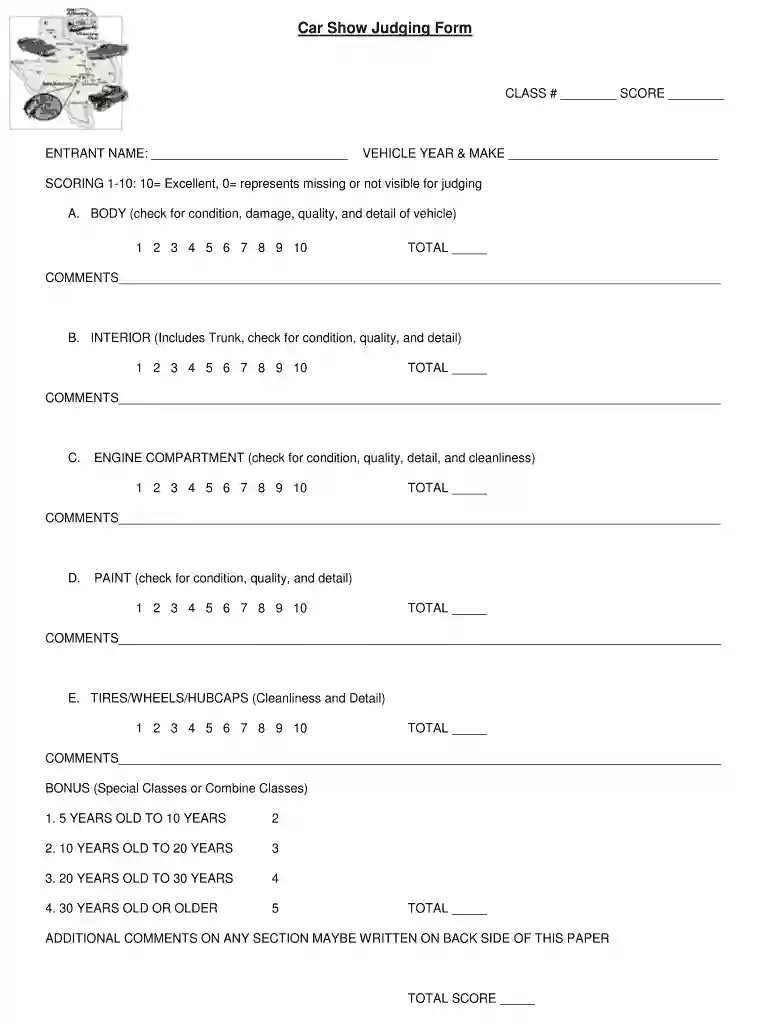
Type text, add images, blackout confidential details, add comments, highlights and more.

Draw your signature, type it, upload its image, or use your mobile device as a signature pad.

Send car show judging sheet pdf via email, link, or fax. You can also download it, export it or print it out.
A car show judging form is an essential tool used during automotive events to systematically evaluate vehicles based on set criteria. This structured document helps judges provide fair and consistent assessments while offering participants an understanding of how their vehicles will be scored. The form typically includes various judging criteria, each with a scoring system to highlight strengths and areas for improvement.
When utilizing a car show judging sheet, specific criteria are used to assess vehicles comprehensively. The common categories often include:
Each of these criteria often utilizes a scale, commonly from one to ten, to allow for a nuanced evaluation.
The scoring on a car show judging form typically ranges from one to ten, where each score corresponds to specific performance benchmarks.
This system allows judges to assign scores quickly while providing room for subjective comments and notes on each category.
In addition to numerical scores, the car show judging form allows judges to provide detailed comments on each vehicle's strengths and weaknesses. This feedback is invaluable for participants seeking to enhance their vehicles for future shows.
To facilitate consistent evaluations across different shows, creating a standardized car show judging sheet template is beneficial. A template typically includes:
Using a template helps ensure all judges focus on the same critical aspects of vehicle presentation, leading to uniformity in scoring.
When conducting car shows, it is crucial for organizers to recognize the legal implications of using a judging form.
During a recent classic car show, judges used the car show judging form to assess a range of vintage vehicles from different eras. One particular Beauty, a 1965 Mustang, scored exceptionally well in engine cleanliness and body condition due to the owner’s meticulous restoration.
Conversely, a more modern vehicle showed well on the exterior but lacked critical interior detailing, leading to lower scores in that category. Judges noted these observations in their comments, providing the owners with actionable feedback to enhance the vehicle for future competitions.
Using these evaluations and examples, both the judges and participants can refine their approaches, ultimately elevating the standard of vehicle exhibitions in future shows.
At DocHub, your data security is our priority. We follow HIPAA, SOC2, GDPR, and other standards, so you can work on your documents with confidence.
JUDGING SHEET. County. Name of Individual or Group.Read more
On this page our team gathered information and links to help the iGEM Judges review our results. Our teams evaluation for medals:Read more
Search for national federal court forms by keyword, number, or filter by category. Forms are grouped into the following categories.Read more


