Type text, add images, blackout confidential details, add comments, highlights and more.
02. Sign it in a few clicks
Draw your signature, type it, upload its image, or use your mobile device as a signature pad.
03. Share your form with others
Send it via email, link, or fax. You can also download it, export it or print it out.
How to use or fill out ss8h1bc with our platform
Ease of Setup
DocHub User Ratings on G2
Ease of Use
DocHub User Ratings on G2
Click ‘Get Form’ to open the ss8h1bc document in the editor.
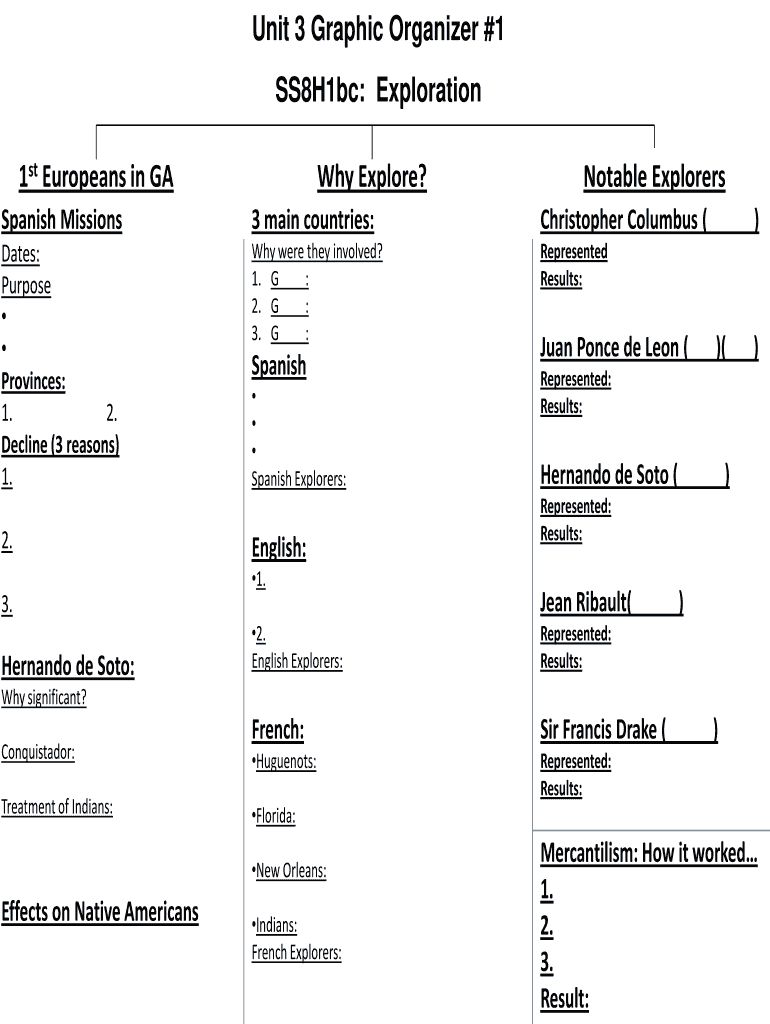
Begin by filling out the 'Why Explore?' section. Here, you can list reasons for exploration, such as economic opportunities or religious motivations.
In the 'Notable Explorers' section, input names and details of key figures like Christopher Columbus and Hernando de Soto. Include their contributions and significance.
Complete the 'Spanish Missions' area by detailing provinces like Guale and Mocama, along with their purposes and decline factors.
For the 'Effects on Native Americans' section, summarize how exploration impacted indigenous populations, including disease and cultural changes.
Start using our platform today to easily fill out your ss8h1bc form for free!
What were the reasons for European exploration and settlement of North America?
Indigenous peoples were forced into settlements called reductions, disrupting their traditional way of life and negatively affecting as many as one thousand villages. European diseases spread in the close quarters of the missions, causing mass death. Abuse, malnourishment, and overworking were common.
Which European nation colonized Georgia?
The Georgia Colony The British government backed the colony of Georgia to establish a barrier between the prosperous colonists in Charleston and the Spanish in Florida. However, obtaining the support of England could not guarantee the success of the colony, or its safety.
Which European explorers first attempted to colonize Georgia?
Overview. Historians generally recognize three motives for European exploration and colonization in the New World: God, gold, and glory.
Who were the first Europeans to explore Georgia?
The first European to explore the interior of what is now the state of Georgia was Hernando de Soto. In fact, De Soto entered the state on two occasions during the course of his expedition. Hernando de Soto was born about the year 1500 in Extremadura, Spain.
Who first colonized Georgia?
After years of planning and two months crossing the Atlantic, James Oglethorpe and 114 colonists climbed 40 feet up the bluff from the Savannah River on this day in 1733 and founded the colony of Georgia. George II granted the Georgia trustees a charter for the colony a year earlier.
Related Searches
Ss8h1bc answersSs8h1bc worksheetsSs8h1bc pdfSs8h1bc questionsSs8h1bc lesson planSs8h2Ss8g1Exceed the standard
Security and compliance
At DocHub, your data security is our priority. We follow HIPAA, SOC2, GDPR, and other standards, so you can work on your documents with confidence.
Marker Text: James Edward Oglethorpe, the founder of Georgia, landed with the original colonists, about 114 in number, at the foot of this bluff on February 1 (February 12, new style), 1733. The site where he pitched his tent is marked by the stone bench located about 100 feet west of this marker.
Who was the first European to explore Georgia?
About 1540, Spanish explorer Hernando de Soto, on a quest for silver and gold, led the first European expedition into the area that is now Georgia.
Cookie consent notice
This site uses cookies to enhance site navigation and personalize your experience.
By using this site you agree to our use of cookies as described in our Privacy Notice.
You can modify your selections by visiting our Cookie and Advertising Notice.