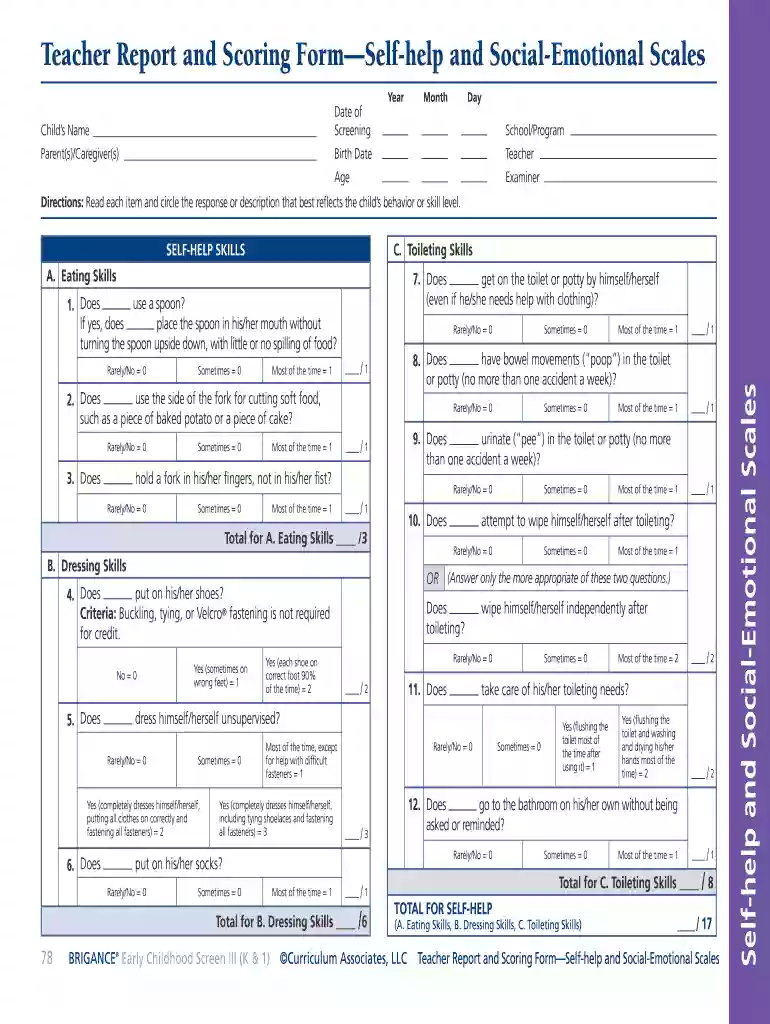
Definition and Meaning of the Brigance Social Emotional Scoring Tool
The Brigance Social Emotional Scoring Tool is an assessment instrument that evaluates children's social-emotional development and their self-help capabilities. Designed primarily for educators and professionals in early childhood settings, this tool assists in measuring various aspects of a child's interaction with peers and adults and their overall emotional well-being.
The scoring tool encompasses a series of structured questions aimed at assessing a child’s self-confidence, motivation, and social relationships. These evaluations are essential for determining a child's readiness for school, identifying areas of strength, and pinpointing opportunities for growth. Various scoring rubrics guide users on how to quantify children's abilities accurately.
Key Components of the Brigance Social Emotional Scoring Tool
- Self-Help Skills: Evaluates proficiency in personal tasks.
- Social Interactions: Measures engagement and relationships with peers and adults.
- Emotional Development: Assesses self-regulation and emotional responses.
- Motivation: Looks at willingness to take initiative and pursue tasks.
How to Use the Brigance Social Emotional Scoring Tool
Understanding how to effectively use the Brigance Social Emotional Scoring Tool is crucial for accurate assessments. The following steps outline the process:
- Preparation: Familiarize yourself with the assessment tool’s components, including the scoring guidelines and the associated evaluation forms.
- Observation: Observe the child in various settings to collect data relevant to their social interactions and emotional responses.
- Documentation: Use the assessment form to document observed behaviors thoroughly, adhering to the prompts provided.
- Scoring: Apply the scoring rubrics to your observations. Assign scores based on the child’s displayed behavior as outlined in the tool.
- Analysis: Analyze the scores to understand patterns in the child's social and emotional development.
- Reporting: Compile findings into a report that can be shared with parents, guardians, or other educators to support targeted interventions.
Best Practices for Effective Use
- Conduct assessments in different environments to gather comprehensive data.
- Engage multiple observers to ensure a balanced perspective.
- Regularly update assessments to track changes in the child’s development over time.
Steps to Complete the Brigance Social Emotional Scoring Tool
Completing the Brigance Social Emotional Scoring Tool involves a systematic approach that ensures accuracy and reliability. Here are the crucial steps:
- Gather Materials: Collect all necessary forms and tools needed for assessment.
- Set Context: Explain the assessment process to the child in an age-appropriate manner to ensure they feel comfortable.
- Implement the Assessment: Follow each section in the scoring tool meticulously, asking questions or prompting activities as required.
- Record Responses: Document answers promptly to ensure that no important details are missed.
- Score the Responses: Use the established criteria to assign scores for each behavior or response. Be objective and ensure consistency in scoring.
- Summarize Results: Prepare a summary of the findings which highlights key strengths and areas of concern for further development.
Why Should You Use the Brigance Social Emotional Scoring Tool
Using the Brigance Social Emotional Scoring Tool provides significant benefits for educators, parents, and intervention specialists. Key reasons include:
- Early Identification: The scoring tool allows for the early identification of social-emotional issues that may hinder a child's development.
- Strategic Planning: The results provide a framework for developing individualized education plans (IEPs) tailored to address specific needs.
- Progress Tracking: Regularly using the tool helps monitor progress and adjust strategies as needed.
- Enhanced Communication: Results can facilitate discussions between educators and parents, promoting a collective approach to supporting the child's development.
Who Typically Uses the Brigance Social Emotional Scoring Tool
The Brigance Social Emotional Scoring Tool is primarily utilized by:
- Educators: Teachers and educational professionals in early childhood settings.
- Early Childhood Development Specialists: Professionals focused on child development and learning.
- Child Psychologists: Practitioners who assess emotional and behavioral needs in children.
- Parents: Guardians interested in understanding and enhancing their child's emotional well-being.
- Administrators: School administrators seeking to implement effective assessment strategies in educational environments.
Each of these users benefits from the tool's structured approach to evaluating a child's social and emotional development, ultimately guiding effective interventions and supporting positive outcomes.