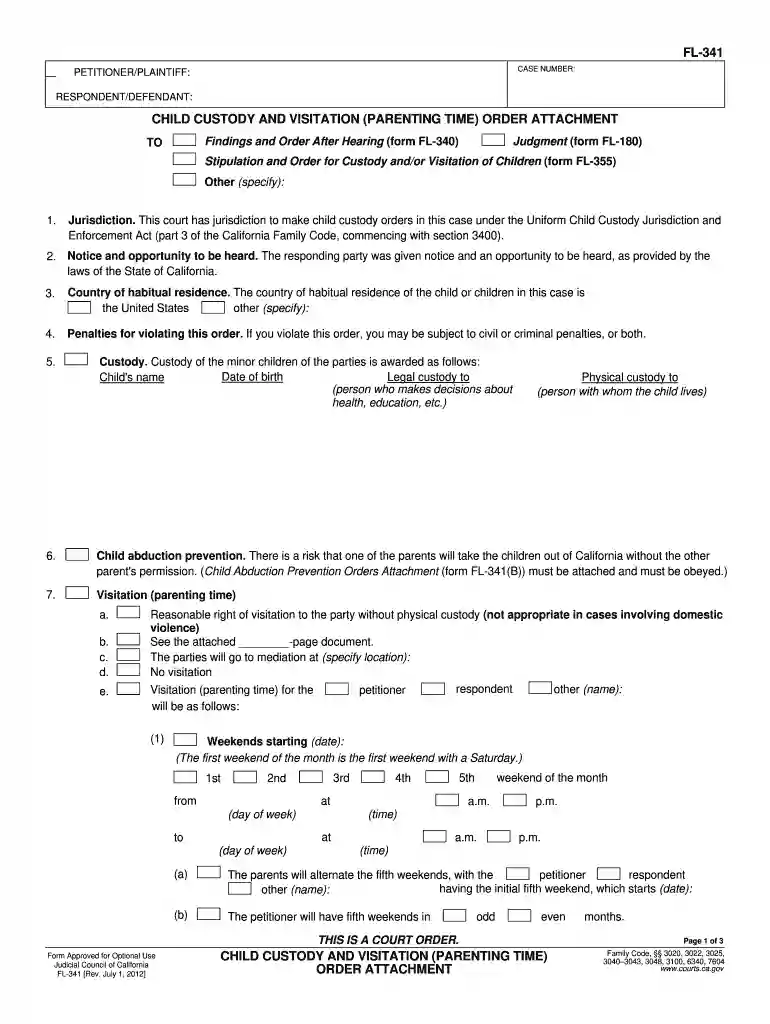
CHILD CUSTODY AND VISITATION (PARENTING TIME) ORDER ATTACHMENT 2026

Get Form
CHILD CUSTODY AND VISITATION (PARENTING TIME) ORDER ATTACHMENT Preview on Page 1

Here's how it works

01. Edit your form online
Type text, add images, blackout confidential details, add comments, highlights and more.

02. Sign it in a few clicks
Draw your signature, type it, upload its image, or use your mobile device as a signature pad.

03. Share your form with others
Send it via email, link, or fax. You can also download it, export it or print it out.

How to use or fill out CHILD CUSTODY AND VISITATION (PARENTING TIME) ORDER ATTACHMENT

Form edit decoration
9.5
Ease of Setup
DocHub User Ratings on G2
9.0
Ease of Use
DocHub User Ratings on G2
  1. Click ‘Get Form’ to open the CHILD CUSTODY AND VISITATION (PARENTING TIME) ORDER ATTACHMENT in our editor.
  2. Begin by entering the case number, petitioner, and respondent details at the top of the form. This information is crucial for identifying your case.
  3. In Section 1, confirm jurisdiction by selecting the appropriate options regarding child custody orders under California law.
  4. Fill out Section 5 regarding custody arrangements. Specify legal and physical custody details for each child, including their names and dates of birth.
  5. Complete Section 7 on visitation rights. Clearly outline the schedule for weekends, weekdays, and any special arrangements or restrictions.
  6. If applicable, provide details in Sections 9 through 14 about supervised visitation, transportation arrangements, holiday schedules, and additional provisions.
  7. Review all entries for accuracy before saving or printing your completed form. Utilize our platform's features to ensure everything is correct.

Start using our editor today to easily complete your CHILD CUSTODY AND VISITATION ORDER ATTACHMENT for free!

be ready to get more

Complete this form in 5 minutes or less

Get form

Got questions?

We have answers to the most popular questions from our customers. If you can't find an answer to your question, please contact us.
Contact us
The evaluator will typically examine each parents emotional functioning, parenting history, and relationship with the child. An unstable parent may demonstrate frequent emotional outbursts, poor decision-making, or an inability to set boundariesall of which could put a child at risk.
Custody Battle Blunders: Top 10 Mistakes To Avoid Negative Speech About The Other Parent. Seeking Sympathy From The Child. Poor Communication With The Other Parent. Unjustifiably Withholding Access With The Other Parent. Misrepresenting Substance Abuse. Separating Siblings In Blended Families.
If there is a court order outlining visitation and the custodial parent refuses to cooperate they can be held in contempt of court. To address this you can either go to the court house or clerk of court and file for hearing or hire an attorney.
Here are 10 tips to give you an edge in your case: Demonstrate that You Provide a Safe Environment. Be Stable. Dont Alienate the Other Parent. Keep Your Children Out of the Litigation (if possible) Pay Your Child Support on Time. Try to Co-Parent Act in the Best Interest of the Child Show The Court Your Best Self.
Child Custody and Visitation (Parenting Time) Order Attachment (FL-341) States the courts decisions (orders) after a hearing about child custody and visitation (parenting time) plans that are in the childs best interest. This can be used as an attachment to many other forms, as noted at the top of form FL-341.
be ready to get more

Complete this form in 5 minutes or less

Get form

People also ask

Conclusion. In most custody battles, the winner is the parent who can best demonstrate that they serve the childs best interests. While mothers still win more cases overall, the gap has narrowed as fathers play a greater role in raising their children.
A writ of attachment in child custody is a court order that authorizes law enforcement to take physical custody of a child from one parent or guardian and place the child with the other.

Related links