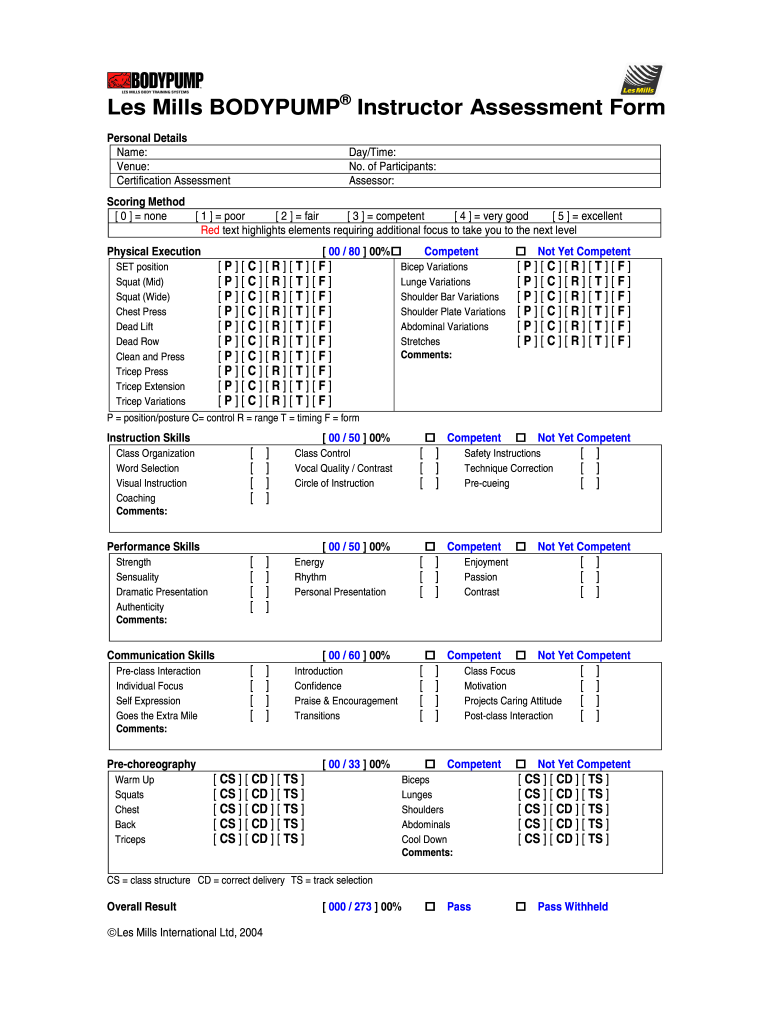
Body assessment form 2026

Get Form
body assessment form Preview on Page 1

Here's how it works

01. Edit your body assessment form online
Type text, add images, blackout confidential details, add comments, highlights and more.
02. Sign it in a few clicks
Draw your signature, type it, upload its image, or use your mobile device as a signature pad.
03. Share your form with others
Send body assessment form pdf via email, link, or fax. You can also download it, export it or print it out.

How to use or fill out body assessment form with our platform

Form edit decoration
9.5
Ease of Setup
DocHub User Ratings on G2
9.0
Ease of Use
DocHub User Ratings on G2
  1. Click ‘Get Form’ to open the body assessment form in the editor.
  2. Begin by entering your personal details, including your name and venue. This information is essential for identification during the assessment.
  3. Fill in the certification assessment section with the day/time of your assessment, number of participants, and assessor's name.
  4. In the scoring method section, evaluate each component using the provided scale from 0 (none) to 5 (excellent). Focus on areas highlighted in red for additional attention.
  5. Proceed to assess physical execution by marking your performance across various exercises such as squats and chest presses. Use the [P][C][R][T][F] indicators for detailed feedback.
  6. Complete sections on instruction skills, performance skills, and communication skills by providing comments where necessary.
  7. Finally, summarize key strengths and areas for improvement in the instructor assessment plan section. Outline actionable drills to enhance your skills.

Start filling out your body assessment form today for free and streamline your evaluation process!

be ready to get more

Complete this form in 5 minutes or less

Get form

Got questions?

We have answers to the most popular questions from our customers. If you can't find an answer to your question, please contact us.
Contact us
A full body assessment gives us a list of docHub findings in your body (or what we call 3s). docHub findings may include movements such as hip flexion (bringing knee to chest) or cervical rotation (turning head); muscles such as your bicep or gastrocnemius (calf); or joints such as your talocrural (ankle).
A head-to-toe assessment is a health evaluation that a nurse administers to better understand a patients status. As a nurse, this process helps you better understand your patients needs. The assessment encompasses every body system and the patients mental and neurological needs.
In general, the standard physical exam typically includes: Vital signs: blood pressure, breathing rate, pulse rate, temperature, height, and weight. Vision acuity: testing the sharpness or clarity of vision from a distance. Head, eyes, ears, nose and throat exam: inspection, palpation, and testing, as appropriate.
The health assessment is a survey about an individuals health history, current environment, and lifestyle. This information may be given to your doctor so that you and your doctor can develop a plan of care that meets your needs.
Comprehensive head-to-toe assessment, including inspection, palpation, percussion, and auscultation. Assessment of skin, head, eyes, ears, nose, throat, cardiovascular system, respiratory system, gastrointestinal system, musculoskeletal system, neurological system, etc.

Security and compliance

At DocHub, your data security is our priority. We follow HIPAA, SOC2, GDPR, and other standards, so you can work on your documents with confidence.

Learn more
ccpa2
pci-dss
gdpr-compliance
hipaa
soc-compliance
be ready to get more

Complete this form in 5 minutes or less

Get form

People also ask

Head to Toe Assessment Checklist Collect their vital signs. (Its encouraged to ask permission before touching a patient. Check heart rate. Measure blood pressure. Take body temperature. Pulse oxymetry. Respiratory rate. Check pain levels. Check hight and weight and calculate their BMI.
Generally, the experts advise a full body checkup once per year or once in a 6-month to 1-year interval with age after 40 particularly depending on risk factors such as family history, sedentary life, smoking, or presence of chronic diseases.

body evaluation form