Wa annexation 60 2026

Get Form
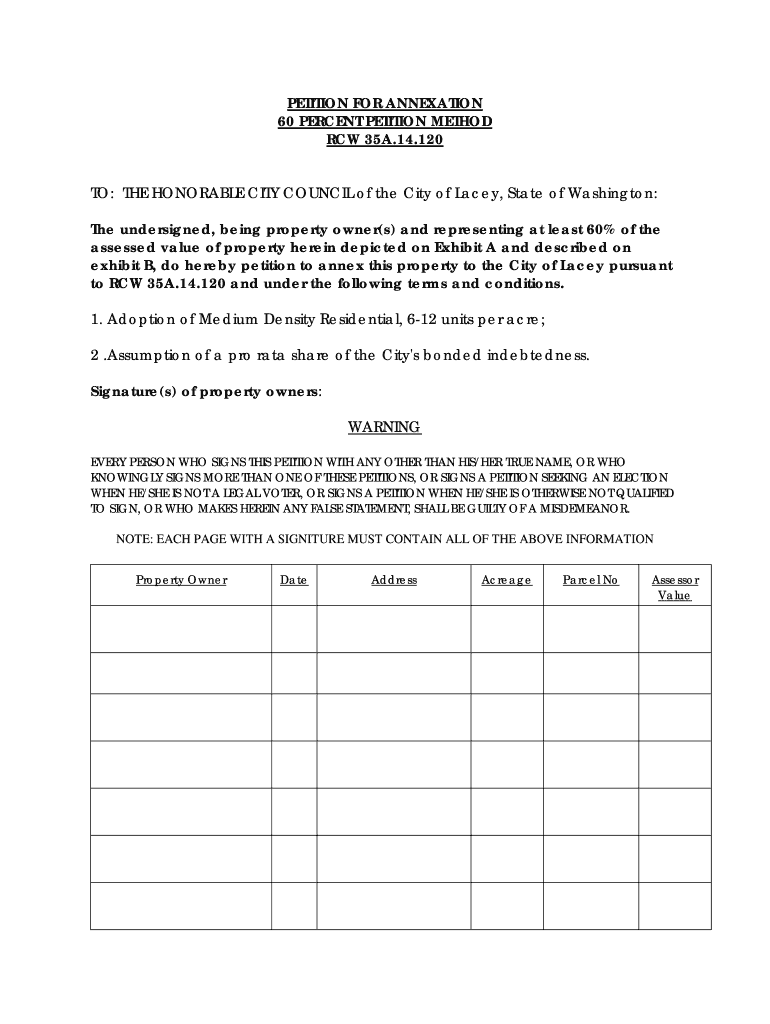
wa annexation 60 Preview on Page 1

Here's how it works

01. Edit your form online
Type text, add images, blackout confidential details, add comments, highlights and more.
02. Sign it in a few clicks
Draw your signature, type it, upload its image, or use your mobile device as a signature pad.
03. Share your form with others
Send it via email, link, or fax. You can also download it, export it or print it out.

How to use or fill out wa annexation 60 with our platform

Form edit decoration
9.5
Ease of Setup
DocHub User Ratings on G2
9.0
Ease of Use
DocHub User Ratings on G2
  1. Click ‘Get Form’ to open the wa annexation 60 document in the editor.
  2. Begin by reviewing Exhibit A, which contains the map of the annexation site. Ensure that the property you are petitioning for is accurately represented.
  3. Proceed to Exhibit B for the legal description of the property. Verify that all details match your records and are correctly filled out.
  4. In the main petition section, enter your name as a property owner, along with the date, address, acreage, parcel number, and assessor value. Make sure this information reflects your ownership accurately.
  5. Gather signatures from other property owners representing at least 60% of the assessed value. Each signature must be accompanied by all relevant information as stated in the warning section.
  6. Once completed, review all entries for accuracy before saving or exporting your document for submission.

Start using our platform today to streamline your wa annexation 60 form completion for free!

be ready to get more

Complete this form in 5 minutes or less

Get form

Got questions?

We have answers to the most popular questions from our customers. If you can't find an answer to your question, please contact us.
Contact us
There are five main types of annexation methods: election, direct petition (60%), 50/50 direct petition, annexation of small unincorporated islands, and annexation by interlocal agreement. The following summarizes each annexation method.
Under current law, a community cannot be annexed over the objections of a majority of the residents in the area to be annexed. Annexations also require the consent of the annexing city.
Annexation, in international law, is the forcible acquisition and assertion of legal title over one states territory by another state, usually following military occupation of the territory. In current international law, it is generally held to be an illegal act.
Annexation is the process of bringing property into the City limits. It is one of the primary means by which cities grow.
A number of states and localities allow the filing of a protest petition by those concerned about annexation, rezoning, conditional use or special exception permits. This action can be critical to winning annexation battles.

Security and compliance

At DocHub, your data security is our priority. We follow HIPAA, SOC2, GDPR, and other standards, so you can work on your documents with confidence.

Learn more
ccpa2
pci-dss
gdpr-compliance
hipaa
soc-compliance

People also ask

annexation, a formal act whereby a state proclaims its sovereignty over territory hitherto outside its domain. Unlike cession, whereby territory is given or sold through treaty, annexation is a unilateral act made effective by actual possession and legitimized by general recognition.
For property owners, annexation is docHub because it provides more voting rights and centralized services, which is a benefit. For home owners, annexation is docHub because it increases the property taxes they have to pay to the municipality once their land is added to the municipal territory.
This refers to a unilateral act of a State through which it proclaims its sovereignty over the territory of another State. It usually involves the threat or use of force, as the annexing State usually occupies the territory in question in order to assert its sovereignty over it.

Related links