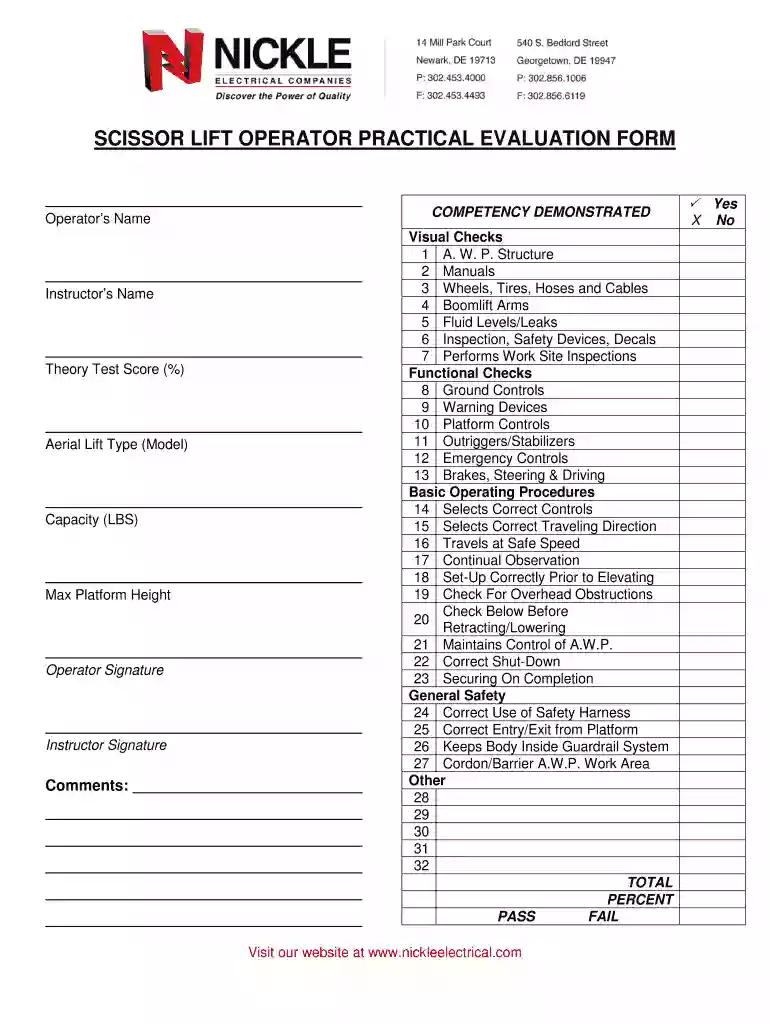
Scissor lift practical evaluation form 2026

Get Form
scissor lift evaluation form Preview on Page 1

Here's how it works

01. Edit your scissor lift evaluation form online
Type text, add images, blackout confidential details, add comments, highlights and more.

02. Sign it in a few clicks
Draw your signature, type it, upload its image, or use your mobile device as a signature pad.

03. Share your form with others
Send aerial lift practical evaluation form via email, link, or fax. You can also download it, export it or print it out.

Definition and Purpose of the Scissor Lift Practical Evaluation Form

The scissor lift practical evaluation form is a critical document used to assess the competency of operators in managing scissor lifts safely and effectively. This form serves several essential functions:

  • Operator Assessment: It provides a structured way to evaluate skilled operators on their ability to perform essential tasks while adhering to safety standards.
  • Legal Compliance: Completing this evaluation is often a requirement in various industries to comply with Occupational Safety and Health Administration (OSHA) regulations regarding aerial lift operations.
  • Training Verification: This form can verify that operators have undergone adequate training, demonstrating their knowledge of equipment use and safety protocols.

In practice, the form includes specific areas for instructor observations, scores from theoretical tests, and a comprehensive checklist ensuring all competencies are evaluated before an operator is deemed fit to operate a scissor lift.

Key Elements Included in the Scissor Lift Practical Evaluation Form

The form encompasses various sections designed to facilitate a thorough evaluation of an operator's capabilities. Key elements include:

  • Operator Information: Details such as name, certification number, and training history are documented.
  • Instructor Information: This section contains the instructor's name and credentials, providing validation for the evaluation process.
  • Theory Test Scores: A record of the operator's performance in written assessments helps verify their understanding of scissor lift operation principles.
  • Equipment Specifications: This portion captures essential data about the scissor lift model being operated, ensuring familiarity with specific equipment.
  • Competence Checklist: A detailed checklist allows the evaluator to observe and mark competencies, such as:
    • Safety checks (visual and functional)
    • Operational skills (starting, stopping, maneuvering)
    • Emergency procedures

Having these key elements ensures the evaluation is comprehensive, leading to reliable results that reflect the operator's ability to perform their duties safely.

Steps for Completing the Scissor Lift Practical Evaluation Form

Completing the scissor lift practical evaluation form requires a systematic approach. Key steps include:

  1. Preparation:

    • Ensure that the operator has prior training and knowledge relevant to scissor lift operations.
    • Gather necessary equipment and documentation.
  2. Filling in Operator and Instructor Details:

    • Both the operator and the instructor need to provide their personal details and relevant certifications.
  3. Conducting the Theory Test:

    • Administer the theoretical section of the evaluation, recording scores in the designated area.
  4. Performance Observation:

    • Evaluate the operator's performance using the competencies checklist, noting observations for each required skill.
  5. Scoring and Feedback:

    • Assign pass/fail marks based on performance, providing constructive feedback for areas needing improvement.
  6. Review and Signatures:

    • Both the operator and instructor should review the completed form, sign, and date it to confirm accountability.

By following this structured process, evaluators can ensure that every critical aspect of the operator’s capabilities is thoroughly examined.

Who Typically Uses the Scissor Lift Practical Evaluation Form

The scissor lift practical evaluation form is employed by various stakeholders involved in worker safety and training. Common users include:

  • Employers: Companies that operate machinery in construction, warehousing, and manufacturing settings utilize this form to ensure operator compliance with safety standards.
  • Training Institutions: Organizations offering certification programs for aerial lift operators often use the evaluation form as part of their training curricula.
  • Safety Inspectors: Professionals conducting workplace safety audits may review these evaluations during inspections to ensure compliance with regulations.
  • Human Resources Departments: They may use the form to track operator training and competencies as part of internal record-keeping.

The form plays a crucial role in maintaining a safe working environment and ensuring that operators are fully qualified to operate heavy machinery.


decoration image ratings of Dochub

Importance of the Scissor Lift Practical Evaluation Form in Workplace Safety

The scissor lift practical evaluation form is integral to maintaining workplace safety for several reasons:

  • Ensures Competence: By thoroughly assessing operators, the form helps to verify that they have the necessary skills and knowledge, reducing the likelihood of accidents.
  • Compliance with Regulations: This form serves as documentation showing adherence to legal requirements in many industries, particularly for OSHA guidelines.
  • Promotes Safe Practices: The evaluation process emphasizes the importance of safety within the organization, fostering an environment where operational safety is paramount.
  • Liability Protection: Adequate documentation of operator qualifications can protect employers from legal issues if incidents occur, demonstrating due diligence in hiring and training practices.

Overall, utilizing the scissor lift practical evaluation form is a proactive measure that underscores a commitment to safety and compliance.

Digital Versus Paper Versions of the Scissor Lift Practical Evaluation Form

Both digital and paper versions of the scissor lift practical evaluation form are available, each offering distinct advantages:

  • Digital Version Pros:

    • Easily shareable and can be integrated into online training systems.
    • Enables real-time updates and modifications, ensuring the form remains current.
    • Facilitates streamlined data collection and storage in organized databases.
  • Paper Version Pros:

    • Provides a tangible record that can be easily filed and accessed in physical form.
    • No need for digital devices or internet access during evaluations, which can be critical on job sites.

Organizations can choose the format that best suits their operational needs, balancing the convenience of technology with the traditional approach to documentation.

Examples of Using the Scissor Lift Practical Evaluation Form in Real-World Scenarios

Real-world usage of the scissor lift practical evaluation form highlights its effectiveness in various scenarios:

  • Construction Site Assessments: A contractor may require all new hires to complete the evaluation form before allowing them to operate scissor lifts. This ensures that every worker is proficient in safety practices, reducing the risk of accidents onsite.

  • Training Program Evaluations: A training provider conducting courses on aerial lift operations incorporates the form as a capstone evaluation to certify that participants meet industry standards before issuance of proof of training.

  • Safety Audits: An organization undergoing a safety audit may present completed evaluation forms to demonstrate compliance with OSHA regulations, showcasing their commitment to maintaining a safe work environment.

These examples illustrate how the scissor lift practical evaluation form serves to enhance safety and compliance across different industries and settings.

be ready to get more

Complete this form in 5 minutes or less

Get form

Got questions?

We have answers to the most popular questions from our customers. If you can't find an answer to your question, please contact us.
Contact us

eSignatures are a great replacement for traditional signing, as they save time, effort, and costs people spend on printing, scanning, and paper delivery. You can electronically sign your aerial lift evaluation form using a reliable and powerful online document management tool like DocHub. It complies with main eSignature policies (ESIGN and UETA), so all documents approved there are legally binding and have the same validity as manually signed ones.

If you are using Chrome, there are two simple ways to edit your scissor lift practical evaluation form online. First, go to the DocHub site, add your file, and edit it utilizing our toolbar. You can also set up our Chrome extension and edit any document by dragging and dropping it in your web browser window.

Scissor lift PPE refers to any equipment used to keep operators safe from accidents. It can include belts, body harnesses, and lanyards, to name a few. Such equipment can protect scissor lift operators against falls. It can also minimize the risk of scissor lift accidents that cause serious injury or death.
Scissor lifts must have guardrails installed to prevent workers from falling (see 29 CFR 1926.451(g) or 29 CFR 1910.29(a)(3)(vii)). Employers should train workers to: Check to see that a guardrail system is in place before working on the scissor lift. Only stand on the work platform; never stand on the guardrails.
Hazardous PPE is also an essential addition to scissor lift safety to protect workers from chemical leakages while working on elevated surfaces in industries that handle hazardous materials.

Security and compliance

At DocHub, your data security is our priority. We follow HIPAA, SOC2, GDPR, and other standards, so you can work on your documents with confidence.

Learn more
ccpa2
pci-dss
gdpr-compliance
hipaa
soc-compliance
be ready to get more

Complete this form in 5 minutes or less

Get form

People also ask

Scissor lift PPE refers to any equipment used to keep operators safe from accidents. It can include belts, body harnesses, and lanyards, to name a few. Such equipment can protect scissor lift operators against falls. It can also minimize the risk of scissor lift accidents that cause serious injury or death.
Scissor lifts must have guardrails installed to prevent workers from falling (see 29 CFR 1926.451(g) or 29 CFR 1910.29(a)(3)(vii)). Employers should train workers to: Check to see that a guardrail system is in place before working on the scissor lift. Only stand on the work platform; never stand on the guardrails.
Assuming theres an adequate guardrail system in place, scissor lift harnesses arent required by OSHA, but for all other situations, a personal fall restraint system is mandatory.
In regards to your specific question, when working from an elevated scissors lift (ANSI A92. 6 series), a worker need only be protected from falling by a properly designed and maintained guardrail system.
Also, aerial lift inspections help improve the longevity of the equipment and reduce costs. Thats because if defects are found early, they can be repaired before they balloon into more costly issues. And finally, inspections are required by ANSI and OSHA.

scissor lift training test