




01. Edit your static 99 online
Type text, add images, blackout confidential details, add comments, highlights and more.

Type text, add images, blackout confidential details, add comments, highlights and more.

Draw your signature, type it, upload its image, or use your mobile device as a signature pad.

Send static 99r via email, link, or fax. You can also download it, export it or print it out.
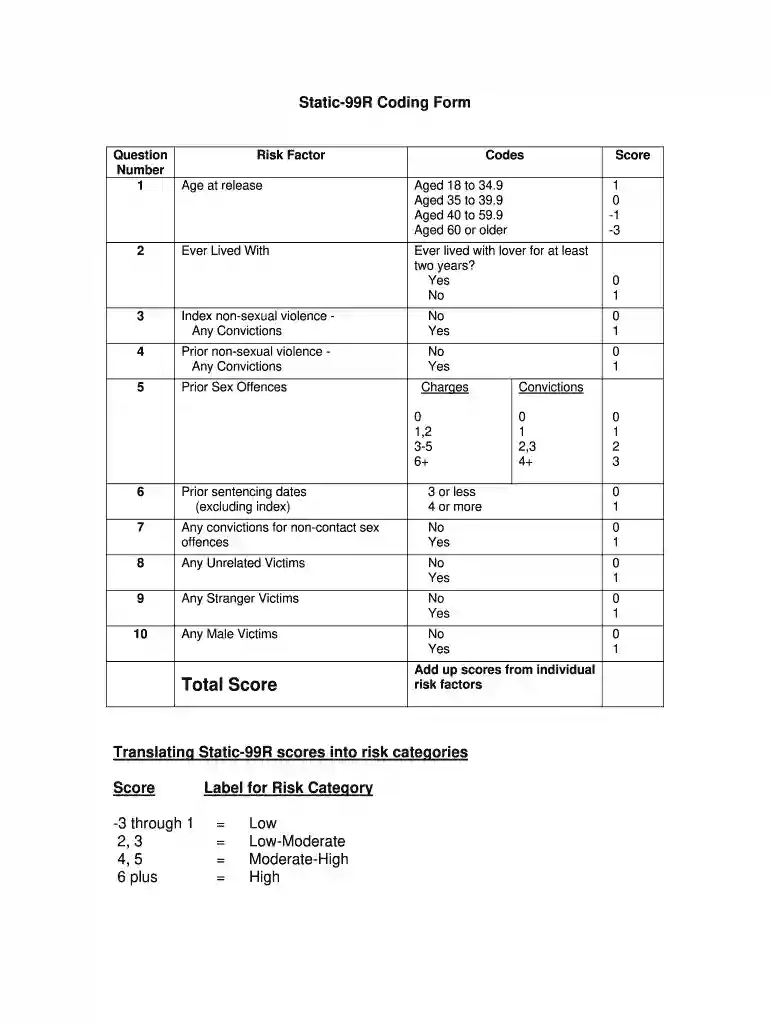
The Static 99R scoring sheet is a widely used assessment tool designed to evaluate the risk of sexual reoffending among individuals with a history of sexual offenses. This actuarial risk assessment tool incorporates various factors, including age, prior offenses, and living situation, to generate a score that categorizes individuals into risk classifications. Understanding how to use this scoring sheet effectively is essential for professionals involved in risk assessments, including psychologists, parole officers, and other law enforcement personnel.
The Static 99R scoring sheet comprises several risk factors, each contributing to the overall score:
Each of these factors is scored according to predefined guidelines, and the cumulative score determines the offender's risk category.
The scores generated by the Static 99R scoring sheet categorize offenders into distinct risk brackets:
These categories serve as a foundation for policymakers and practitioners when making informed decisions regarding supervision levels and treatment needs.
To maximize the utility of the Static 99R scoring sheet, professionals should follow a systematic approach:
Practitioners may encounter several challenges while utilizing the Static 99R scoring sheet, such as:
Using the Static 99R scoring sheet also involves navigating various legal and ethical considerations. Notably:
Ensuring adherence to these ethical standards is vital for maintaining the integrity of the assessment process.
The Static 99R scoring sheet is utilized in various real-world contexts, including:
For professionals using the Static 99R scoring sheet, ongoing training and staying current with research findings is essential. This may include:
Incorporating these educational elements fosters a more critical and informed approach to using the Static 99R scoring sheet in practice.
At DocHub, your data security is our priority. We follow HIPAA, SOC2, GDPR, and other standards, so you can work on your documents with confidence.
During audits of Static-99R scoring sheets the most commonly identified error is mechanical. (e.g., incorrect summing of item scores). Consequently it isRead more
If score is -3: On the Static-99R which predicts sexual recidivism this offender scored in the low risk range. Offenders with this same score.Read more


