




01. Edit your domestic discipline contract online
Type text, add images, blackout confidential details, add comments, highlights and more.

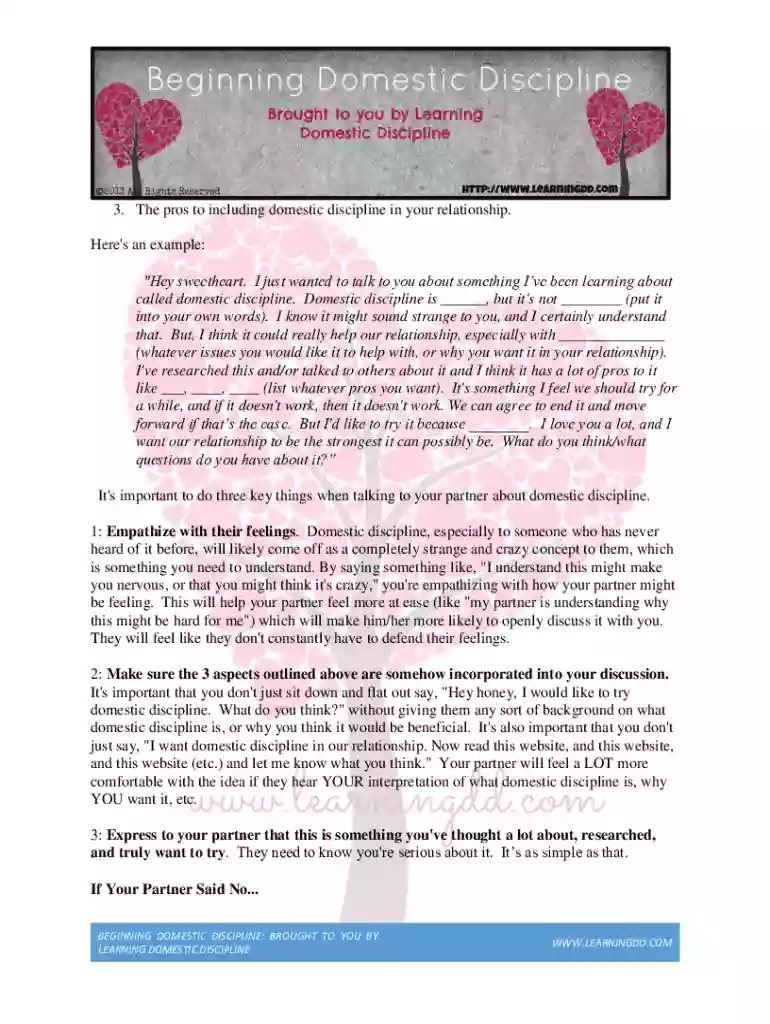
Type text, add images, blackout confidential details, add comments, highlights and more.

Draw your signature, type it, upload its image, or use your mobile device as a signature pad.

Send domestic discipline contract iblp via email, link, or fax. You can also download it, export it or print it out.
A domestic discipline contract is a formal agreement outlining the dynamics of a domestic discipline relationship. This type of contract typically addresses the expectations, responsibilities, and consequences associated with domestic discipline practices, which may involve behavioral correction methods such as spanking or other forms of discipline. The purpose of the contract is to establish clear communication and mutual consent between partners, ensuring that both parties understand their roles and the rules governing their relationship.
To create an effective domestic discipline contract, consider incorporating the following components:
Roles and Responsibilities: Clearly define the roles of each partner within the context of domestic discipline. This section should detail who takes on the authoritative role and what responsibilities each person holds regarding discipline.
Rules and Guidelines: Outline specific behaviors or actions that are considered acceptable or unacceptable. This will provide a framework for the discipline approach.
Types of Discipline: Discuss the allowed forms of discipline, whether they involve spanking, time-outs, or other methods. Ensure that both partners agree on these methods to promote understanding and consent.
Consequences: Specify the consequences for breaking established rules. It is crucial that these consequences are agreed upon by both parties to avoid misunderstandings or feelings of unfair treatment.
Communication Methods: Include intentions for ongoing communication about feelings, experiences, and adjustments to the agreement. These discussions will help reinforce trust and understanding between partners.
Creating a domestic discipline contract involves several steps to ensure clarity and mutual respect:
Start a Discussion: Engage in an open dialogue with your partner to discuss the concept of domestic discipline. Share your motivations and concerns, and listen to your partner's perspective.
Draft the Agreement Together: Collaborate on writing the contract. Each partner should contribute ideas to ensure the contract reflects both perspectives.
Review and Revise: Once an initial draft is created, review it together. Make revisions as needed to address any concerns or thoughts that arise during the review process.
Finalize the Contract: After reaching an agreement on the contents, finalize the document. This may include signing the contract as a formal acknowledgment of the partnership's commitment.
Plan Regular Check-Ins: Establish regular intervals for revisiting the contract. These check-ins can provide opportunities for adjustments and enhancements based on experiences and feelings.
A domestic discipline contract fundamentally relies on mutual consent and ongoing communication between partners. Consent ensures that both parties willingly engage in the dynamics of discipline outlined in the contract. Discussing boundaries, desires, and feelings creates a supportive environment and emphasizes the importance of trust and understanding within the relationship.
Contracts can vary widely based on partners' preferences and goals. Here are some examples of how couples may choose to outline their domestic discipline agreements:
Basic Domestic Discipline Contract: This may include a straightforward agreement to establish roles, rules, and consequences without diving too deeply into specifics.
Spanking Agreement: This could detail when and how spanking will be used, including limitations on frequency and context, ensuring both partners are comfortable with this form of discipline.
Christian Domestic Discipline Contract: Focused on spiritual principles, these contracts might integrate aspects of faith, emphasizing mutual respect, spiritual growth, and the consensual foundation of discipline.
While a domestic discipline contract can greatly enhance a relationship, challenges may arise, including:
Miscommunication: Partners may interpret rules and expectations differently, leading to potential conflicts. Clarity is essential in reducing misunderstandings.
Boundary Issues: Changes in one partner's comfort level with a particular method or consequence may necessitate amendments to the contract.
Emotional Response: The dynamic of discipline may elicit strong feelings. Regular communication is crucial to ensure both partners feel respected and valued throughout the process.
In a well-structured domestic discipline contract, both partners can explore their preferences and boundaries while cultivating a healthy, consensual relationship dynamic rooted in mutual respect.
Microsoft Word doesn’t have signing tools to create valid electronic signatures and enforceable paperwork. Fortunately, DocHub is an online eSignature-compliant editor that works with various file formats, including .doc files. Log in to your account and add the Word version of your spanking contract from your device and cloud, or URL - our editor will automatically transform it into an editable PDF. Make all essential adjustments in your document and click Sign to create your own legally-binding electronic signature. You will find four signing methods from which to choose.
You need only an internet connection and a web browser to complete your domestic discipline contract sample on an iOS phone. Open the DocHub website and authenticate. Then, add your document or select it from the list in your dashboard. Then use our editing tools to complete your form and preserve all your changes. You may also send it to a specified recipient immediately.
At DocHub, your data security is our priority. We follow HIPAA, SOC2, GDPR, and other standards, so you can work on your documents with confidence.
by TL Kuennen 2010 Cited by 39 A public education approach to domestic violence, coupled with punishment that demonstrates that there are consequences for violent behavior,.Read more
by W Nussbaum 2015 Cited by 7 The youth demonstrates less and less tolerance for discipline and anger, responding more quickly with violence. Often, the youth will make unrealistic demandsRead more
An employer who employs a domestic worker for 40 hours a week or more shall provide a period of rest of at least 24 consecutive hours in each calendar week.Read more


