NATIONAL LACY DOG REGISTRY 2026

Get Form
dog transfer ownership Preview on Page 1

Here's how it works

01. Edit your dog transfer ownership online
Type text, add images, blackout confidential details, add comments, highlights and more.

02. Sign it in a few clicks
Draw your signature, type it, upload its image, or use your mobile device as a signature pad.

03. Share your form with others
Send dog ownership form via email, link, or fax. You can also download it, export it or print it out.

How to use or fill out NATIONAL LACY DOG REGISTRY with our platform

Form edit decoration
9.5
Ease of Setup
DocHub User Ratings on G2
9.0
Ease of Use
DocHub User Ratings on G2
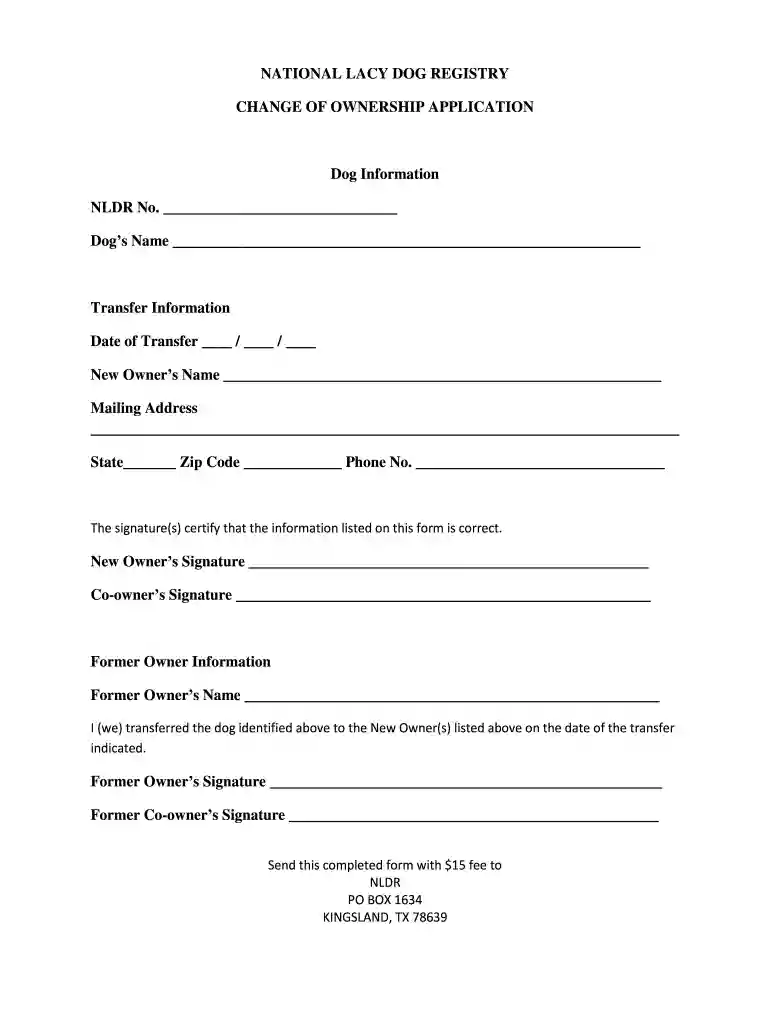
  1. Click ‘Get Form’ to open the NATIONAL LACY DOG REGISTRY Change of Ownership Application in the editor.
  2. Begin by entering the Dog Information. Fill in the NLDR Number and the Dog’s Name in the designated fields.
  3. Proceed to Transfer Information. Enter the Date of Transfer, followed by the New Owner’s Name and Mailing Address, ensuring all details are accurate.
  4. Complete the State, Zip Code, and Phone Number fields for the new owner.
  5. Both new owners must sign in the provided signature fields to certify that all information is correct.
  6. Fill out Former Owner Information by providing the Former Owner’s Name and signatures as required.
  7. Once completed, review all entries for accuracy before sending this form along with a $15 fee to NLDR at PO BOX 1634, KINGSLAND, TX 78639.

Start using our platform today to streamline your document editing and ensure a smooth transfer process!

be ready to get more

Complete this form in 5 minutes or less

Get form

Got questions?

We have answers to the most popular questions from our customers. If you can't find an answer to your question, please contact us.
Contact us
The Lacys started the line in the mid-1800s, by mixing Greyhounds, scent hounds, English Sheepdogs and/or coyotes. They wanted to create a breed that would be great at herding hogs, but would also be a suitable family pet. Mission accomplished! Its worth noting that Blue Lacys arent currently recognized by the AKC.
Steps Register with .akc.org. To research a dog on the AKC site, you will need to register for a free account with them. Hover over the AKC Shop in the menu bar. Once you have registered, navigate to the shop tab on the top-of-page menu bar. Select the Competitor Reports option. Click on Free Dog Lookup.
In most cases, you cannot register a purebred puppy if its parents are not themselves registered with a recognized breed registry. Registration typically requires that both parents be registered with the same organization or a compatible one, ensuring that the lineage is documented and verified.
If your dog has no papers you cannot get legitimate registration papers for it unless the original breeder does a litter registration and then gives you puppy papers for your dog. As for tags you apply for those usually at a city clerks office or the animal control office in your city or town. Hope this helps you!
The Blue Lacy was first developed in Texas in the mid-1800s by four brothersGeorge, Ewin, Frank, and Harry Lacywho needed a working dog to help them herd their familys cattle and hogs. The breed was reportedly a mix of Greyhounds, scent hounds, and coyotes, ing to the Texas Lacy Game Dog Association (TLGDA).

Security and compliance

At DocHub, your data security is our priority. We follow HIPAA, SOC2, GDPR, and other standards, so you can work on your documents with confidence.

Learn more
ccpa2
pci-dss
gdpr-compliance
hipaa
soc-compliance

People also ask

Yes, you can take your dog to the vet without papers. While documentation such as medical records and identification may be helpful, veterinary clinics generally prioritize providing care and treatment based on the animals health needs, regardless of paperwork.
To prove that a lost dog is yours, you can provide detailed descriptions of the dog, including any distinctive markings or features. Having recent photos of the dog can also be helpful. Additionally, you can show proof of ownership through veterinary records, adoption papers, or microchip information if available.

dog owner transfer