




01. Edit your letter of authenticity ascp online
Type text, add images, blackout confidential details, add comments, highlights and more.

Type text, add images, blackout confidential details, add comments, highlights and more.

Draw your signature, type it, upload its image, or use your mobile device as a signature pad.

Send ascp letter of authenticity via email, link, or fax. You can also download it, export it or print it out.
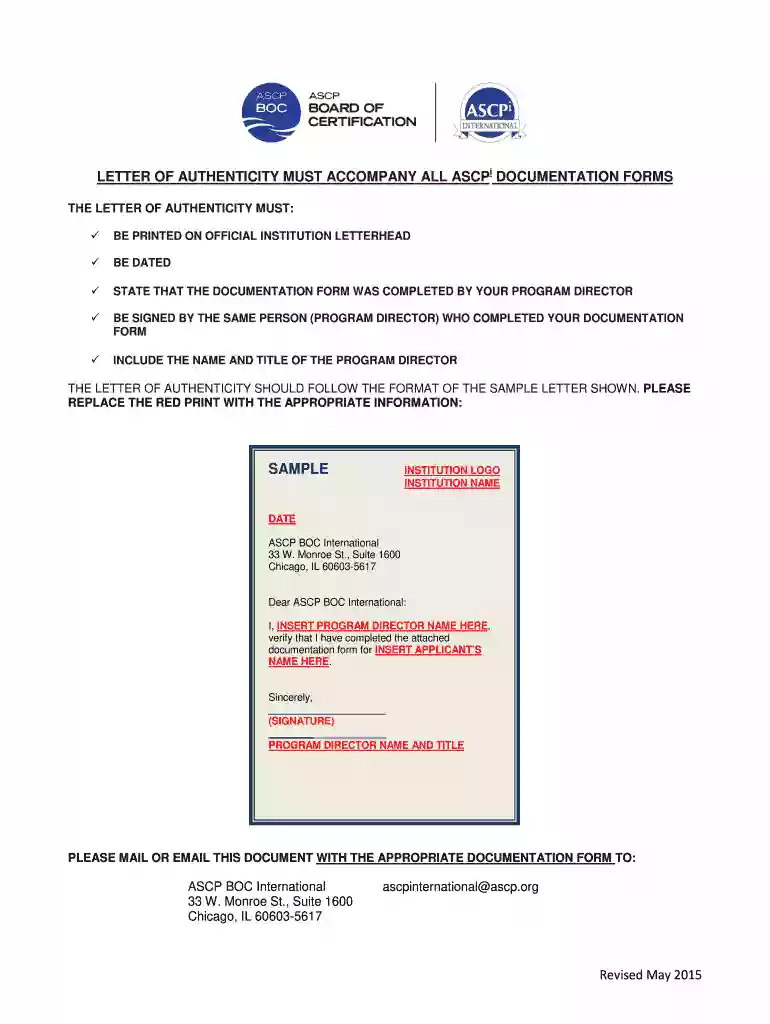
The letter of authenticity ASCP is a formal document that serves to verify the legitimacy of certain credentials, experiences, or qualifications, particularly related to professional certifications and educational achievements. It is often required by the American Society for Clinical Pathology (ASCP) for candidates who are documenting their work experience in fields such as laboratory medicine and pathology. The letter not only confirms that an individual has the requisite training or experience but is typically issued on official letterhead, signed by a relevant authority such as a program director.
The main purpose of the ASCP letter of authenticity is to affirm that the credentials listed in the accompanying ASCP documentation forms are valid and accurately represent the candidate’s qualifications. This is essential for ensuring that individuals seeking certification are adequately trained and possess the necessary skills for their profession.
Crafting an effective ASCP letter of authenticity involves several key elements that must be included to ensure its acceptability:
To ensure that the letter of authenticity ASCP is correctly completed, follow these steps:
Acquiring the letter of authenticity ASCP can be straightforward if you know the right steps to follow:
The letter of authenticity ASCP can serve a variety of purposes and use cases:
By providing clarity and credence to professional qualifications, the letter of authenticity ASCP plays a vital role in the career advancement of professionals in clinical settings.
At DocHub, your data security is our priority. We follow HIPAA, SOC2, GDPR, and other standards, so you can work on your documents with confidence.
THE LETTER OF AUTHENTICITY MUST BE. PRINTED ON ORIGINAL LETTERHEAD. IT MUST STATE THAT THE WORK EXPERIENCE DOCUMENTATION FORM WAS. COMPLETED, SIGNED AND DATEDRead more
Notice. The unofficial laws and rules contained in this book are not to be considered the final authority on the current law. While every effort has beenRead more


