





Definition & Meaning
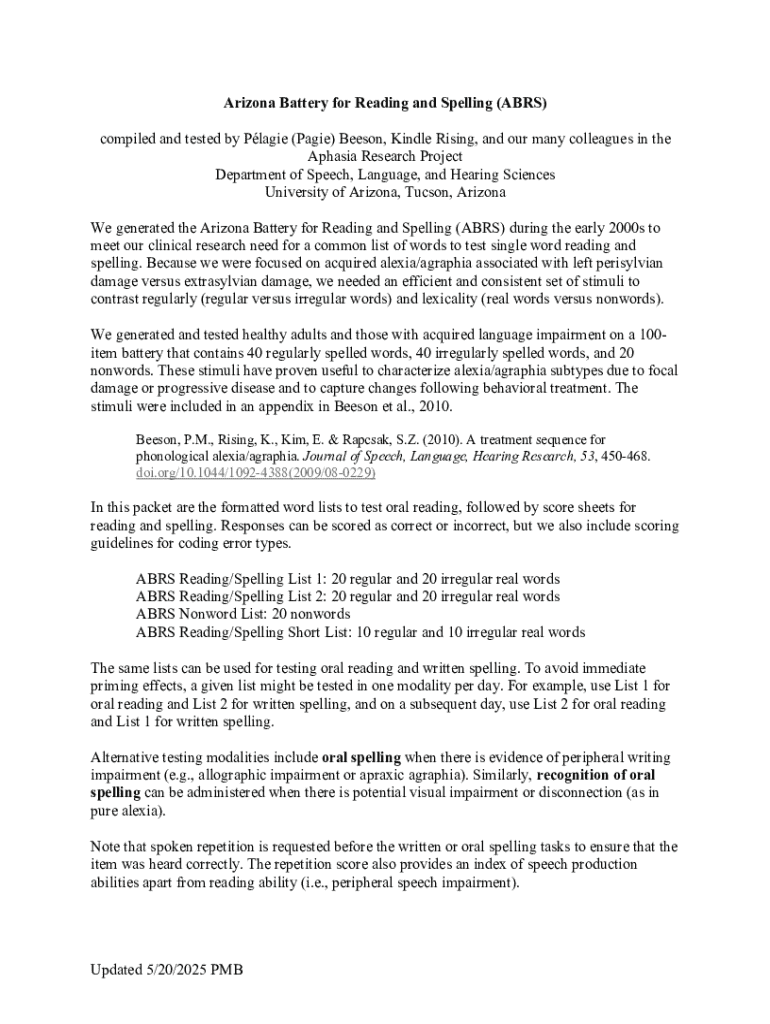
The Arizona Battery for Reading and Spelling (ABRS) Form is a standardized assessment tool designed to evaluate the reading and spelling abilities of individuals. Often used in educational and clinical settings, this form helps identify specific strengths and weaknesses in literacy skills. It can be instrumental in diagnosing learning disabilities such as dyslexia or to monitor the progress of individuals over time. The comprehensive nature of the ABRS allows for detailed insight into phonological processing, orthographic knowledge, and other literacy-related areas.
How to Use the Arizona Battery for Reading and Spelling (ABRS) Form
To use the ABRS form effectively, practitioners should follow several key steps:
- Preparation: Gather necessary materials, such as pencils, timers, and the ABRS form. Familiarize yourself with the test instructions and guidelines.
- Test Administration: Position the participant comfortably, ensuring they understand each task. Maintain a distraction-free environment to enhance accuracy.
- Scoring: As the participant completes each section, record responses and use the scoring keys provided to evaluate performance.
- Interpreting Results: Analyze scores in context, considering the individual’s background, age, and educational history. Use results to identify patterns or areas needing intervention.
- Follow-Up: Based on findings, develop tailored educational plans or refer to specialists if necessary for further evaluation.
Steps to Complete the Arizona Battery for Reading and Spelling (ABRS) Form
Completing the ABRS involves the following detailed steps:
- Reading Tasks: Includes reading words, sentences, or passages aloud. Assess the individual’s fluency and accuracy.
- Spelling Exercises: Dictate words for the individual to spell. Note errors to pinpoint specific spelling challenges.
- Phonological Awareness: Engage in tasks that require identification and manipulation of sounds within words.
- Contextual Analysis: Evaluate comprehension through questions about reading material.
- Documentation: Ensure all responses are correctly recorded. Make additional notes on behavior or observed difficulties that might inform interpretation.
Key Elements of the Arizona Battery for Reading and Spelling (ABRS) Form
- Phonemic Awareness: Ability to hear, identify, and manipulate individual sounds in spoken words.
- Word Recognition: Accuracy and speed in reading individual words.
- Spelling Accuracy: Consistency in spelling words correctly across varied contexts.
- Reading Fluency: Speed and ease of reading text passages aloud.
- Comprehension Questions: Understanding of text and ability to answer questions related to content.
Who Typically Uses the Arizona Battery for Reading and Spelling (ABRS) Form
The ABRS form is frequently used by:
- Educators: Teachers and school psychologists for assessing student literacy levels.
- Clinicians: Speech and language therapists, and educational psychologists to diagnose reading disorders.
- Researchers: In studies exploring literacy development and interventions.
- Parents: Interested in understanding their child’s reading and spelling abilities.

Important Terms Related to Arizona Battery for Reading and Spelling (ABRS) Form
- Orthographic Knowledge: Understanding of the writing system, including patterns and rules.
- Decoding: The ability to translate written words into their corresponding sounds.
- Encoding: The process of using sounds to construct written words.
- Dysgraphia: A condition characterized by difficulty with writing, which might be addressed during spelling assessments.
Examples of Using the Arizona Battery for Reading and Spelling (ABRS) Form
- Case Study in Schools: An 8-year-old student identified with reading difficulties undergoes ABRS testing, revealing challenges in phonemic awareness, which are addressed through targeted interventions, resulting in improved reading fluency.
- Clinical Evaluation: A teenager referred for persistent literacy challenges is assessed using the ABRS, leading to a diagnosis of dyslexia and subsequent personalized support strategies.
Eligibility Criteria
The ABRS is applicable to individuals across a spectrum of ages and abilities. However, it is particularly beneficial for:
- Students exhibiting signs of reading or spelling difficulties.
- Individuals undergoing evaluation for language disorders.
- People in transitional education phases, such as moving from elementary to middle school, where foundational literacy skills are crucial.

Digital vs. Paper Version
While traditionally paper-based, consideration for digital adaptations of the ABRS can facilitate easier data analysis and integration with electronic health records. However, it’s critical to ensure that digital versions maintain the testing integrity and provide equivalent levels of reliability and validity.


