




Definition & Meaning
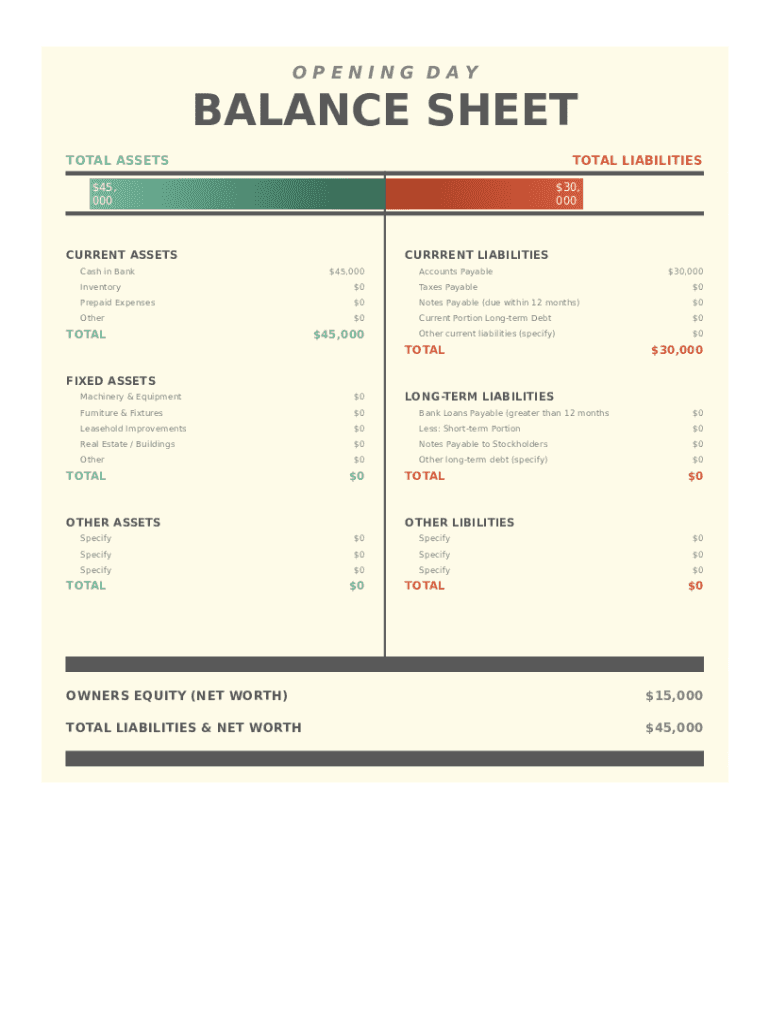
The "Opening Day Balance Sheet" is a fundamental financial statement that provides a snapshot of a company's financial condition on the first day of the financial year or the day the business starts operations. It includes assets, liabilities, and equity accounts to establish the baseline financial position. It acts as a benchmark for tracking the company’s financial progress over time. The statement comprises current and non-current assets and liabilities, which collectively outline the initial state of the company’s finances.
Components of the Balance Sheet
- Assets: Reflects what the company owns, including current assets like cash and inventory, and long-term assets such as property and equipment.
- Liabilities: Indicates what the company owes, covering both short-term obligations like accounts payable and long-term liabilities such as bonds or loans.
- Equity: Represents the owner's claim after all liabilities have been paid, including contributed capital and retained earnings.
Steps to Complete the Opening Day Balance Sheet
Creating an Opening Day Balance Sheet involves several detailed steps to ensure completeness and accuracy.
-
Compile Financial Records: Gather all relevant financial documents, including bank statements, invoices, and loan agreements, to accurately depict financial transactions up to the opening day.
-
Classify Assets and Liabilities: Segment all financial items into assets, liabilities, and equity, ensuring correct categorizations and valuations.
-
Valuate Each Item: Assign current market values to assets and liabilities. This may involve appraisals or market assessments for non-liquid assets.
-
Draft the Balance Sheet: Use a systematic format to list assets first, followed by liabilities and equity. Ensure that the total assets equal the sum of liabilities and equity.
-
Review and Verify: Cross-check all entries to confirm accuracy and completeness. Adjustments might be necessary to reflect accurate valuations or missed entries.
-
Consult a Professional: Consider having a financial advisor or accountant review the balance sheet for compliance with accounting standards and practices.
Why Should You Use the Opening Day Balance Sheet
The Opening Day Balance Sheet is a powerful tool for new businesses and established companies entering a new fiscal period. It provides insights into the financial health and operational capacity from the onset.
- Financial Benchmarking: Establishes a baseline for future financial analysis and performance appraisals.
- Investor Assurance: Offers a transparent view of financial standing necessary for potential investors or stakeholders.
- Strategic Planning: Aids in setting financial and operational goals aligned with available resources.
Key Elements of the Opening Day Balance Sheet
Certain key elements are essential to a comprehensive Opening Day Balance Sheet, often dictating the usability and accuracy of the document.
- Current Assets: Cash, accounts receivable, and inventory.
- Current Liabilities: Short-term obligations like accounts payable.
- Long-Term Debt: Includes loans and bonds not due within the current year.
- Owner's Equity: Represents owner investment and retained earnings.
These elements provide clarity on both what the company owns and owes from the starting point, laying the foundation for effective financial management.
Important Terms Related to Opening Day Balance Sheet
Familiarizing with key terms related to the Opening Day Balance Sheet enhances comprehension and accurate application.
- Liquidity: The ease with which assets can be converted to cash.
- Solvency: The ability to meet long-term obligations.
- Current Ratio: A liquidity metric calculated as current assets divided by current liabilities.
- Debt-to-Equity Ratio: A solvency measure defined as total liabilities divided by shareholder's equity.
These terms facilitate a deeper understanding of financial health indicators surfaced in the balance sheet.
Examples of Using the Opening Day Balance Sheet
Practical examples underscore the significance of an Opening Day Balance Sheet in various business contexts.
- Startup Enterprises: A new retail store uses its Opening Day Balance Sheet to secure a loan by showcasing initial financial conditions to the bank.
- Mergers: A merging entity evaluates the Opening Day Balance Sheet of the acquired company to adjust and realign operational strategies.
- Seasonal Businesses: A summertime ice cream vendor lists down equipment expenses and initial stock, ensuring appropriate financial tracking as the season begins.
By deploying concrete examples, companies can plan effectively and maximize the utility of their Opening Day Balance Sheet.
Business Types That Benefit Most from Opening Day Balance Sheet
Various business types substantially benefit from employing an Opening Day Balance Sheet due to the strategic insights it provides.
- Small Businesses: Securing initial investor funding often hinges on transparent financial starting points.
- Corporations: Opening fiscal years with a clear financial blueprint aids regulated reporting and compliance.
- Non-Profits: Establishing initial financial conditions assists in delineating budget allocations for program activities.
Each business type uniquely applies the usage of an Opening Day Balance Sheet to fit their specific financial strategy and operational goals.
Digital vs. Paper Version
Digital and paper forms of the Opening Day Balance Sheet serve different purposes, and selecting the appropriate format depends on the business's needs and capabilities.
Advantages of Digital Forms
- Ease of Access and Sharing: Allows seamless sharing among team members and stakeholders, facilitating real-time collaboration.
- Integration with Software: Synchronizes with accounting software like QuickBooks or TurboTax for automated data entry and error reduction.
Limitations of Paper Forms
- Manual Updating Required: All entries need to be updated manually, increasing the chances of errors and omissions.
- Difficulty in Distribution: Sharing physical copies is less efficient and poses security concerns regarding sensitive financial data.
Choosing between digital and paper versions depends on factors such as technological competence, the scale of operations, and preferences in data management.