





Definition and Meaning
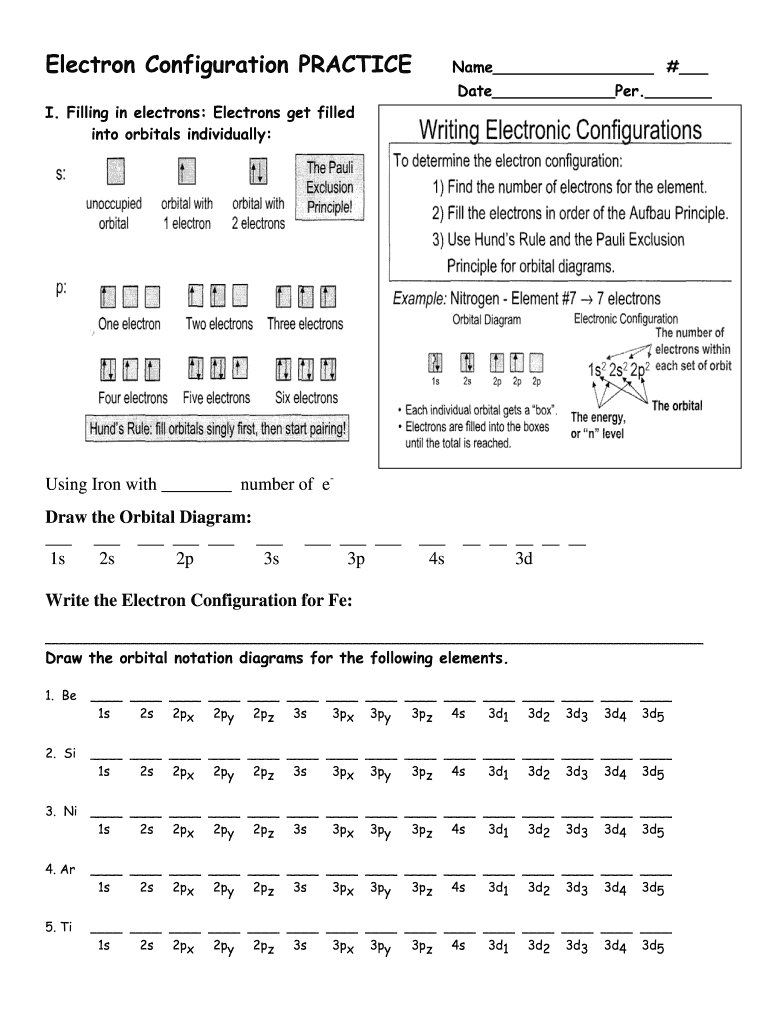
An electron configuration practice worksheet is a tool used to help students and educators understand and master the arrangement of electrons in an atom's orbitals. It serves as a foundational exercise in chemistry and physics classes, providing a structured template for practicing the principles of electron configuration. This form typically includes spaces for filling in electron orbitals, as well as sections for writing configurations in standard notation. Its purpose is to reinforce learning about how electrons populate different energy levels and sublevels around an atomic nucleus.
How to Use the Electron Configuration Practice Worksheet
-
Understand the Aufbau Principle: Begin with the understanding that electron configurations are written from lower to higher energy levels. Follow the layman's order for filling electron orbitals, starting from 1s and moving upwards.
-
Apply Hund’s Rule and Pauli Exclusion Principle: Use these rules to arrange electrons. Hund's Rule states that electrons will fill an unoccupied orbital before they pair up, while the Pauli Exclusion Principle asserts that no two electrons in an atom can have the same set of quantum numbers.
-
Practice with Elements: Practice electron configurations with elements from the periodic table, starting with lighter elements and gradually moving to heavier ones to understand transitions between energy levels better.
-
Write Electron Configurations: Record the electron configuration using standard notation that indicates the number of electrons in each sublevel (e.g., 1s² 2s² 2p⁶).
-
Visualize with Orbital Diagrams: Use the worksheet to draw orbital diagrams that present a visual representation of electron configuration, illustrating how electrons fill each orbital with arrows representing electron spins.
Steps to Complete the Electron Configuration Practice Worksheet
-
Choose an Element: Identify an element from the periodic table to practice. Write down its atomic number, as this determines the number of electrons to arrange.
-
Write the Electron Configuration: Begin filling in orbitals according to the Aufbau principle, using the periodic table as a guide for the energetic order of orbitals.
-
Use Orbital Notation: Use lines and arrows to depict the filling of each sublevel, reflecting both the number of electrons and their spins.
-
Check with the Periodic Table: Verify your configuration against known electron arrangements for accuracy, ensuring you have the correct number of electrons in each orbital.
-
Practice Special Cases: Some elements have exceptions, such as copper and chromium, where electron configurations differ due to stability offered by half-filled or completely filled d-sublevels.
-
Review and Repeat: Practice with multiple elements and isotopes to strengthen your understanding and mastery of electron configurations.
Key Elements of the Electron Configuration Practice Worksheet
- Atomic Number: Designation for the number of electrons an element has, crucial for determining its electron configuration.
- Sublevel Blocks: Sections like s, p, d, and f that electrons occupy, ordered by increasing energy levels.
- Notation: Standard notation format that includes sublevels and electron numbers (e.g., 1s², 2p⁶).
- Orbital Diagrams: Diagrams illustrating electron positions within orbitals, using lines for orbitals and arrows for electrons.
- Exceptions to the Rules: Notations or notes for elements with electron configurations that deviate from standard rules due to electron configurations that result in additional stability.
Examples of Using the Electron Configuration Practice Worksheet
-
Example with Neon (Ne): The worksheet would illustrate filling 1s, 2s, and then 2p orbitals, leading to the configuration 1s² 2s² 2p⁶.
-
Example with Iron (Fe): Guide learners through writing 1s² 2s² 2p⁶ 3s² 3p⁶ 4s² 3d⁶, including using appropriate blocks and visual diagrams.
-
Transition Metal Configurations: For example, copper, where its electron configuration is listed as [Ar] 3d¹⁰ 4s¹ instead of the expected [Ar] 3d⁹ 4s².
Important Terms Related to Electron Configuration Practice Worksheet
- Aufbau Principle: Concept used to determine the filling order of electron orbitals based on increasing energy levels.
- Hund's Rule: An electron placement principle that emphasizes filling orbitals singly before pairing electrons.
- Pauli Exclusion Principle: States that no two electrons can have the same four quantum numbers, critical for understanding electron arrangement.
Versions or Alternatives to the Electron Configuration Practice Worksheet
- Digital Worksheets: Online versions that allow interactive input and real-time feedback on electron configuration exercises.
- Printed Worksheets: Traditional paper versions that students can fill out by hand in a classroom setting.
State-by-State Differences
Though primarily a uniform educational tool, certain state educational standards may emphasize different parts of electron configuration based on curricular goals, which could affect how the worksheets are used or graded in academic assessments.