Definition & Meaning
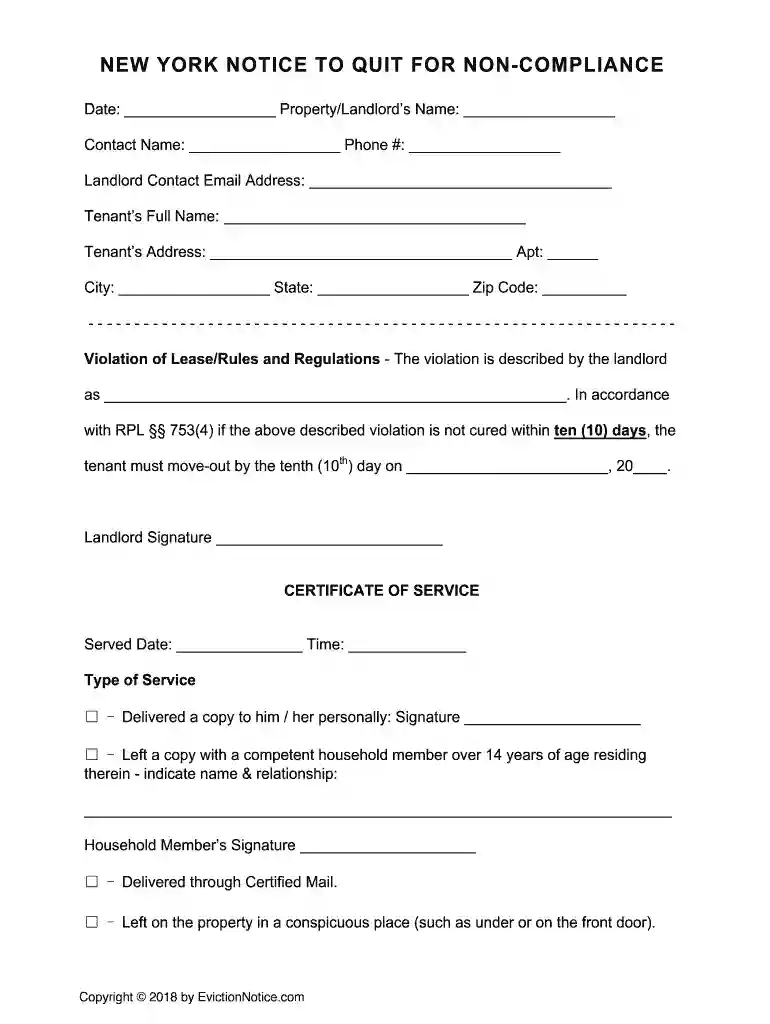
A "New York Notice to Quit for Non-Compliance" is a legal document used by landlords to notify tenants that they have violated the terms of their lease agreement. The notice prompts the tenant to correct the violation or vacate the property by a specified deadline. This notice is a formal step in the eviction process when tenants fail to adhere to lease requirements, such as paying rent or maintaining property standards.
Key Terms
- Non-compliance: Refers to any breach of lease terms by the tenant.
- Lease Agreement: A contract outlining the terms between landlord and tenant.
- Eviction Process: Legal proceedings required to remove a tenant from a rental property.
How to Use the New York Notice to Quit for Non-Compliance
The process of using a New York Notice to Quit for Non-Compliance involves several crucial steps:
- Identify the Violation: Determine how the tenant has breached the lease.
- Fill Out the Notice: Include essential details such as the date, tenant's name, and specific violation.
- Deliver the Notice: Serve the notice to the tenant personally or via certified mail to ensure delivery.
- Allow Time for Compliance: Give the tenant an opportunity to rectify the issue according to state laws.
Practical Examples
- A tenant failing to pay rent on time consistently.
- A tenant causing damage to the property beyond normal wear and tear.
Steps to Complete the New York Notice to Quit for Non-Compliance
Completing the notice requires careful attention to detail:
- Complete Tenant Details: Enter the tenant's full name and address.
- State the Violation: Clearly articulate the non-compliance issue.
- Set a Deadline: Specify a date by which the tenant must comply or vacate.
- Landlord’s Information: Provide the landlord’s name and contact information for further communication.
- Sign the Notice: Ensure the notice is signed by the landlord or their representative.
Completion Tips
- Use clear, concise language.
- Double-check all information for accuracy.
- Consider consulting with a legal professional to validate the notice.
Scenarios Involving Use
- A multi-unit landlord addressing non-compliance across several properties.
- A legal representative drafting the notice for a landlord-client.
Legal Use of the New York Notice to Quit for Non-Compliance
This notice serves as a legal instrument in the eviction process under New York real estate law. Its proper use helps landlords maintain control over leased properties and resolve non-compliance issues efficiently.
Legal Implications
- Failure to use the notice correctly may invalidate eviction proceedings.
- Tenants have legal rights to dispute the notice, which can lead to court mediation.
Key Elements of the New York Notice to Quit for Non-Compliance
A valid notice should include:
- Tenant Identification: Name and address of the tenant.
- Description of Violation: Specifics of the breach of lease terms.
- Corrective Action Required: Instructions on how the tenant can remedy the situation.
- Deadline for Compliance: Specific date for compliance or vacating the property.
Detailed Breakdown
- Accurate tenant details ensure the notice reaches the right party.
- Clear violation descriptions avoid misunderstandings and potential disputes.
State-Specific Rules for the New York Notice to Quit for Non-Compliance
New York imposes specific legal requirements for eviction notices:
- Notice Period: The timeframe landlords must allocate for the tenant to address the violation or leave the premises.
- Tenant Rights: Protections under state law allowing tenants to contest unjust notices.
Notable Differences
- Variation in notice period length between residential and commercial leases.
- Differences in procedure when lease agreements are silent on specific issues.
Examples of Using the New York Notice to Quit for Non-Compliance
Several real-world scenarios exemplify effective use of the notice:
- A landlord issues a notice after discovering a prohibited sublet arrangement.
- A tenant breaches a noise regulation provision of the lease, prompting a formal notice.
Case Study
- Background: A landlord in New York City identifies a tenant's unauthorized pet as a lease violation.
- Action: Issues a Notice to Quit, citing specific lease sections violated and offering options to resolve the issue, including vacating the premises if compliance is not met.
- Resolution: The tenant complies by rehoming the pet, preventing eviction.
By following these guidelines, landlords and property managers can effectively leverage the New York Notice to Quit for Non-Compliance to maintain adherence to lease conditions while ensuring a legally compliant eviction process.