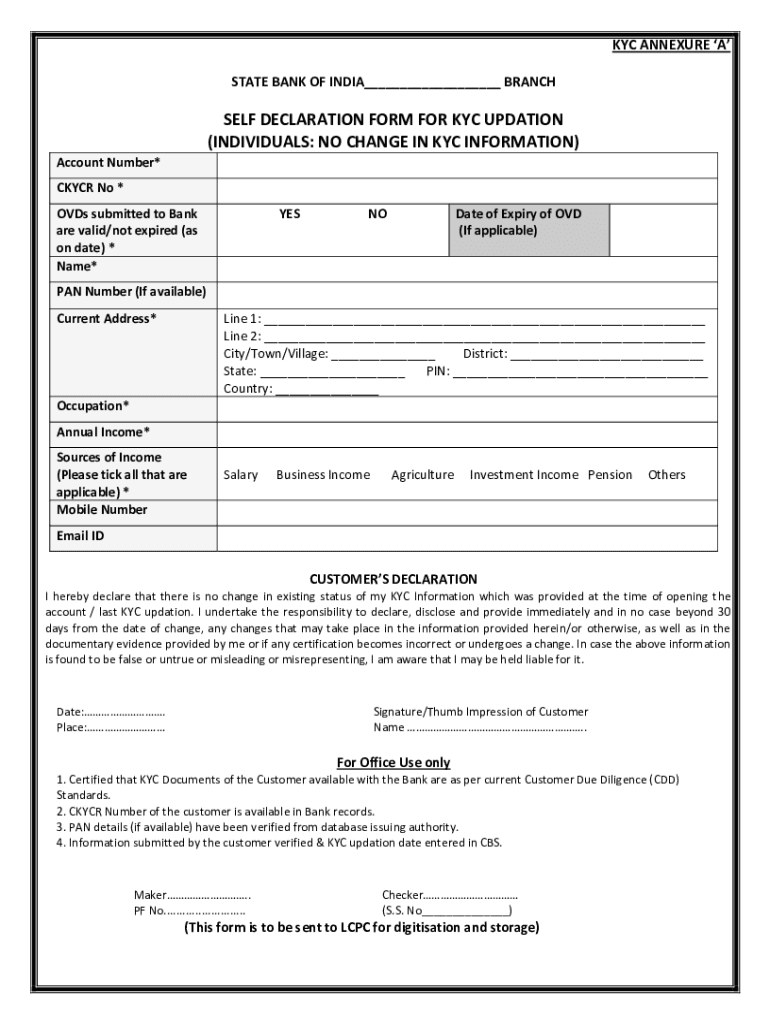







Definition & Meaning
The KYC Self Declaration Form is a document used in banking and financial services for verifying and updating a customer's identity and address. KYC stands for "Know Your Customer," a critical process ensuring that businesses understand who their customers are. This form is primarily used to fulfill regulatory requirements and to prevent fraud, money laundering, and other financial crimes. It helps institutions maintain accurate customer records and ensure compliance with legal obligations.
How to Use the KYC Self Declaration Form
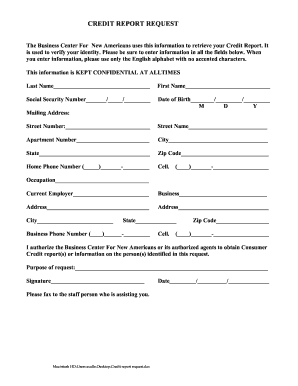
Using the KYC Self Declaration Form involves gathering and providing your personal information accurately. This data typically includes your full name, date of birth, nationality, and contact details. You must verify this information with appropriate identification and address proof. Following careful completion, the form can be submitted to your financial institution, either in person or through designated online portals, depending on their procedures.
Steps to Complete the KYC Self Declaration Form
-
Gather Required Documents: Before starting, collect necessary identification documents such as a passport, driver's license, or a utility bill for address verification.
-
Fill Out Personal Details: Complete sections requesting your name, date of birth, and contact information clearly and accurately.
-
Attach Supporting Documents: Provide photocopies of identification and address proofs as specified by the financial institution.
-
Review and Sign: Double-check all information for accuracy. Sign the form where required to confirm the authenticity of the provided details.
-
Submit the Form: Send the completed form to your institution either electronically, if the facility is available, or physically by delivering it to the relevant branch.
Required Documents
Completing the KYC Self Declaration Form requires submitting multiple documents to verify your identity and residence:
- Identity Proof: Passport, driver's license, or government-issued ID card.
- Address Proof: Utility bill, bank statement, or rental agreement confirming your permanent address.
These documents must be current and valid, meeting the financial institution's criteria. Additional documents may be requested based on specific circumstances.
Legal Use of the KYC Self Declaration Form
The form is legally mandated for financial institutions to meet anti-money laundering regulations. It's designed to ensure that banks and other financial entities have sound, verified information on their clients, thereby reducing risks of identity fraud, tax evasion, and enabling compliance with legal standards such as the USA PATRIOT Act. Compliance ensures that financial interactions are transparent and secure, aligning with national and international legal frameworks.
State-Specific Rules for the KYC Self Declaration Form
While the fundamental process of KYC is standardized across the United States, certain states may impose additional requirements based on local regulations. These can include additional identification documents, variations in accepted address proofs, or specific declarations that align with state financial laws. It's advisable to consult with the financial institution or a local compliance officer for precise guidance tailored to your state's rules.
Penalties for Non-Compliance
Failure to complete and submit a KYC Self Declaration Form can lead to severe repercussions for both individuals and businesses. These include account suspension, inaccessibility to financial services, potential fines, and increased scrutiny of financial activities. Institutions may face regulatory penalties, impacting their ability to operate. Regular updating of KYC information is crucial to avoid these implications.
Differences Between Digital and Paper Versions
Modern financial institutions often provide both digital and paper versions of the KYC Self Declaration Form. Digital versions facilitate online submission and can be more convenient for individuals familiar with electronic systems. In contrast, paper forms may be preferred by those who favor traditional methods or lack internet access. Both formats require the same level of accuracy and completeness, although digital formats might include additional electronic signature features for improved efficiency.
Examples of Using the KYC Self Declaration Form
Consider a scenario where a customer opens a new savings account at a bank. They would be required to complete the KYC Self Declaration Form as part of the account opening process. Alternatively, if an existing customer changes their residential address, they need to update their KYC details using this form to ensure continued access to banking services without disruptions.