




01. Edit your form online
Type text, add images, blackout confidential details, add comments, highlights and more.

Type text, add images, blackout confidential details, add comments, highlights and more.

Draw your signature, type it, upload its image, or use your mobile device as a signature pad.

Send it via email, link, or fax. You can also download it, export it or print it out.
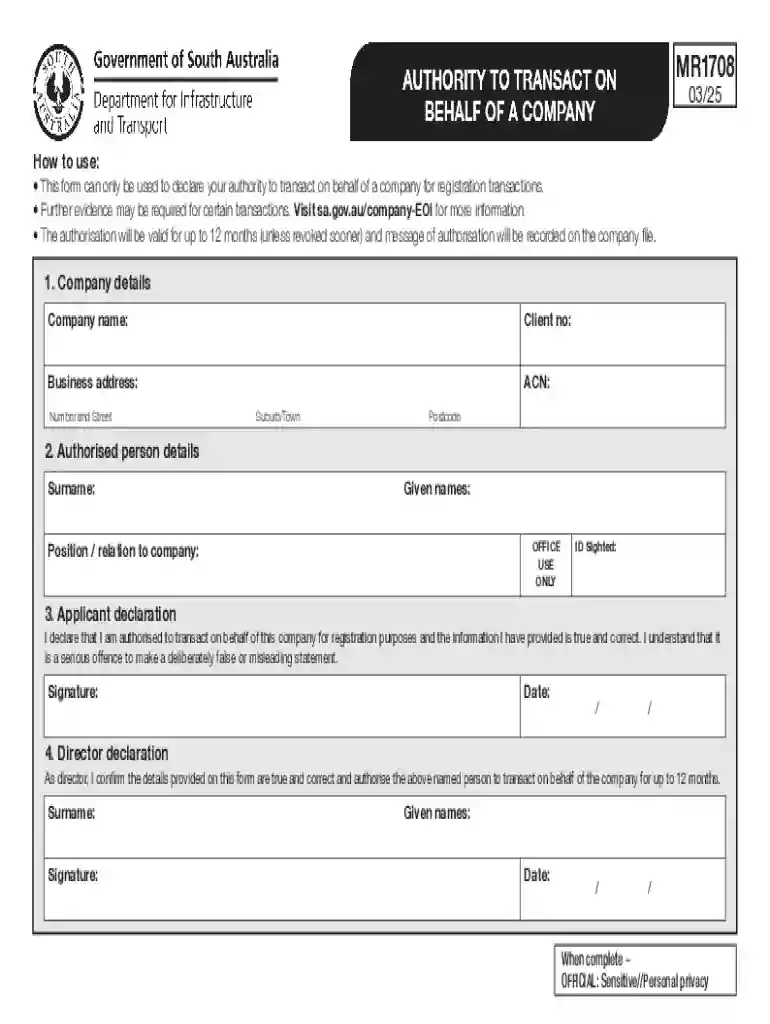
The South Australia Company Registration Authority Form is a legal document used to declare the authority of a person to act on behalf of a company in registration transactions within South Australia. This form is crucial for establishing the legal ability to make official changes or updates to company details in government records. It ensures that only authorized individuals are engaging with the registration process, thereby protecting the integrity and accuracy of company data.
In contexts where business operations span multiple jurisdictions, understanding regional requirements like the South Australia Company Registration Authority Form becomes essential. For international businesses, this form represents a compliance step within the broader framework of operating across state lines.
The form is structured with specific sections designed to gather comprehensive information needed for authorization purposes. These sections ensure that all relevant data is collected to validate the authority being granted.
Completing this form involves a series of steps that ensure accurate and valid submission. Following these steps helps avoid processing delays or rejections due to incomplete or incorrect information.
Familiarity with specific terms used in the form helps in accurately filling out and comprehending the implications of the declarations made.
Understanding these terms ensures that both the applicant and the company fully comprehend the commitments and responsibilities they are agreeing to through this form.
Legal guidelines dictate how the form should be used to ensure compliance with state regulations. Non-adherence can lead to legal repercussions or invalidation of the authority being claimed.
Completing the South Australia Company Registration Authority Form requires an attention to detail and a systematic approach.
Specific documents must accompany the form to verify the authenticity of the information and the legitimacy of the request.
Consider a scenario where a company authorizes an employee to handle annual registration duties. Documentation might include board meeting minutes where this authority was granted, alongside the employee's identification credentials.
Understanding the demographics of applicants and their roles within the company helps in recognizing the typical users of the South Australia Company Registration Authority Form.


For instance, a director might authorize the company's legal counsel to handle all registration aspects with state authorities, ensuring legal compliance with minimal direct intervention.
By understanding these sections and their applications, businesses and individuals can more effectively manage registration processes and ensure compliance with South Australian requirements.
At DocHub, your data security is our priority. We follow HIPAA, SOC2, GDPR, and other standards, so you can work on your documents with confidence.


Cohesity gives you both data security and data management. 1-855-214-3133 Contact
Information on this form is transmitted to SFCC. Business office at (660) 530-5826 for a paper Vendor Registration Application. (660) 530-5826 busoffice@sfccmo


