




01. Edit your form online
Type text, add images, blackout confidential details, add comments, highlights and more.

Type text, add images, blackout confidential details, add comments, highlights and more.

Draw your signature, type it, upload its image, or use your mobile device as a signature pad.

Send it via email, link, or fax. You can also download it, export it or print it out.
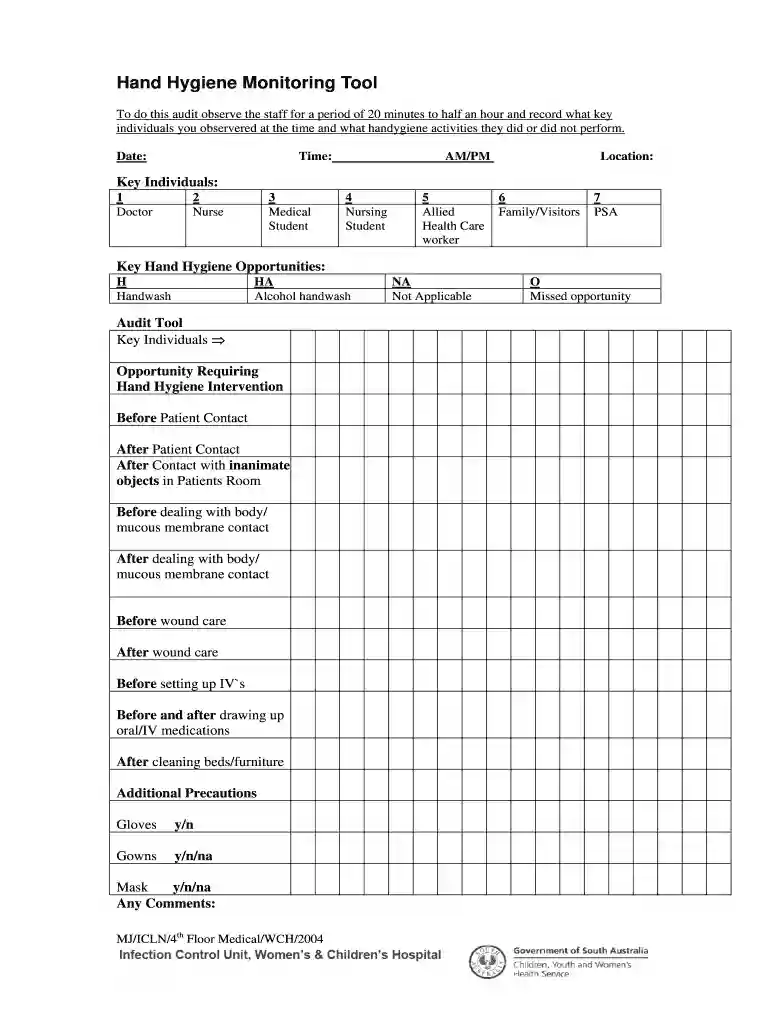
The Hand Hygiene Monitoring Tool is a specialized form used to observe and record the hand hygiene practices of healthcare staff. Its primary role is to help facilities ensure adherence to hygiene protocols, which is crucial in preventing healthcare-associated infections. It serves as both an observational checklist and a data collection sheet for auditing hand hygiene compliance.
This tool involves systematic observation over a set period, usually ranging from 20 to 30 minutes, to understand how key personnel adhere to hand hygiene protocols.
Completing the tool involves several critical stages, from initial observation to finalizing the report. Here is a detailed step-by-step guide:
Understanding the core components of the tool aids in effective utilization and data accuracy.
Observer Details: Name and role of the person conducting the observation.
Date and Time: Accurate recording of when the observations take place.
Location: Specific area within the healthcare facility where observations are conducted.
Task Categories: Various sections of the tool designed to capture different elements of hand hygiene practice.
Data Fields: Includes categories for documenting compliance or non-compliance actions, additional notes, and observations about specific events.
Knowledge of the following terms is essential for accurately using and understanding the tool:
Compliance Rate: The percentage of correct hand hygiene actions observed compared to opportunities.
Healthcare-Associated Infections (HAIs): Infections acquired in hospitals during the patient's treatment.
Personal Protective Equipment (PPE): Items worn to protect healthcare personnel from exposure to infectious agents.
Interventions: Strategies implemented to improve compliance, often tailored based on monitoring outcomes.
Adhering to legal frameworks is critical when conducting hand hygiene audits.
This tool is predominantly used by infection control professionals and quality assurance teams within healthcare environments.
Infection Control Nurses: Specialists tasked with observing and enhancing hygiene practices.
Quality Assurance Teams: Focus on maintaining high standards of care and adhering to health regulations.
Healthcare Administrators: Review collected data to strategize improvements and training requirements.


Real-world case studies illuminate its effectiveness and utility in healthcare settings.
Case Study 1: A metropolitan hospital reduced its HAIs by 30% within a year after implementing systematic hand hygiene observations.
Case Study 2: A small clinic identified peak hours of non-compliance and adjusted staffing patterns to boost monitoring and adherence rates.
Proactive Measures: Implementing educational programs based on observation data resulted in significantly improved compliance among nursing staff.
These detailed segments provide comprehensive insight into the Hand Hygiene Monitoring Tool, highlighting its operational framework and practical application within healthcare settings.
At DocHub, your data security is our priority. We follow HIPAA, SOC2, GDPR, and other standards, so you can work on your documents with confidence.
This form is intended to guide hand hygiene-based facility and healthcare personnel observations.
Jan 16, 2025 ICAP at Columbia University has developed an electronic tool to monitor hand hygiene compliance among health care workers in Ukraine.Read more
An alert system based on monitoring of World Health Organization (WHO), the Centers for Disease Control (CDC) and other Federal, State and Local sources


