




01. Edit your form online
Type text, add images, blackout confidential details, add comments, highlights and more.

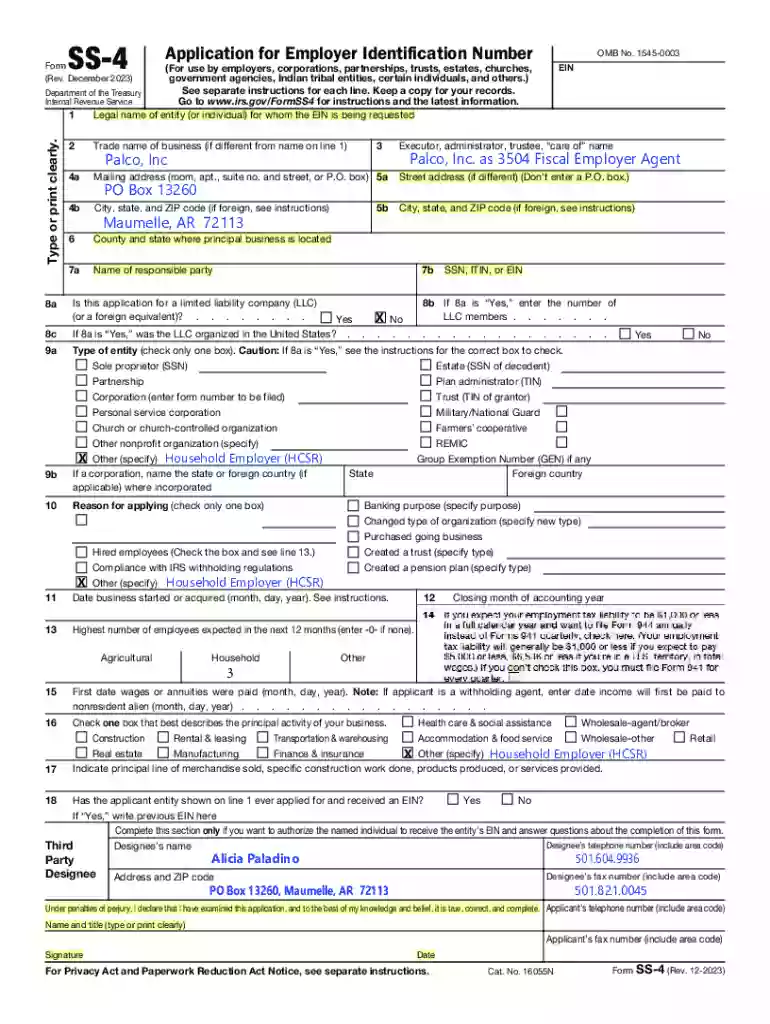
Type text, add images, blackout confidential details, add comments, highlights and more.

Draw your signature, type it, upload its image, or use your mobile device as a signature pad.

Send it via email, link, or fax. You can also download it, export it or print it out.
IRS Form SS-4, officially titled the "Application for Employer Identification Number," is essential for businesses and entities requiring an Employer Identification Number (EIN). An EIN is akin to a Social Security number but is used to identify a business entity for tax purposes, assisting with various tax-related activities such as filing returns and establishing business credits.
Entities needing an EIN include corporations, partnerships, estates, trusts, and certain individuals. The form can be used to obtain an EIN when starting a new business, restructuring an existing one, or when specific changes necessitate an update, such as changing the organization’s form or type.
Determine Eligibility: Ensure your business entity is eligible to apply for an EIN. U.S.-based entities are primarily eligible, but international entities with specific U.S. operations may also qualify.
Gather Required Information: Before filling out the form, collect the necessary details such as the name of the responsible party, address, the type of entity, and the reason for the application.
Completing the Form: Follow the instructions on the IRS website or on DocHub’s platform to accurately fill out each section. This involves specifying the business type, providing the physical address, and selecting the reason for requesting an EIN.
Submission Methods: The completed form can be submitted online through the IRS website, by fax, or by mail. Online submissions are typically processed much faster than those sent via mail or fax.
Receiving the EIN: Upon processing, the IRS will issue the EIN. For online submissions, the EIN is assigned immediately; otherwise, expect a response via mail.
Eligibility to apply for an EIN via Form SS-4 is determined by the nature of the business entity and its location. Typically, businesses requiring an EIN include those:


When choosing a submission method, consider the urgency of obtaining your EIN and any technology constraints your entity might face.
Form SS-4 is available in both digital and paper formats. For efficiency, the digital version is preferable, especially given the immediate feedback and confirmation of submission. However, entities that prefer or require physical records may still use the paper form. Opting for digital simplifies integration with software platforms like DocHub, enhancing workflow and record management.
The EIN is a legal requirement for businesses engaged in U.S.-oriented financial activities. Non-compliance, which includes failure to obtain an EIN when necessary or using an incorrect one, could lead to:
Understanding and adhering to the legal stipulations associated with Form SS-4 ensures smooth business operations and regulatory compliance.
At DocHub, your data security is our priority. We follow HIPAA, SOC2, GDPR, and other standards, so you can work on your documents with confidence.
May 2, 2017 You can get an EIN by applying online at IRS.gov, or by filing Form SS-4, Application for Employer Identification. Number. Also see AgentRead more
Oct 17, 2025 File Form SS-4 if the applicant entity doesnt already have an EIN but is required to show an EIN on any return, statement, or other document.1
Application by Mail.Complete Form SS-4 at least 4 to 5 weeks before you will need an EIN. Sign and date the application and mail it to the service center


