




01. Edit your form online
Type text, add images, blackout confidential details, add comments, highlights and more.

Type text, add images, blackout confidential details, add comments, highlights and more.

Draw your signature, type it, upload its image, or use your mobile device as a signature pad.

Send it via email, link, or fax. You can also download it, export it or print it out.
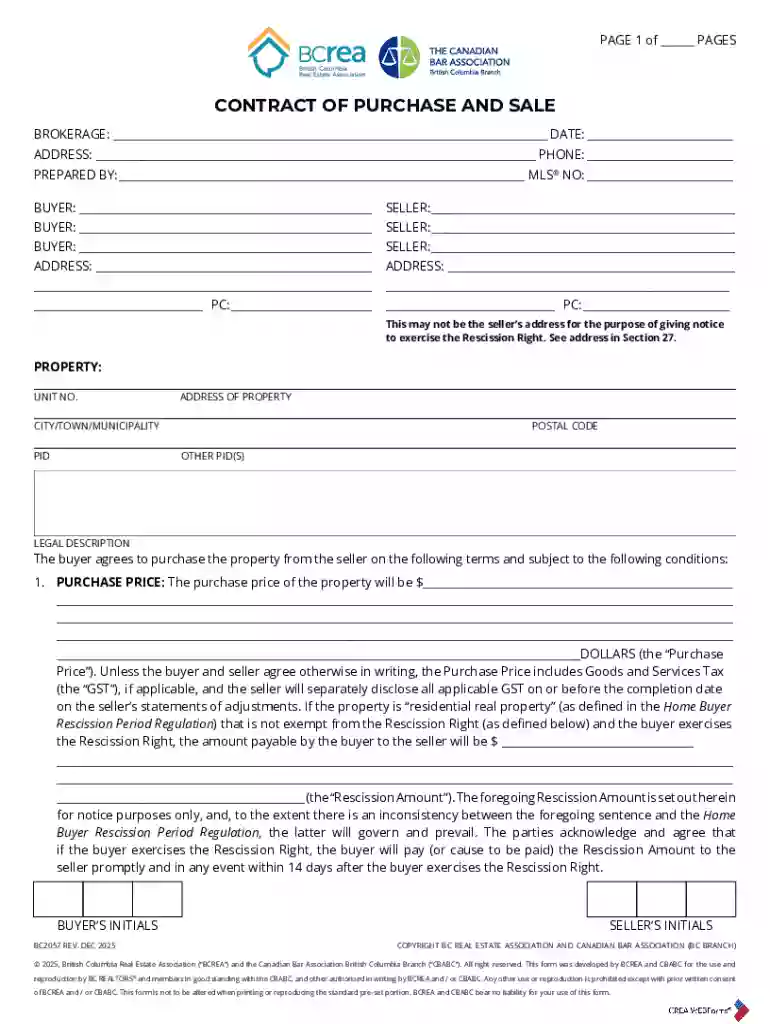
The British Columbia Residential Purchase Agreement serves as a legally binding contract between the buyer and seller of a residential property in British Columbia. It outlines the terms and conditions under which the sale of the property will occur. Key components of the agreement include the purchase price, deposit details, and closing date, among others. This agreement is essential in ensuring transparency and mutual understanding between both parties involved, which safeguards their rights and interests.
The agreement serves not just as a formalized promise, but also as a protection mechanism for both parties, ensuring adherence to the mutually agreed terms.
To effectively use the British Columbia Residential Purchase Agreement, one must first understand its structural components and terminology. Typically, real estate agents or legal professionals guide both parties in filling out the necessary components accurately.
By fostering clear communication between buyers and sellers, the agreement minimizes disputes and supports a smooth transaction process.
Completing the British Columbia Residential Purchase Agreement involves several specific steps that must be followed diligently to ensure the document's validity and enforceability.
Before the final signing, a legal review is often recommended to ensure that all aspects of the agreement comply with current legal requirements in British Columbia.
Critical elements of the British Columbia Residential Purchase Agreement establish the framework for a successful residential property transaction.
Understanding these elements is crucial for both parties, ensuring that they are fully aware of their commitments and rights under the agreement.
The British Columbia Residential Purchase Agreement is not just a procedural formality but a significant legal instrument that encapsulates the rights and duties of both the buyer and the seller, subject to regional real estate laws.
Purchasers and vendors alike should be acutely aware of their legal obligations to avoid breaches that could lead to litigation.
Several pivotal terms are essential in the context of the British Columbia Residential Purchase Agreement. Familiarity with these terms is critical for proper navigation of the document.
Understanding and contextualizing these terms ensure clear communication and the smooth execution of the purchase process.
Though primarily a provincial form, awareness of specific municipal rules or adjustments can be vital when conducting real estate transactions in British Columbia.
By staying informed about these regulations, parties can ensure compliance and avoid potential hindrances to the transaction.
The practical application of the British Columbia Residential Purchase Agreement can be seen in various real-world scenarios.
These diverse use-case scenarios highlight the agreement’s flexibility in catering to varying buyer and seller needs within the province.
At DocHub, your data security is our priority. We follow HIPAA, SOC2, GDPR, and other standards, so you can work on your documents with confidence.


