




01. Edit your form online
Type text, add images, blackout confidential details, add comments, highlights and more.

Type text, add images, blackout confidential details, add comments, highlights and more.

Draw your signature, type it, upload its image, or use your mobile device as a signature pad.

Send it via email, link, or fax. You can also download it, export it or print it out.
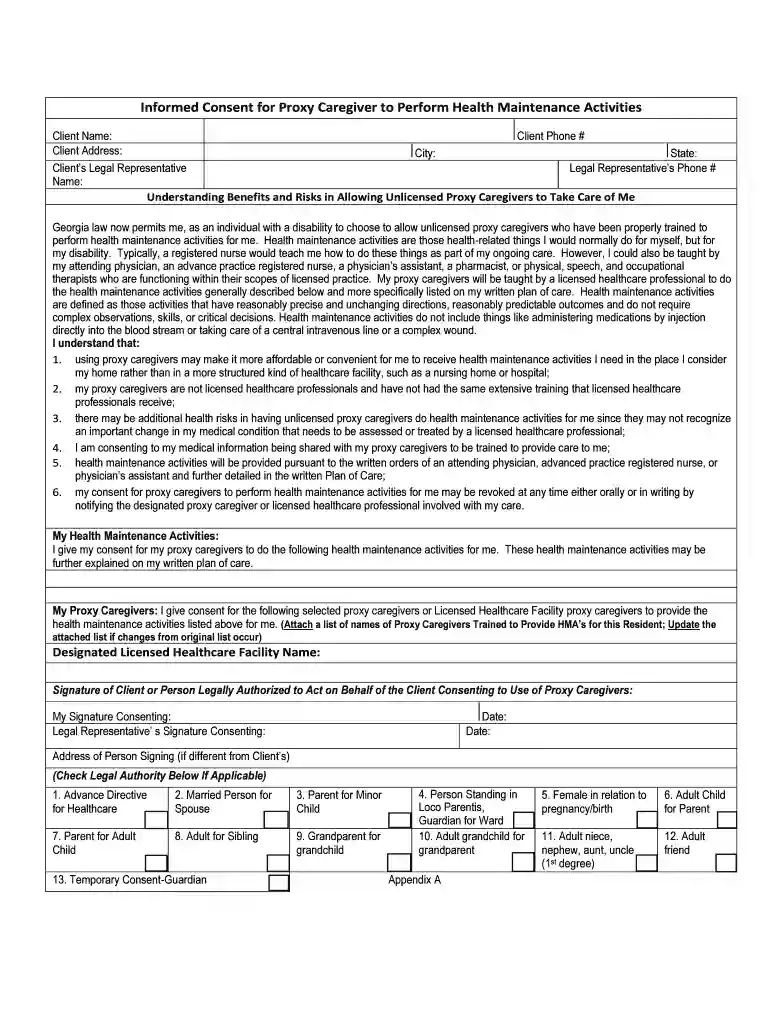
The Georgia Proxy Caregiver Consent Form is a legal document used to authorize an individual, known as a proxy caregiver, to perform health maintenance activities on behalf of a client. Typically utilized in healthcare settings, this form is crucial in situations where a client is unable to care for themselves due to health or cognitive conditions. Under the Georgia Proxy Caregiver Act, specific guidelines and standards must be adhered to when assigning such responsibilities.
The form is comprehensive, covering various scenarios and detailing the nature and extent of responsibilities assigned to the caregiver.
To properly utilize the Georgia Proxy Caregiver Consent Form, follow these steps:
Identify the Parties: Clearly specify the client or their legal representative and the designated proxy caregiver. Include contact information to facilitate communication.
Define Responsibilities: Outline the health maintenance activities the caregiver is authorized to perform. This may include administering medication, assisting with mobility, or other medical tasks as per the client’s needs.
Obtain Necessary Approvals: Secure consent from the client or their authorized representative, validating the delegation of tasks. In many instances, this process requires the oversight of a healthcare professional or legal advisor to ensure compliance with state regulations.
Documentation and Review: Ensure all sections of the form are filled out accurately. Review the document for completeness and clarity.
Secure Signatures: Obtain signatures from all parties involved, including witnesses if required, to make the form legally binding.
There are several methods to access the Georgia Proxy Caregiver Consent Form:
Online Download: Many healthcare organizations and legal service providers offer downloadable versions of the form on their websites.
Healthcare Facilities: Forms are often available at hospitals, clinics, and caregiving agencies, where professionals can provide guidance.
Legal Offices: Attorneys specializing in healthcare law can supply the form and offer legal advice related to its completion and usage.
When retrieving the form, ensure that it is the most recent version to comply with any updated legal standards.
Completing the Georgia Proxy Caregiver Consent Form involves several steps:
Fill in Client Details: Start by entering the client’s personal information, including name, address, and contact number.
Specify Caregiver Information: Provide details about the proxy caregiver, such as full name and phone number to establish clear identification.
Detail Health Maintenance Activities: List the specific tasks the proxy caregiver is authorized to perform. This section should be exhaustive to cover all necessary activities.
Legal Representative: If applicable, include information about the client’s legal representative, ensuring their awareness and approval.
Signatures and Dates: All applicable parties should sign and date the form, including witnesses if necessary, to validate the consent.
Each step requires careful attention to ensure that the form is legally sound and all parties understand their obligations.
The form consists of several critical elements designed to ensure all parties understand the responsibilities and legal implications involved:
Client and Caregiver Information: Name, contact details, and roles must be precisely recorded.
Scope of Care: Explicitly defines the tasks the caregiver is responsible for, providing clarity and reducing ambiguity.
Consent Agreement: Signatures from the client and legal representative affirm their understanding and acceptance of the terms.
These elements work collectively to form a solid legal foundation for the proxy caregiving arrangement.
While the form serves a similar purpose across different states, Georgia has specific regulations tied to the implementation and oversight of proxy caregiver arrangements:
Regulatory Compliance: In Georgia, proxy caregivers must abide by state-defined standards for training and certification.
Medicaid Guidelines: Often, the form is aligned with Medicaid policies, particularly for clients receiving government-funded healthcare services.
Healthcare Oversight: Sometimes, a licensed healthcare provider must oversee the caregiving arrangement, ensuring adherence to professional care standards.
Understanding and complying with these rules is critical to the effective use of the form in Georgia.
Several scenarios illustrate the practical application of the Georgia Proxy Caregiver Consent Form:
Elderly Care: An elderly individual suffering from chronic illness utilizes the form to appoint a family member as their caregiver, allowing them to assist with daily health-related tasks.
Disability Services: A person with a disability employs a trained attendant as a proxy caregiver to help manage their medication regimen.
Post-Surgery Care: After surgery, a patient may use the form to delegate health maintenance tasks to a trusted friend or relative during recovery.
These examples underscore the form’s flexibility and necessity in diverse caregiving situations.
The legal framework governing the use of the Georgia Proxy Caregiver Consent Form ensures that all delegated activities comply with state laws:
Authorization Limits: Clearly delineates the scope of activities the caregiver can perform, preventing unauthorized medical procedures.
Accountability Measures: Sets responsibilities and expected standards, holding caregivers accountable for their actions.
Legal Protection: Offers legal protection for both the client and the caregiver against liability when the tasks are performed as specified.
Understanding these legal boundaries is vital for both clients and caregivers to protect their rights and responsibilities.
At DocHub, your data security is our priority. We follow HIPAA, SOC2, GDPR, and other standards, so you can work on your documents with confidence.
Proxy caregivers provided by the licensed facility who provide assistance with medications must document in the clients record any unusual reactions to theRead more
Proxy Caregivers and Informed Consent Ga. Licensed facilities, may allow proxy caregivers to perform health maintenance activities for individuals with


