Definition & Meaning
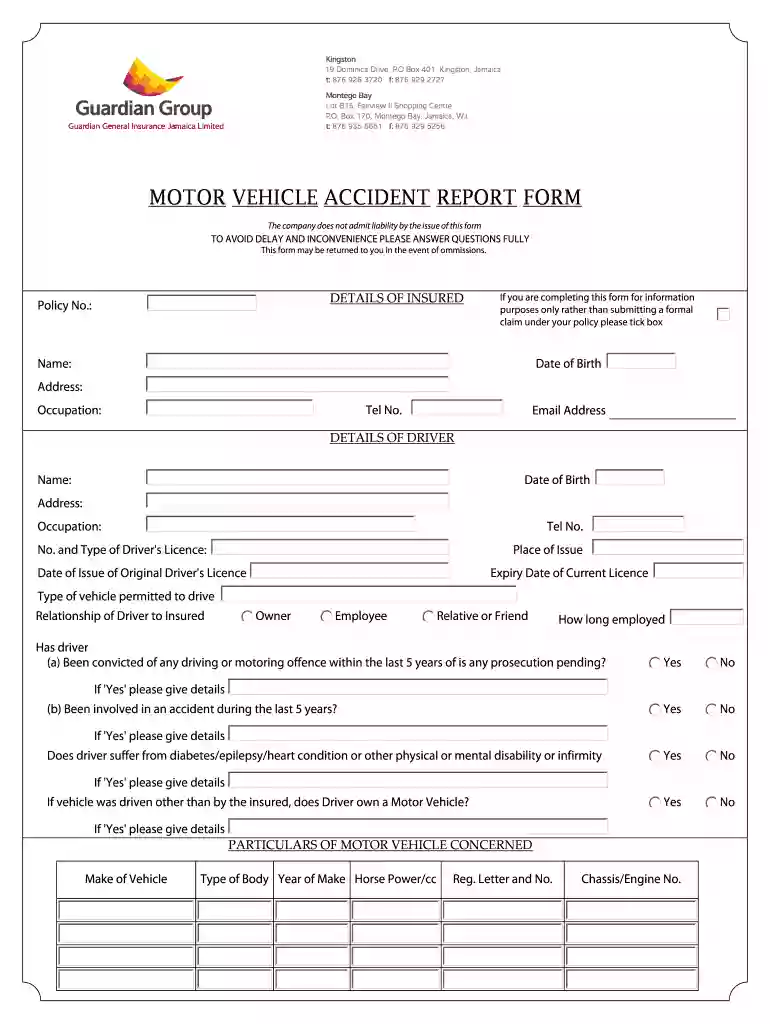
The "Motor Vehicle Accident Report Form" serves as an official document used to record details about a motor vehicle accident. This form captures essential information such as the date, time, location of the accident, the vehicles involved, and the personal details of drivers and witnesses. It acts as a fundamental tool for insurance claims, legal proceedings, and data collection by traffic authorities.
- Date and Time: Precise recording of when the accident occurred.
- Location Details: Exact address or coordinates where the incident took place.
- Driver Information: Details of all drivers involved, including name, contact information, and driver's license number.
- Vehicle Descriptions: Information about the vehicles including make, model, year, and license plate.
- Witness Statements: Recorded observations from any individuals who witnessed the accident.
- Damage Details: Descriptions of damage to vehicles and surrounding property.
- Injury Reports: Notes on any injuries sustained by drivers, passengers, or pedestrians.
Understanding the content and purpose of this form helps parties involved in an accident to accurately document the incident, which is crucial for insurance and legal follow-up.
How to Use the Motor Vehicle Accident Report Form
Utilizing the Motor Vehicle Accident Report Form involves several steps to ensure accuracy and completeness.
Gather Initial Information:
- Collect basic details immediately at the scene, such as driver and vehicle information from all involved parties.
- Seek contact information from witnesses who can provide unbiased accounts of the incident.
Document the Scene:
- Use your smartphone to take photographs of the scene, including vehicle positions and any notable environmental conditions (e.g., weather, road conditions).
- Note the exact location, using landmarks and street names if possible.
Fill Out the Form:
- Enter all collected information into the relevant sections of the form.
- Be precise and clear in all descriptions, particularly regarding any injuries or damages.
Review and Submit:
- Double-check all entries for accuracy.
- Ensure all required fields are completed, including any additional sections as needed by state regulations.
- Submit the form to the appropriate authorities or insurance companies as directed.
Completing the form accurately is vital, as it impacts subsequent insurance claims and any potential legal processes.
Important Terms Related to Motor Vehicle Accident Report Form
Understanding specific terminology used within the Motor Vehicle Accident Report Form helps in accurately filling out and interpreting the form.
- Collision: An incident where two or more vehicles hit each other or when a vehicle hits a pedestrian, animal, or object.
- Liability: Refers to the legal responsibility for the damage and injuries caused in an accident.
- Claimant: An individual who makes an insurance claim.
- Policyholder: The person who has purchased the insurance policy under which a claim is filed.
- Adjuster: An insurance agent who examines the facts of the accident and determines the insurer's liability under the policy terms.
- No-fault Insurance: A type of insurance where policyholders are compensated by their insurance company, regardless of who was at fault.
These terms are pivotal in deciphering the obligations and rights of each party involved in a motor vehicle accident and the accompanying report form.
Key Elements of the Motor Vehicle Accident Report Form
The form comprises several critical sections that gather comprehensive data about the accident.
Personal Information
- Recording Information: All involved parties must include their personal details like name, contact information, and driver's license number.
Vehicle Information
- Vehicle Details: Includes data such as make, model, year, license plate number, and vehicle identification number (VIN).
Accident Description
- Accident Narrative: A detailed description of how the accident occurred, including directional information and any contributing factors like weather or visibility issues.
Diagram of the Scene
- Sketching the Accident: Some forms require a simple diagram to depict the position and movement of vehicles before, during, and after the collision.
Accurately completing each section ensures that the form can be used reliably in subsequent claims or legal evaluations.
States with Specific Rules for the Motor Vehicle Accident Report Form
Different states in the U.S. might have variations in how the Motor Vehicle Accident Report Form is structured and processed.
- California: Requires specific forms like SR 1 for accidents with damages over a defined monetary threshold.
- New York: Mandates filing a report within ten days if property damage exceeds a stated amount.
- Florida: Provides a specific form, HSMV 90010S, which includes detailed instructions on completion and submission.
It is crucial to check state-specific rules to ensure compliance with local regulations, as some states might have additional filing or reporting requirements.
Steps to Complete the Motor Vehicle Accident Report Form
A structured approach ensures effective completion of the form.
Initial Data Collection:
- Personal Information Gathering: Record data from all drivers, passengers, and witnesses.
Accurate Damage Recording:
- Vehicle Impact Analysis: Note the specific areas of damage on each vehicle.
Event Timeline Description:
- Chronological Account: Clearly outline the sequence of events leading up to the accident.
Witness Accounts:
- Capture Statements: Include any insights or testimonies from bystanders.
Submission Preparation:
- Final Review: Ensure every required field is filled with accurate information and submit to the correct entities.
Following these steps meticulously contributes significantly to the clarity and usefulness of the report.
Legal Use of the Motor Vehicle Accident Report Form
The report serves multiple legal functions crucial for all parties involved.
Evidence in Legal Proceedings
- Validity of Statements: Accurately completed forms can be crucial evidence during court proceedings to ascertain responsibility.
Insurance Requirements
- Claim Support: The form supports evidence during insurance claims. Falsifying details can result in denied claims and potential legal actions.
Understanding the legal implications helps individuals and businesses deal with accidents professionally and within the framework of state laws.
Digital vs. Paper Version
Understanding the differences between digital and paper versions of the form is imperative in choosing the suitable method for completion and submission.
Advantages of Digital Forms
- Efficiency: Easier to edit and share electronically, with potential integration with databases and insurance platforms.
- Security: Offers better security measures to protect sensitive information through encryption.
Benefits of Paper Forms
- Accessibility: Situations where digital access is not possible or practical, paper forms can be immediately used.
Incorporating the digital version into workflows optimizes the accident reporting process through improved efficiency and security, especially in environments where electronic submissions are preferred or required.