
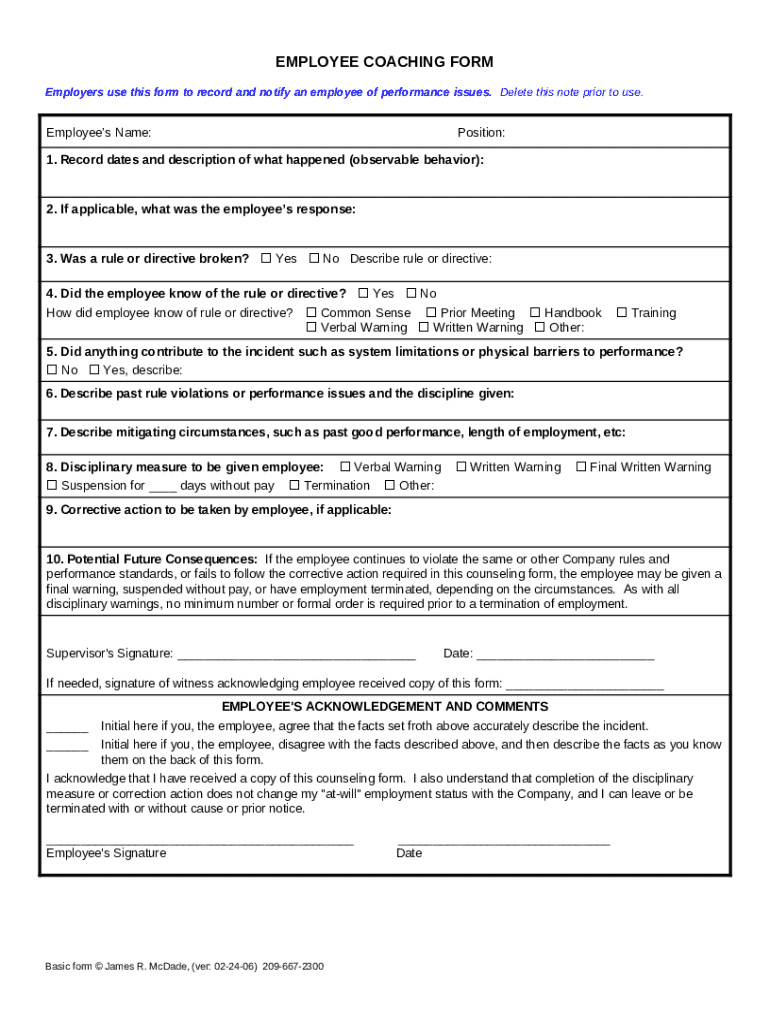







Definition and Importance of the Employee Coaching Form
The Employee Coaching Form is a critical tool used by companies to document and facilitate conversations around employee performance and development. This form is designed to formalize the feedback process, providing a structured framework for both managers and employees. It plays a significant role in encouraging employee growth and addressing performance issues constructively. The form ensures that all coaching sessions are documented, which can be useful for future reference and in assessing long-term employee progress.
- Purpose: The form helps in identifying performance gaps, setting goals, and outlining steps for improvement.
- Standardization: It ensures a consistent approach to employee feedback across an organization.
- Record Keeping: Documenting coaching interactions aids in maintaining a record for performance evaluations.
Key Components of the Employee Coaching Form
Several essential elements make up an effective Employee Coaching Form, ensuring it can comprehensively capture the details of coaching sessions.
- Employee Information: Includes name, department, and role to clearly identify the individual being coached.
- Coach's Information: The name and position of the person conducting the session.
- Coaching Date and Time: To track when the session occurred.
- Performance Summary: An overview of the employee’s current performance levels.
- Goals and Objectives: Clearly defined goals that the employee is expected to achieve.
- Action Plan: Step-by-step actions required to meet the outlined goals with specific timelines.
Steps to Complete the Employee Coaching Form
Filling out the Employee Coaching Form requires attention to detail to ensure all relevant aspects of performance and goals are covered.
- Initial Preparation: Collect all necessary data and performance metrics before the meeting.
- Conduct the Session:
- Discuss current performance with the employee, providing specific examples.
- Identify areas of improvement and potential obstacles.
- Set Goals: Collaboratively define realistic and measurable goals.
- Action Plan: Develop a detailed plan including steps, resources needed, and expected timelines.
- Review and Sign: Both the employee and the coach should review the form to ensure all discussed items are accurately captured. After review, the form should be signed by both parties.
How to Obtain the Employee Coaching Form
Organizations typically provide the Employee Coaching Form through their human resources or management departments. Here's how to ensure you have the correct form:
- Internal Resources: Check your company's intranet or HR portal for a downloadable version of the form.
- HR Department: Contact your HR representative to obtain a copy if it's not available electronically.
- Customization: Some companies offer customizable forms to ensure they meet specific departmental needs.
Legal Use and Compliance of the Employee Coaching Form
While the Employee Coaching Form is not a legal document, it serves as an important tool in documenting employee-manager interactions.
- Documentation: Provides a written record that can be helpful in disputes or grievances.
- Consistency: Ensures fair treatment across similar cases by maintaining uniform documentation practices.
- Confidentiality: Information on the form should be kept confidential and only shared with relevant parties within the organization.
Examples of Using the Employee Coaching Form
Practical applications of the Employee Coaching Form vary widely across sectors, highlighting its versatility.
- Performance Improvement Plans: Utilize the form to formalize discussions around necessary improvements.
- Career Development: For employees seeking advancement, the form can outline development milestones and educational goals.
- Behavioral Coaching: Documenting discussions focused on interpersonal skills or professionalism.
Digital vs. Paper Versions of the Employee Coaching Form
Digital and paper formats each have unique benefits. Selecting the right version depends on your organizational needs and infrastructure.
-
Digital Version:
- Advantages: Easily accessible, modifiable, and can be stored securely online.
- Collaboration: Facilitates remote completion and electronic signatures.
-
Paper Version:
- Advantages: Useful in environments with limited digital access.
- Tangibility: Some organizations prefer a physical copy for record-keeping.
Software Compatibility for the Employee Coaching Form
When utilizing the digital version, it's important to ensure compatibility with your existing systems.
- Document Platforms: Compatible with software like DocHub for ease of editing, signing, and sharing.
- HR Systems: Many forms can be integrated with HR management systems for seamless data entry and storage.
- Cross-Platform Access: Ensure forms can be accessed on multiple devices and platforms for flexibility in use, aligning with remote work policies.




