




01. Edit your form online
Type text, add images, blackout confidential details, add comments, highlights and more.

Type text, add images, blackout confidential details, add comments, highlights and more.

Draw your signature, type it, upload its image, or use your mobile device as a signature pad.

Send it via email, link, or fax. You can also download it, export it or print it out.
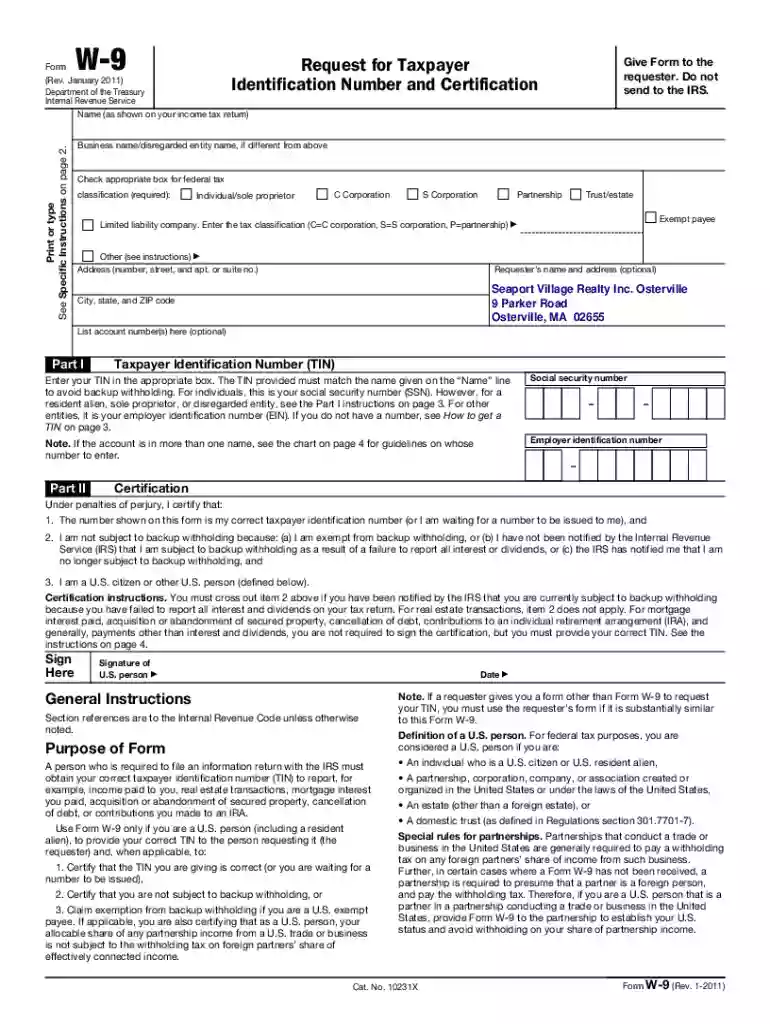
The Form W-9, officially known as the "Request for Taxpayer Identification Number and Certification," is a crucial IRS document used in the United States for tax purposes. This form is primarily used by third parties to collect taxpayer information to report specific types of income paid during the year. The information gathered on Form W-9 includes the taxpayer’s name, address, and Taxpayer Identification Number (TIN), which may be a Social Security Number (SSN) or Employer Identification Number (EIN).
This form is not filed with the IRS but is instead sent to the entity that requested the information. The primary purpose is to ensure that accurate information reporting occurs, allowing the IRS to match payments to the corresponding tax return efficiently.
To effectively use Form W-9, individuals or entities must accurately fill out the required fields. The form should be completed under the following conditions:
Various scenarios necessitate the need for Form W-9, such as when freelancers or contractors provide services to a company, ensuring that their income is reported correctly to the IRS for tax purposes.
Obtaining Form W-9 is straightforward. It can be downloaded directly from the IRS website or accessed through various tax preparation software. Businesses needing to request information from multiple contractors may distribute the form electronically to streamline the collection process. While downloading the form, ensure it is the most current version to avoid compliance issues.
Printing the form from a reliable source guarantees that all fields are up-to-date, and users can complete it with confidence.
Filling out the Form W-9 involves several steps, each of which must be followed carefully to ensure accuracy:
Enter Personal Information: Input your full name, business name (if applicable), and select the appropriate federal tax classification.
Provide Address: Fill in your current address, including street, city, state, and ZIP code.
Enter Taxpayer Identification Number (TIN): This could be your SSN or EIN, dependent on your tax classification.
Certification: By signing the form, you certify under penalties of perjury that the TIN you provided is correct and that you are not subject to backup withholding.
Ensuring that every section of the form is meticulously completed safeguards against reporting errors and potential penalties.
Several key elements are essential when completing the Form W-9:
Name and Business Entity: Make sure the name matches the tax returns filed with the IRS.
Federal Tax Classification: Select the appropriate box that categorizes your status, such as individual/sole proprietor, corporation, partnership, etc.
TIN Requirement: Depending on whether you are an individual or an entity like an LLC, the TIN may vary.
Understanding these components helps streamline the form completion process and ensures compliance with IRS requirements.
Form W-9 is commonly used by:
Freelancers and Independent Contractors: Individuals who receive income outside of regular employment need to complete this form to provide their TIN to businesses.
Corporations and LLCs: These entities often request this form from their vendors to document payments and ensure accurate IRS reporting.
Financial Institutions: Banks and brokers use Form W-9 to obtain correct taxpayer information to report interest, dividends, and other income types.
Knowing the typical users helps in understanding the contexts in which the form is utilized.


Legally, the Form W-9 serves as a certification mechanism for taxpayer identity and status related to federal income tax. By signing the form, taxpayers confirm that their TIN is correct and acknowledge that failing to provide this information can result in backup withholding on their payments. Understanding its legal implications can prevent misuse and ensure the taxpayer is assured that their information is handled responsibly by the requestor.
The IRS provides clear directions about when and how the Form W-9 should be used. These guidelines emphasize:
These guidelines help both requesters and taxpayers align with federal tax regulations to avoid infractions.
Consider these practical scenarios:
Freelancer Contractor for a Tech Company: A graphic designer, working independently, completes Form W-9 for the company they design for, ensuring their payment is reported correctly.
Property Management Firm Needing Contractor Information: A property management business hires a handyman for maintenance work. The firm requests a completed W-9 to document payments over $600 made to the contractor within a tax year.
Such examples illustrate the diverse applications of Form W-9 in different sectors to ensure transparent financial reporting.
At DocHub, your data security is our priority. We follow HIPAA, SOC2, GDPR, and other standards, so you can work on your documents with confidence.
Apr 15, 1976 transcript by calling 1-800-908-9946. The Online EIN Application (IRS.gov/EIN) helps you get an employer identification number. Form Number and
Use Form W-9 to request the taxpayer identification number (TIN) of a U.S. person (including a resident alien) and to request certain certifications and claims
Apr 29, 2026 Use Form W-9 to provide your correct Taxpayer Identification Number (TIN) to the person who is required to file an information return with the IRS.Read more


