




01. Edit your form online
Type text, add images, blackout confidential details, add comments, highlights and more.

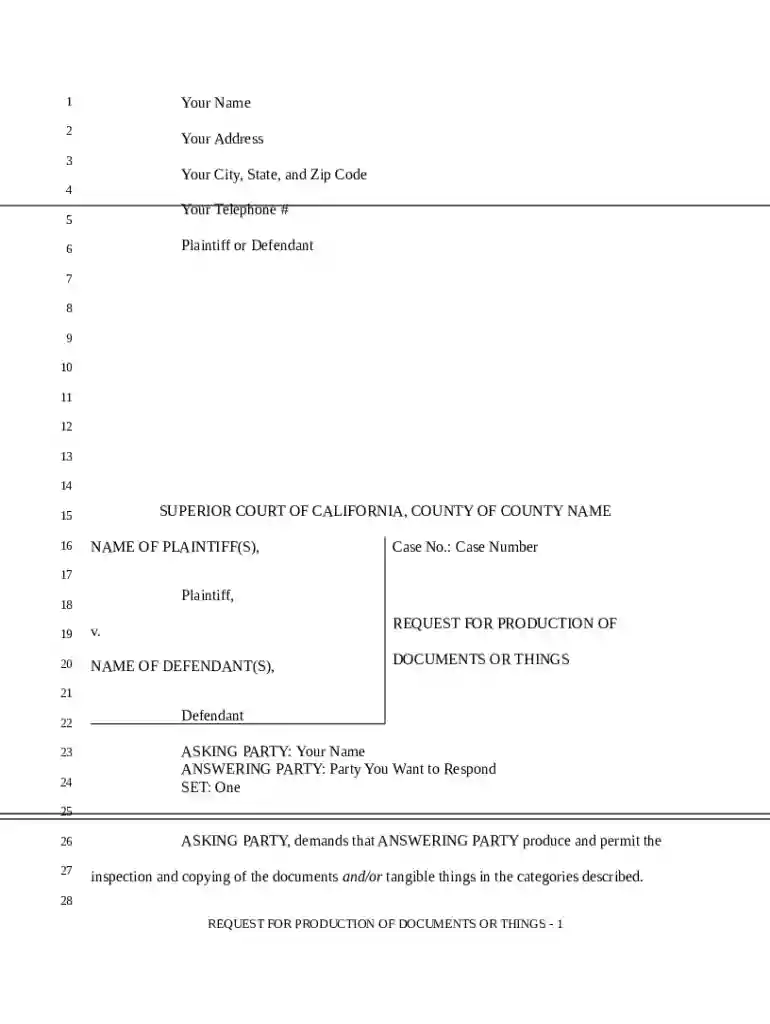
Type text, add images, blackout confidential details, add comments, highlights and more.

Draw your signature, type it, upload its image, or use your mobile device as a signature pad.

Send it via email, link, or fax. You can also download it, export it or print it out.
The "California Request for Production of Documents" is an essential legal tool within the discovery process of civil litigation. This document allows a party involved in a lawsuit to request specific documents from the opposing party, which are pertinent to the case at hand. It is crucial in helping build a case by enabling a detailed examination of evidence held by the opposition.
Leveraging a Request for Production effectively requires understanding its strategic value in litigation.
Identify Relevant Documents: Analyze what documents are likely to contain information supporting your case. This could include financial records, correspondence, or other business documents.
Draft Specific Requests: Carefully draft requests to be as specific as possible to avoid confusion or objection from the opposing party. This ensures compliance and completeness in the production of documents.
Review and Revise: Before serving the request, ensure it aligns with legal standards and adequacy requirements specific to California’s legal framework. Legal counsel can assist in this process to avoid procedural errors.
The process of obtaining and serving a Request for Production involves several clear, methodical steps.
Prepare the Request: Use standard templates available through legal resources or law firms. Customize the template to fit the specifics of your case and ensure all requests are clear and comprehensive.
File the Request with the Court: Once the document is prepared, it must be filed with the California Superior Court associated with your case. This formalizes the request.
Serve the Opposing Party: The document must then be served to the opposing party, typically through certified mail or a professional process server, to ensure a verified receipt.
Filling out the request form comprehensively and correctly is essential for effective document discovery.
Case Information: Begin with entering all relevant case information, including docket number, names of the parties, and the court where the case is filed.
Detailed Descriptions: Provide detailed descriptions for each document requested. This includes specifying document types, dates, and any specific details pertinent to the evidence required.
Legal Compliance: Ensure each section of the form complies fully with the local rules of civil procedure. Each request should be fair and not overly burdensome.
This legal document plays a critical role in securing pertinent evidence, which can significantly influence the outcome of a case.
Identifying the essential components of a well-crafted Request for Production is crucial in leveraging its full potential.
The state of California has specific procedural requirements for discovery documents, which parties must follow closely.
Understanding the legality and ethical considerations when using this form is vital.
By understanding and accurately applying the guidelines surrounding the California Request for Production of Documents, parties can effectively utilize this tool in their litigation strategy, ensuring a thorough preparation for trial.
At DocHub, your data security is our priority. We follow HIPAA, SOC2, GDPR, and other standards, so you can work on your documents with confidence.
A party must produce documents as they are kept in the usual course of business or must organize and label them to correspond to the categories in the request.Read more
A Request for Production (also known as a Demand for Inspection) asks the other side to produce and allow copying or inspection and measuring of a document orRead more


