






Definition & Meaning
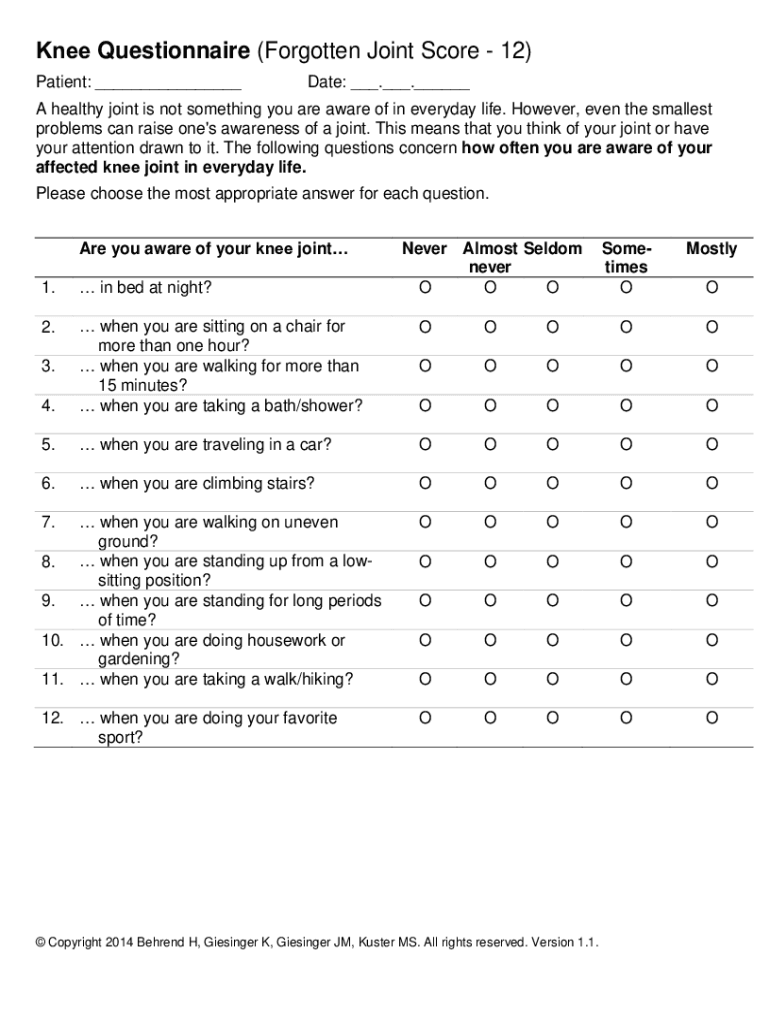
The Knee Questionnaire Forgotten Joint Score 12, commonly referred to as the FJS-12, is an assessment tool used to measure the awareness patients have of their knee joint during daily activities. It is specifically designed to evaluate the success of knee-related treatments, such as joint replacement surgeries, by determining how often the joint is "forgotten" in everyday life. The premise is that a healthy or well-functioning joint is typically not noticed by the individual using it.
How to Use the Knee Questionnaire Forgotten Joint Score 12
Using the FJS-12 involves a patient completing a set of questions that pertain to their experience with their knee joint during various physical activities and resting states. The questions require individuals to reflect on scenarios where they might be consciously aware of their knee joint, like walking, climbing stairs, or standing for extended periods. Patients rate each question, and the aggregated scores offer insights into their level of joint awareness.
Practical Guide to Completion
- Ensure the patient understands each question before answering.
- Encourage honesty and reflection based on typical daily experiences.
- Provide assistance if the patient has difficulty comprehending specific activities being referenced in the questions.
Steps to Complete the Knee Questionnaire Forgotten Joint Score 12
Completing the FJS-12 requires the patient to follow these steps:
- Read each question carefully to understand the context.
- Reflect on recent experiences involving the knee joint under various conditions and activities.
- Rate the frequency of joint awareness on the provided scale for each item.
- Review responses to ensure they accurately reflect the patient’s experiences.
- Submit the completed questionnaire to the clinician or researcher for scoring and interpretation.
Who Typically Uses the Knee Questionnaire Forgotten Joint Score 12
The FJS-12 is primarily used by:
- Orthopedic surgeons to evaluate postoperative outcomes in knee joint surgery.
- Rehabilitation specialists to monitor recovery progress and fine-tune physical therapy programs.
- Researchers investigating the effectiveness of different knee treatments or prosthetics.
- Patients themselves to self-assess the impact of treatments on their daily living and mobility.

Key Elements of the Knee Questionnaire Forgotten Joint Score 12
The questionnaire is composed of several key elements that ensure its effectiveness as an assessment tool:
- Twelve specific questions focused on daily activities that may involve knee movement.
- Rating scales that allow for nuanced patient responses.
- Neutral wording to prevent bias in patient answers.
- Scoring system that translates survey responses into a meaningful metric for clinicians and researchers.
Rating Scale Details
- This scale typically ranges from "Never" to "Always," reflecting the frequency of joint awareness.
Important Terms Related to Knee Questionnaire Forgotten Joint Score 12
Understanding the concepts within the FJS-12 is vital for its proper application:
- "Forgotten joint": Referring to the ideal state where the joint does not draw conscious attention.
- Awareness score: The numerical value indicating the degree of joint awareness during activities.
- Postoperative evaluation: The use of the questionnaire to assess recovery efficacy after surgical interventions.
Examples of Using the Knee Questionnaire Forgotten Joint Score 12
Clinical Context
- Patient A, post total knee replacement, reports "rare" awareness during light activities; high FJS-12 score suggests successful surgery outcome.
- Patient B, undergoing conservative management for knee arthritis, indicates "frequent" awareness; lower FJS-12 score may prompt treatment adjustments.
Research Application
- Studies analyzing the FJS-12 scores of postoperative patients compared to those receiving non-surgical interventions provide insight into long-term effectiveness.
Form Submission Methods
Conducting assessments using the FJS-12 can be done through:
- Paper Forms: Administered during in-office visits, then scored manually or via software.
- Digital Surveys: Completed by patients online before telehealth consultations, allowing integrated storage and analysis via electronic health records.
Online Submission Benefits
- Immediate data collection
- Facilitation of remote consultations
- Automated response analysis for faster feedback to patients
Digital vs. Paper Version
When using the FJS-12, opting for digital or paper forms depends on:
- Technical accessibility: Some patient populations may lack access to digital platforms.
- Data integration capabilities: Digital versions streamline data into healthcare systems for seamless tracking.
- Preference for traditional methods: Some practitioners and patients favor paper forms for tangibility and direct interaction.
Overall, the Knee Questionnaire Forgotten Joint Score 12 provides a structured and insightful approach to assessing knee joint functionality, offering valuable data for both clinical application and patient self-awareness.