




01. Edit your form online
Type text, add images, blackout confidential details, add comments, highlights and more.

Type text, add images, blackout confidential details, add comments, highlights and more.

Draw your signature, type it, upload its image, or use your mobile device as a signature pad.

Send it via email, link, or fax. You can also download it, export it or print it out.
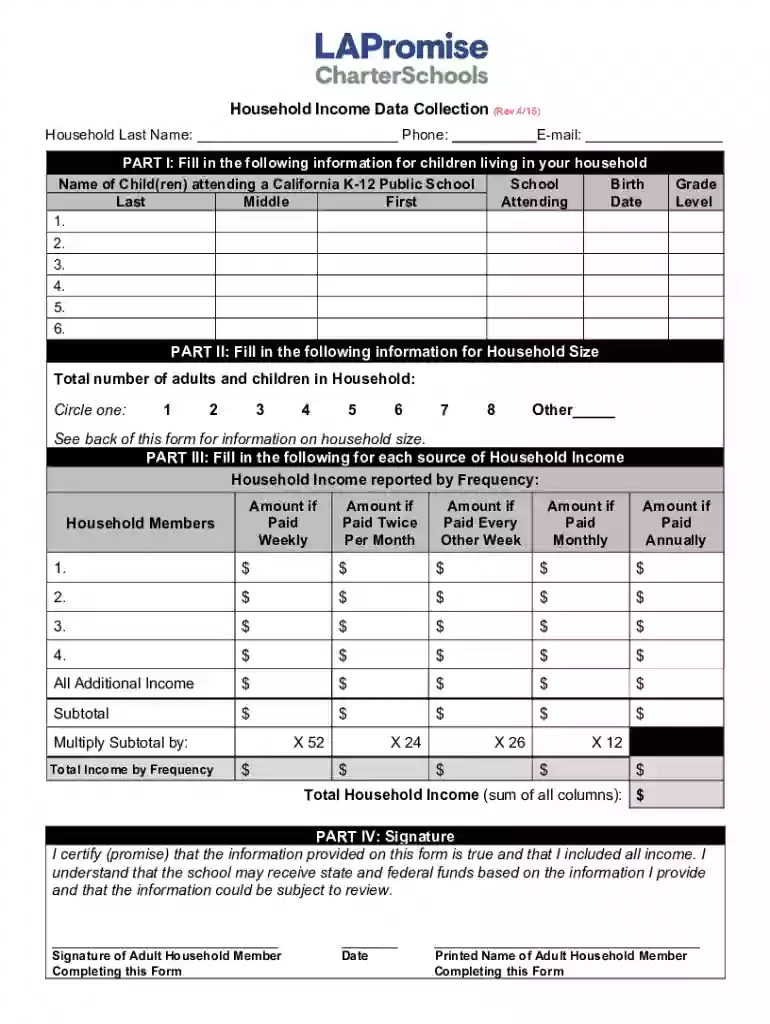
The California Household Income Data Collection Form is a standardized tool used to gather information about the financial status of households within the state. This form is essential for various state programs that determine eligibility for income-based assistance or benefits. It serves as a systematic method for collecting comprehensive household income data, which is pivotal for ensuring accurate aid distribution and improving overall policy planning.
Household Information: This section requires information such as the last name, phone number, and email of the household head. It sets the stage for identifying the household and ensuring that the collected data pertains to the correct family unit.
Children's Data: Part I of the form focuses on children residing in the household. It gathers details about each child, including their names and educational institutions, which helps in correlating income data with program requirements.
Income Sources: The form requires a detailed account of all income sources, including wages, benefits, and other financial contributions, providing a complete picture of the household's financial situation.
Gather Necessary Documents: Before filling out the form, collect all relevant financial documents, such as pay stubs, tax returns, and benefit statements. Having these on hand will ensure all income sources are accurately documented.
Fill Out Personal and Contact Information: Begin by entering the principal household's last name, phone number, and email to establish a point of contact.
Detail Household Composition: List all children in the household. This includes their names, ages, and the schools they attend, providing context for income needs related to education expenses.
Document All Income Sources: This is the most crucial step, requiring precise reporting of all income streams—salaries, unemployment benefits, child support, pensions, etc. It is imperative to accurately report these numbers to avoid future discrepancies.
Review and Verify Information: Carefully review all entered information for accuracy and completeness. Correct any errors and ensure all fields are filled appropriately.
Online Access: The form can be downloaded from various state agency websites. Accessing it online provides convenience and ensures you're using the latest version.
Request via Mail: If online access is unavailable, the form can be requested by contacting the relevant state agency, which will send a physical copy to your address.
In-Person Collection: Visit a local government office, such as the Department of Social Services, to obtain a printed form directly.
The form plays an essential role in identifying individuals eligible for state aid programs such as subsidized housing, food assistance, and medical services. Accurate data collection aids in policy formulation, helping to align support programs with the real financial needs of California residents. It serves as a critical tool for both government administration and individuals seeking aid.
State agencies and various non-profit organizations primarily use this form to assess eligibility for assistance programs. Beneficiaries include low-income families, individuals applying for state-sponsored health plans, and others needing income-based public services. Additionally, researchers and policy analysts utilize aggregate data from these forms to conduct socio-economic studies and tailor interventions accordingly.


It is crucial for individuals filling out the form to provide truthful and accurate information, as it is used in official government assessments. Any falsification can result in penalties, including fines or disqualification from receiving state benefits. The form must adhere to all state and federal privacy laws, ensuring collected data is kept confidential and only used for intended purposes.
Understanding specific terminology is vital for correctly completing the form. Terms often included are:
The California Household Income Data Collection Form can be submitted through various channels:
Online Submission: Check if the issuing agency allows online form submission, which speeds up processing and ensures immediate upload.
Mail Submission: Forms can be mailed to the appropriate agency. Ensure that all parts are complete and photocopied for personal records before sending.
In-Person Submission: Direct submission to local government offices may be required to ensure accuracy and expedite the processing of applications.
Failing to submit the form, providing incomplete information, or misstating data can have significant repercussions:
Loss of Benefits: Non-compliance can lead to withdrawal or denial of state assistance or benefits previously granted.
Fines and Legal Actions: Intentional misrepresentation might attract fines or legal action, emphasizing the importance of accuracy and honesty in every submission.
At DocHub, your data security is our priority. We follow HIPAA, SOC2, GDPR, and other standards, so you can work on your documents with confidence.
(1) demographic data on median income levels, distribution of household income, nature of housing stock, housing costs, and other relevant data pertaining to a.Read more
Explore census data with visualizations and view tutorials. Explore data on data.census.gov View all data resources Census Academy Combining Data Data ToolsRead more
Total Household Income includes all of the following: Gross earnings from work: Use your gross income, not your take-home pay. Gross income is theRead more


