




01. Edit your form online
Type text, add images, blackout confidential details, add comments, highlights and more.

Type text, add images, blackout confidential details, add comments, highlights and more.

Draw your signature, type it, upload its image, or use your mobile device as a signature pad.

Send it via email, link, or fax. You can also download it, export it or print it out.
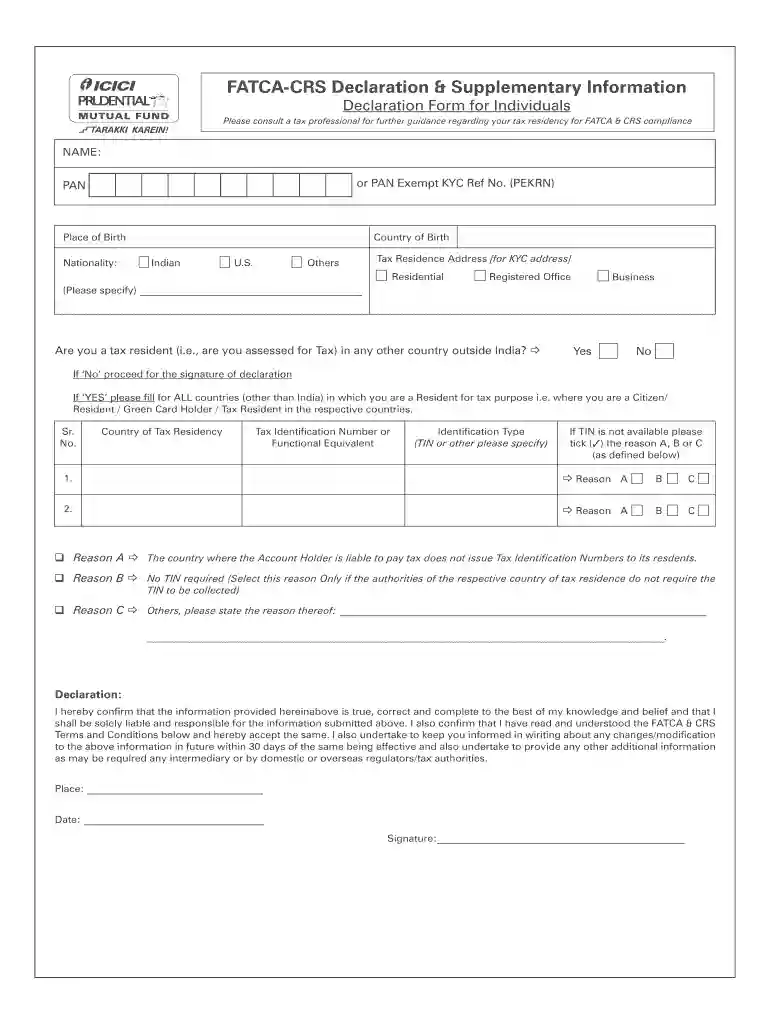
The FATCA-CRS Declaration Form for Individuals is a document used to comply with global tax regulations mandated by the Foreign Account Tax Compliance Act (FATCA) and the Common Reporting Standard (CRS). This form is essential for individuals with international financial accounts or assets to declare their tax residency and report foreign-held assets accurately. The main objective of the form is to prevent tax evasion by requiring taxpayers to disclose accounts held outside their resident jurisdictions.
The FATCA-CRS Declaration Form is integral in fulfilling tax obligations if you hold financial assets or accounts abroad. Use it to report and disclose such accounts to the appropriate tax authorities.
Filling out the FATCA-CRS Declaration Form requires careful attention to detail to ensure compliance and accuracy.
Adhering to the FATCA-CRS guidelines through this form is crucial to ensuring transparency and avoiding legal penalties.
Understanding the core components of the form can help streamline the completion process.
The form serves a vital legal role in global tax compliance efforts.
The Internal Revenue Service (IRS) provides instructions on properly filing and timing the submission of the FATCA-CRS forms.
Failure to properly submit the FATCA-CRS Declaration Form for Individuals can result in significant penalties.
Understanding these areas ensures individuals can navigate their tax reporting obligations effectively, reducing risks associated with non-compliance. Through DocHub's tools, managing and submitting such forms becomes a simplified yet secure process.
At DocHub, your data security is our priority. We follow HIPAA, SOC2, GDPR, and other standards, so you can work on your documents with confidence.
FATCA requires a participating foreign financial institution (FFI) to report all U.S. account holders that are specified U.S. persons (generally individuals,.Read more
Feb 4, 2026 The following FATCA forms and instructions are available: Individuals. Form 3520, Annual Return To Report Transactions With Foreign TrustsRead more


