




01. Edit your form online
Type text, add images, blackout confidential details, add comments, highlights and more.

Type text, add images, blackout confidential details, add comments, highlights and more.

Draw your signature, type it, upload its image, or use your mobile device as a signature pad.

Send it via email, link, or fax. You can also download it, export it or print it out.
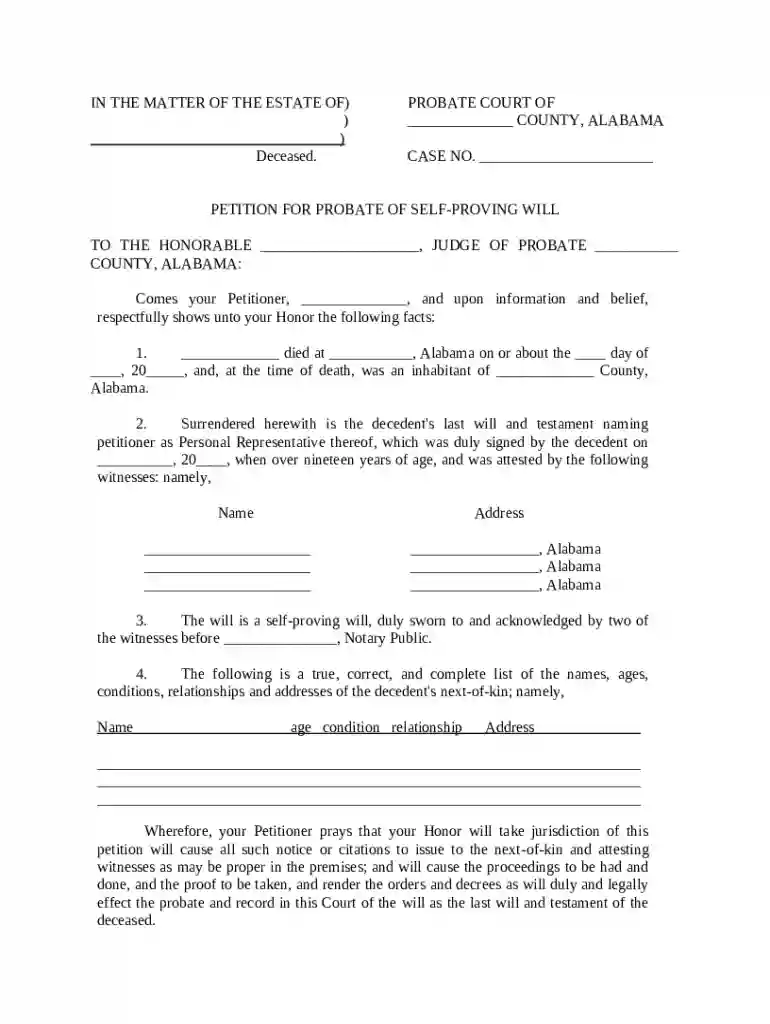
The "Alabama Self-Proving Will Probate Petition" is a legal document used to initiate the probate process for a self-proving will in the state of Alabama. A self-proving will is one that includes affidavits from the witnesses, verified at the time of signing, which allows the court to accept the will without the need for testimony from those witnesses during probate. This document streamlines the legal proceedings following the death of a will creator, ensuring that their assets are distributed according to their wishes.
To utilize the Alabama Self-Proving Will Probate Petition, you must first ensure that the will in question qualifies as self-proving. This means it contains an attached affidavit from the witnesses confirming its validity. The petition serves as an official request to the probate court to admit the will as valid and oversee the distribution of the deceased’s estate. The form must be completed with accurate information about the deceased and their heirs, and then submitted to the appropriate probate court in Alabama.
Gather Necessary Information:
Fill Out the Petition:
Attach Required Documents:
File the Petition:
Attend Court Hearings:
A self-proving will is beneficial because it simplifies the probate process by eliminating the need for witness testimony. This petition legally requests the court to recognize the will, essentially speeding up the administration of the estate while minimizing disputes over its legitimacy. The document is indispensable for ensuring that the decedent's assets are distributed as intended, adhering to Alabama state laws.


Alabama law allows for self-proving affidavits, making the probate process more straightforward by authenticating the will without additional proof. However, all probate procedures must be conducted in an Alabama probate court, specifically in the county where the decedent resided. Executors should be aware of specific deadlines for filing and adhere to procedural requirements to ensure a smooth probate process.
At DocHub, your data security is our priority. We follow HIPAA, SOC2, GDPR, and other standards, so you can work on your documents with confidence.


