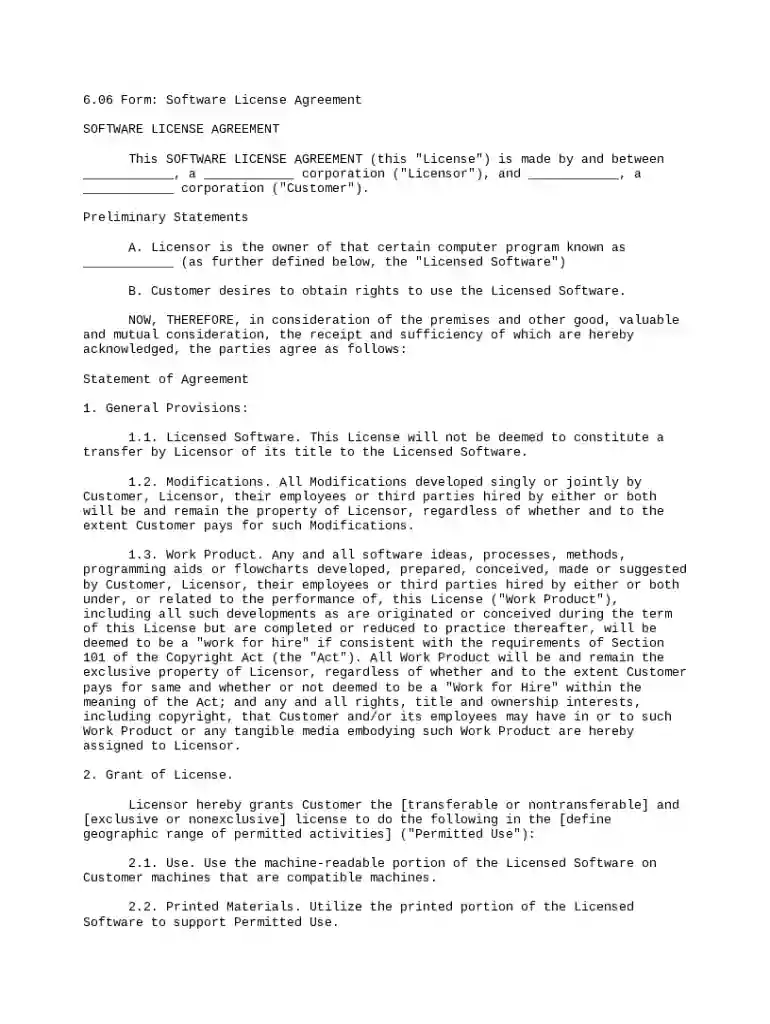
Definition and Meaning
A Software License Agreement is a legally binding contract between the software owner and the user, granting permission to use the software under specific conditions. This document outlines the rights and responsibilities of both parties and serves to protect intellectual property rights. A typical agreement contains clauses related to usage rights, restrictions, warranties, and liabilities. It is crucial for users to understand these terms to ensure legal compliance and to maximize the software’s potential.
Key Elements of a Software License Agreement
A comprehensive Software License Agreement includes several key elements:
- Grant of License: Details the extent of usage rights granted to the user, including limitations on duration and scope.
- Restrictions: Enumerates actions that are prohibited, such as reverse engineering, copying, or distributing the software.
- Ownership: Clarifies that the licensor retains all intellectual property rights.
- Warranties and Disclaimers: Provides information on performance guarantees or lack thereof.
- Liability Limitations: Limits the liability of the software owner for any damages that may occur from the software's use. Each of these components ensures that both parties are aware of their rights and obligations.
How to Use a Software License Agreement
Utilizing a Software License Agreement involves several steps:
- Review: Thoroughly read and understand all terms and conditions.
- Agree: Accept the terms by clicking an acceptance button or signing a physical document.
- Comply: Ensure all software use complies with the agreement to avoid legal issues. These steps help users legally and effectively utilize the software while respecting the owner's rights.
Steps to Complete the Software License Agreement
Completing a Software License Agreement correctly involves:
- Identification: Specify the parties involved, including legal names and contact information.
- Terms and Conditions: Clearly outline the terms of usage and obligations.
- Signatures: Include signatures from authorized representatives of both parties.
- Execution Date: Record the date when the agreement becomes effective. Following these steps ensures the agreement is legally valid and enforceable.
Who Typically Uses a Software License Agreement
Software License Agreements are typically used by:
- Software Developers: To protect their intellectual property and establish usage terms.
- Corporations: For enterprise software services, ensuring compliance and security.
- Educational Institutions: When incorporating software services into educational programs. These parties rely on the agreement to structure legal frameworks around software usage.
Legal Use of the Software License Agreement
The legal use of a Software License Agreement involves:
- Ensuring all terms comply with relevant laws such as copyright and patent laws.
- Using the agreement to prevent unauthorized use or distribution.
- Enforcing the agreement in court, if necessary, to protect intellectual property. Understanding these legal uses helps uphold the integrity of the agreement and protect against infringement.
Important Terms Related to Software License Agreement
Familiarity with terms commonly found in these agreements is crucial:
- Licensor/Licensee: The party granting the license and the party receiving it.
- Perpetual License: A license allowing indefinite use of the software.
- Entitlement: Specific permissions granted to the licensee. Understanding these terms helps users navigate and comprehend the agreements fully.
State-Specific Rules for the Software License Agreement
Software License Agreements may vary based on state legislation:
- California: Often has consumer protection laws that can affect the enforceability of certain clauses.
- New York: May require additional disclosures related to data privacy.
- Texas: Could impose specific requirements for liability limitations. Reviewing state-specific rules ensures the agreement is compliant with local legal standards.
Examples of Using the Software License Agreement
Practical examples of Software License Agreement usage include:
- Corporate Deployments: Large organizations licensing software for internal business operations.
- Software as a Service (SaaS): Contracts for cloud-based software subscriptions.
- Mobile Applications: Agreements when distributing apps through platforms like the Apple App Store or Google Play. These scenarios show how these agreements are implemented in everyday business and personal transactions.