







Definition & Meaning
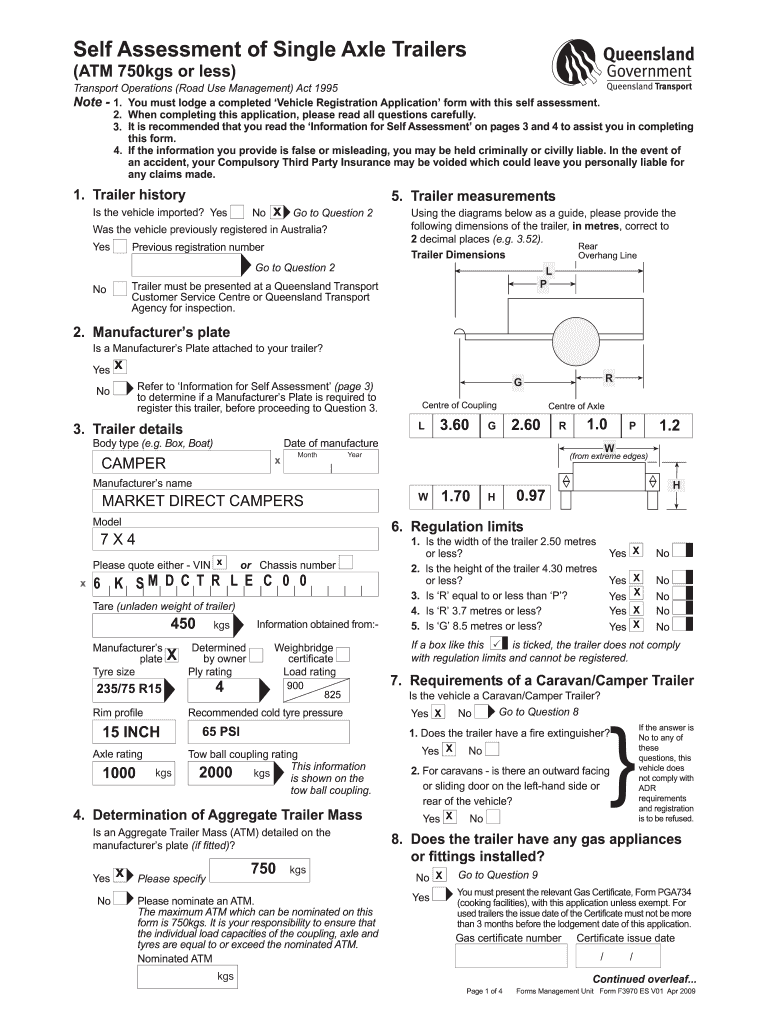
The Queensland Single Axle Trailer Self Assessment is a formal process designed to evaluate if single axle trailers, particularly those with an Aggregate Trailer Mass (ATM) of 750 kilograms or less, comply with local road use regulations. This self-assessment ensures trailers meet the necessary safety and legal requirements before being used on public roads. It is framed under the Transport Operations (Road Use Management) Act 1995, which governs road safety standards in Queensland.
Single axle trailers are often used for transporting goods and materials, and this assessment helps in verifying their roadworthiness. Ensuring compliance through self-assessment not only aligns with legal mandates but also promotes safer road conditions for all users.
How to Use the Queensland Single Axle Trailer Self Assessment
To conduct the self-assessment, trailer owners must review the specific criteria outlined in the form, which typically includes checks on the trailer's structure, braking system, lights, and overall condition. Here's a step-by-step guide on how to proceed:
- Review Guidelines: Begin by thoroughly reading the instructions provided in the self-assessment documentation to understand the requirements.
- Check Trailer Specifications: Measure and document the trailer's dimensions, weight, and load specifications to ensure they fall within permissible limits.
- Inspect Safety Features: Verify that all safety components, such as brake lights and reflectors, are functioning correctly.
- Fill Out the Form: Complete the self-assessment form, providing detailed answers to each section based on your trailer’s inspection results.
- Document Verification: Attach any required supporting documents, such as proof of purchase or previous inspection reports.
- Submit the Form: Follow designated submission methods for self-certification under the Queensland transport regulations.
Steps to Complete the Queensland Single Axle Trailer Self Assessment
Completing this self-assessment involves a methodical approach to ensure all regulatory boxes are ticked:
- Preparation: Gather all relevant information, including trailer specifications, previous assessments, and any peculiar modifications done to the trailer.
- Conducting the Assessment:
- Structural Review: Inspect the frame, axles, and coupling device for any signs of wear or damage.
- Operational Checks: Test the functionality of brake systems and ensure tire conditions meet safety standards.
- Lighting System: Confirm all lights, including indicators and brake lights, are operational and visible.
- Filling the Form: Accurately record findings on the assessment form, ensuring clarity and completeness.
- Review and Submission: Double-check form entries for accuracy before submitting via approved channels.
Legal Use of the Queensland Single Axle Trailer Self Assessment
The legal use of this self-assessment hinges on adherence to guidelines set forth by transport authorities. It confers certain responsibilities on the trailer owner, such as ensuring the trailer remains compliant even after the assessment. Legal compliance involves:
- Regular Inspections: Conducting periodic checks to maintain roadworthiness.
- Updated Documentation: Keeping records current, especially after any trailer modifications.
- Reporting Changes: Notifying authorities of any significant changes or upgrades to the trailer post-assessment.
Key Elements of the Queensland Single Axle Trailer Self Assessment
Several critical components must be addressed within this self-assessment to ensure legality and safety:
- Compliance with ATM Regulations: Trailers must have an ATM of 750kg or less.
- Structural Integrity: No structural defects such as rust or weld fractures should exist.
- Functionality of Safety Equipment: All safety features should be fully operational.
- Document Accuracy: Accurate completion of all required documentation is essential.
- Regulatory Conformance: Adherence to regulations under the Transport Operations Act.
State-Specific Rules for the Queensland Single Axle Trailer Self Assessment
Although the principles of trailer safety are universally significant, Queensland has specific legislation that influences self-assessment practices:
- Vehicle Registration Requirements: Must be coupled with a vehicle registration application form.
- Inspection Standards: More stringent checks on mechanical components and environmental considerations (like emission control).
- Localized Compliance: Adapting to state-specific compliance measures that align with Queensland’s traffic management strategies.
Important Terms Related to Queensland Single Axle Trailer Self Assessment
Understanding specific terminology can greatly enhance the accuracy of the assessment:
- ATM (Aggregate Trailer Mass): The total mass of the trailer, including load and equipment.
- Coupling: The device connecting the trailer to the towing vehicle.
- Roadworthiness: A measure of whether a trailer is deemed safe for use on public roads.
- Compliance Documentation: Forms and records demonstrating adherence to regulations.
Penalties for Non-Compliance
Non-compliance with the self-assessment requirements can result in legal ramifications and penalties. Penalties may include:
- Fines: Monetary penalties for failure to comply with the self-assessment process.
- Registration Restrictions: Prohibition from registering or renewing trailer registration.
- Road Use Limitations: Restrictions on using the trailer until compliance is rectified.
Trailer owners are encouraged to take the self-assessment seriously, ensuring that all areas of non-compliance are addressed promptly to avoid these consequences.




