
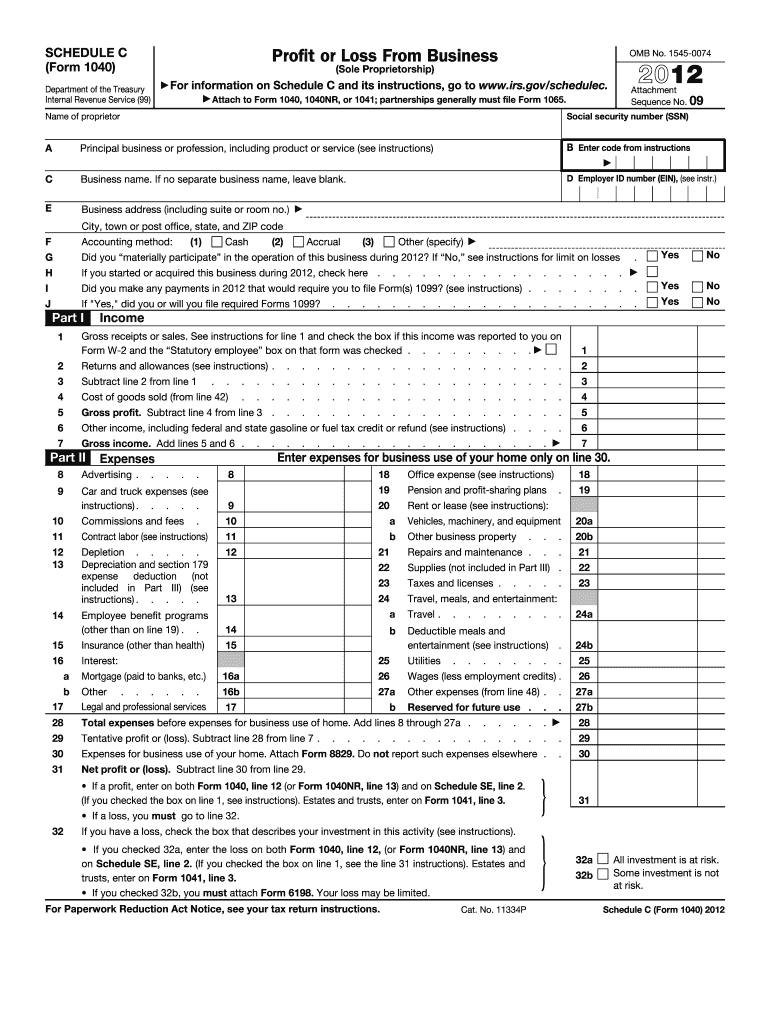







Definition and Purpose of Schedule C Tax Form
The Schedule C tax form, officially known as "Schedule C (Form 1040), Profit or Loss from Business," is used by sole proprietors in the United States to report income and expenses related to their business. This form is essential for calculating net profit or loss, which is then transferred to Form 1040 to determine the individual's taxable income. The primary focus of Schedule C is to capture detailed information on various income sources, costs, and deductions, allowing sole proprietors to accurately reflect the financial performance of their businesses.
Key Information Required
- Income Sources: Sole proprietors must report all business income, including gross receipts or sales, income reported on Form W-2 as a statutory employee, and other business-related income.
- Expenses: The form allows for deductions on business expenses such as advertising, car and truck expenses, commissions, insurance, office supplies, rent, utilities, and wages.
- Net Profit Calculation: Net profit is determined by subtracting total expenses from gross income. This figure is crucial for determining the amount of tax owed or refund due.
How to Obtain the Schedule C Tax Form
The Schedule C tax form can be accessed through various sources to ensure ease of filing for all U.S. taxpayers.
Methods of Acquisition
- IRS Website: The most direct way to obtain Schedule C is by downloading it from the official IRS website. Taxpayers can visit the forms section, locate Form 1040 Schedule C, and download it for free.
- Tax Software: Many tax preparation software programs, such as TurboTax and QuickBooks, provide integrated access to Schedule C within their platforms. This can simplify the filing process by auto-populating fields based on the user's financial data.
- Local IRS Offices: For those preferring a physical copy, visiting a local IRS office can be a viable option. They offer printed forms and instructions for those who prefer or require a non-digital format.
- Tax Professionals: Tax advisors or accountants typically provide clients with necessary forms, including Schedule C, as part of their service offering, ensuring they have everything needed for accurate filing.
Steps to Complete the Schedule C Tax Form
Completing the Schedule C tax form involves several steps to ensure all information is accurate and compliant with IRS guidelines.
Step-by-Step Instructions
-
Business Information: Start by filling out the top section with your business name, Social Security Number (SSN), and Employer Identification Number (EIN) if applicable. Include details like business address and principal business or service provided.
-
Income Section: Report your total gross receipts or sales. Consider returns and allowances to determine your net revenue. Input any other types of business income as necessary.
-
Expense Deductions: List allowable business expenses to minimize taxable income. Each category of expenses should be carefully entered to reflect actual business expenditures accurately.
-
Cost of Goods Sold (COGS): Calculate the COGS if applicable, detailing beginning and ending inventory values, purchases, cost of labor, and materials used.
-
Depreciation and Section 179 Expenses: Deduct applicable depreciation and any Section 179 expense deduction using the detailed instructions provided by the IRS.
-
Net Profit or Loss: Subtract total deductions from total income to arrive at the net profit or loss. Transfer this figure to Schedule 1 (Form 1040).
Important Considerations
- Accuracy: Ensure all figures are accurate and well-documented, as incorrect filings can lead to audits or penalties from the IRS.
- Documentation: Keep all receipts and records of transactions to substantiate any deductions or income reported.
Who Typically Uses the Schedule C Tax Form
The Schedule C tax form is mainly utilized by certain types of individuals and businesses to accurately report business income and expenses.


Primary Users
- Sole Proprietors: The largest group of individuals using Schedule C are sole proprietors who operate unincorporated businesses.
- Independent Contractors: Freelancers and gig workers, whose income is often reported on 1099 forms, use Schedule C to report business income and expenses.
- Single-Member LLCs: These entities are typically treated as sole proprietorships for taxation, thus requiring the completion of Schedule C.
Additional Users
- Home-Based Businesses: Entrepreneurs who run businesses from their homes are required to itemize expenses and report income through Schedule C.
- Hobbyists Making Income: Those engaging in activities that generate income technically require the use of Schedule C if the activity qualifies as a business.
Important Terms Related to the Schedule C Tax Form
Understanding specific terms related to Schedule C is crucial for accurate and efficient completion.
Key Terms
- Gross Income: Total business revenue before applying any deductions.
- Net Profit: Income after all operating expenses and deductions have been subtracted from gross income.
- Depletion: A deduction allowed for the exhaustion of natural resources.
- Depreciation: The allocation of an asset's cost over its useful life, claimed annually.
Advanced Terms
- Section 179 Deduction: A special deduction allowing businesses to deduct the cost of certain property as an expense rather than capitalizing it.
- Statutory Employee: A worker classified as an employee for certain tax purposes, ensuring clarification and appropriate reporting.
IRS Guidelines for Completing Schedule C
Following IRS guidelines is critical in ensuring compliance and maximizing potential deductions.
Compliance Guidelines
- Accurate Reporting: Ensure all income and expenses are accurately reported. Misreporting can lead to audits and penalties.
- Deadline Adherence: Submit the Schedule C along with your 1040 by the deadline, typically April 15, to avoid late filing penalties.
- Record-Keeping: Maintain detailed records of all income and expenses for at least three years in case of an audit.
Filing Guidance
- Electronic Filing: The IRS encourages electronic filing for efficiency and faster processing. Many tax software applications facilitate this.
Filing Deadlines and Important Dates for Schedule C
Adhering to deadlines is critical to avoid penalties and ensure timely processing of tax returns.
Key Dates
- Annual Deadline: The most common deadline for submission is April 15, aligned with federal tax deadlines.
- Extensions: Taxpayers unable to file by April 15 can request an extension, typically extending the deadline by six months to October 15.
Considerations
- State Deadlines: Some states may have different deadlines for state income tax returns, although federal deadlines apply for Schedule C filings.
- Quarterly Estimates: Those expecting to owe more than $1,000 in taxes must pay estimated quarterly taxes to avoid interest and penalties.
Software Compatibility and Integration
Using compatible software can streamline the completion, filing, and storage of Schedule C.
Compatible Software
- TurboTax and QuickBooks: Leading accounting software like TurboTax and QuickBooks offer robust support for Schedule C, automating many calculations and simplifying the process.
- DocHub: Streamlines the document editing and signature processes, making it easier to manage tax documents alongside other business paperwork.
Integration Features
- Data Import: Many programs enable direct import of bank and credit statements, reducing manual entry and ensuring accuracy.
- Secure Filing: Software solutions offer secure online submission options, reducing the risk of lost or delayed filings.




