




01. Edit your form online
Type text, add images, blackout confidential details, add comments, highlights and more.

Type text, add images, blackout confidential details, add comments, highlights and more.

Draw your signature, type it, upload its image, or use your mobile device as a signature pad.

Send it via email, link, or fax. You can also download it, export it or print it out.
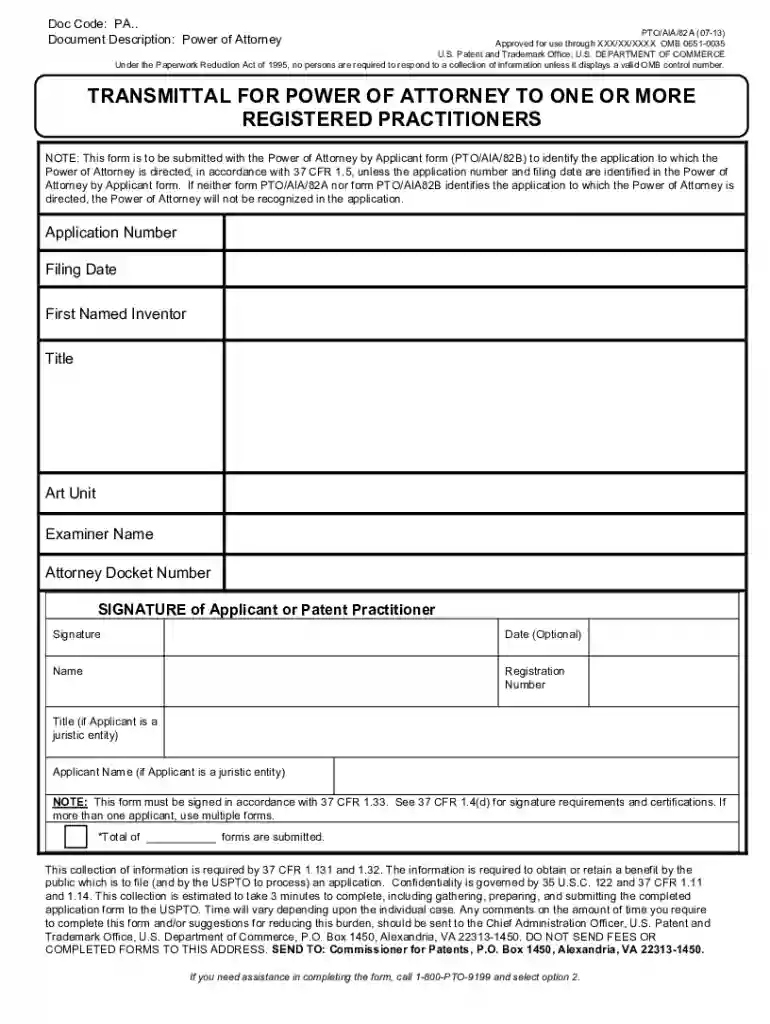
The US Patent Power of Attorney Form, officially referred to as PTO/AIR/82A, authorizes a designated individual—often a registered patent attorney or agent—to act on behalf of a person or entity in matters related to patent applications and maintenance in the United States. This legal document facilitates the efficient handling of intellectual property matters by empowering the designated representative to make decisions, file documents, and correspond with the United States Patent and Trademark Office (USPTO) concerning the patent processes.
Authority Granted: The form grants the appointed representative the ability to manage tasks such as responding to office actions, paying fees, and making other critical patent-related decisions without needing further authorization from the applicant.
Intended Users: Primarily utilized by inventors, companies, and research institutions engaging in patent filings to streamline interactions with the USPTO.
The process of utilizing the US Patent Power of Attorney Form involves specific steps to ensure legal compliance and proper authorization. Below is a typical roadmap for employing this form:
Selecting a Representative: Choose a qualified patent attorney or agent registered with the USPTO.
Completing the Form: Fill out the necessary fields, including identification information for both the applicant and the appointed attorney.
Signing: Both parties must sign the document to validate the authority being granted.
Submitting the Form: File the completed form with the USPTO. This can typically be done electronically via the USPTO's Electronic Filing System (EFS-Web).
Understanding the critical components of the US Patent Power of Attorney Form is essential for correct and effective completion. Notable sections of the form include:
Applicant's Details: Provides spaces for applicant name, mailing address, and contact information.
Attorney/Agent Information: Requires details such as the attorney's name, registration number, and affiliation.
Scope of Authority: Clearly defines the powers being granted to the attorney, which might include filing, prosecuting, and maintaining patent applications.
Signature Requirements: Mandates signatures from both the applicant and the attorney, confirming the mutual agreement and the authority being transferred.
Completing the US Patent Power of Attorney Form entails several precise steps:
Review and Understand: Familiarize yourself with the purpose and implications of authorizing a patent attorney through this form.
Gather Information: Collect required information pertaining to both the applicant and the chosen representative.
Fill the Form: Enter all necessary details into the form, ensuring accuracy and completeness.
Verify and Sign: Both parties review the completed form and sign where indicated to confirm the agreement.
Submit to USPTO: Follow proper procedures for submitting the form to the USPTO, which can include electronic, mail, or hand-delivered submissions.
The US Patent Power of Attorney Form has a significant legal standing, which confers specific rights and responsibilities on the attorney appointed under it. Legal uses include:
Representational Authority: The form grants the attorney legal authority to act on the applicant's behalf in any legal proceedings related to patents.
Compliance Requirement: Utilization of the form ensures that submissions to the USPTO meet legal requirements, thus reinforcing the legitimacy of the patent application process.
To navigate the process successfully, understanding key terminology related to the US Patent Power of Attorney Form is crucial:
Grant of Authority: The legal right conferred upon the attorney to act on behalf of the applicant.
Inventor: The individual or entity whose invention is the subject of the patent application.
PTO/AIR/82A: The official identifier for the Power of Attorney form when dealing with the USPTO.
Scenarios where the US Patent Power of Attorney Form proves beneficial include:
Corporate Patent Filings: A company assigns a patent attorney to manage its entire portfolio of patents to streamline interactions with the USPTO.
Individual Inventors: An inventor appoints a patent attorney to handle the complex legalities involved in securing patent protection for a novel invention.
Methods for submitting the US Patent Power of Attorney Form vary to accommodate convenience and accessibility:
Online Submission: Recommended for its speed and ease, submission through the USPTO's EFS-Web ensures immediate receipt and processing.
Mail: For those preferring physical documentation, sending via registered mail provides a tangible record of submission.
In-Person: Available for critical filings, although less common, offering a personal approach for securing proof of submission.
At DocHub, your data security is our priority. We follow HIPAA, SOC2, GDPR, and other standards, so you can work on your documents with confidence.
Power of attorney, if applicable, where the upon, the office handles the filing process with the schools IP attorney. however, will be exploring a US
AIA/81 Patent Power of Attorney or Revocation of Power of Attorney With a New Power of Attorney and Change of Correspondence
Mar 9, 2012 PTO FORMS. All forms are available in DocHub PDF format for viewing and printing; however, doing so requires that you have DocHubs freeRead more


