






Definition & Meaning
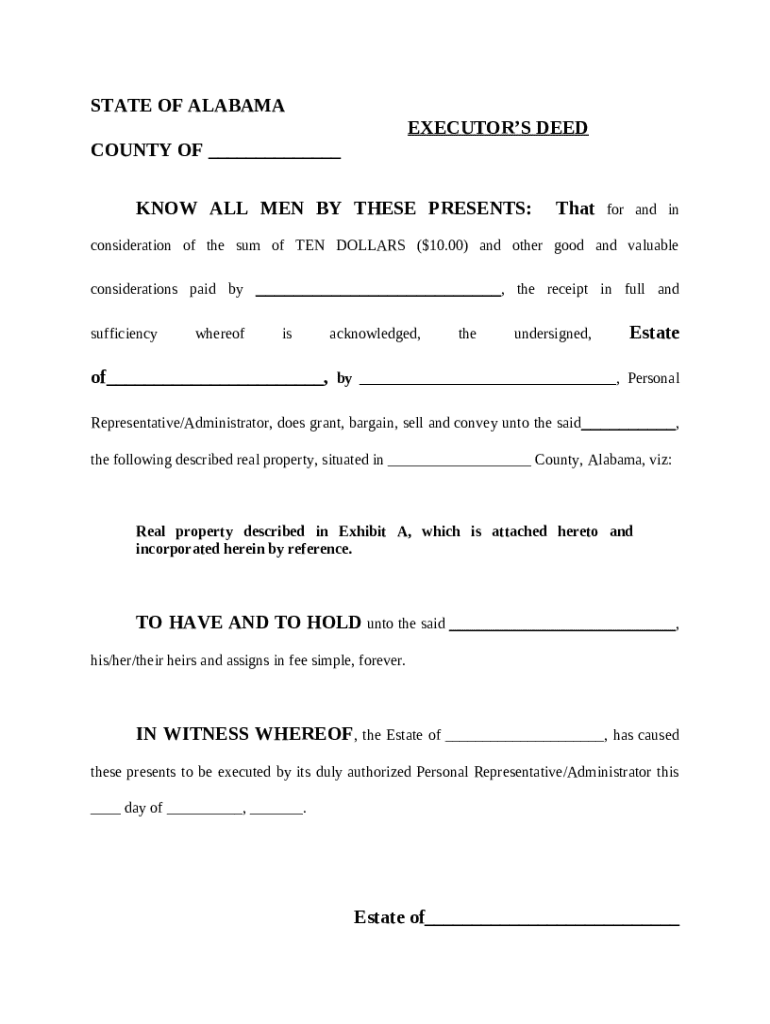
An Alabama Executor's Deed is a legally binding document used in the process of transferring property ownership when the original owner, known as the decedent, has passed away. The deed facilitates the formal transfer of property from the estate of the deceased to the rightful heir or beneficiary as specified in the will. In this context, the executor is the individual appointed to administer the last will and testament, ensuring that the decedent’s wishes are fulfilled. This type of deed confirms that the executor possesses the legal authority to execute the transfer of the property.
How to Use the Alabama Executor's Deed
Using an Alabama Executor's Deed involves several key steps. Initially, the executor must be officially designated by a court to administer the estate. Once appointed, the executor prepares the deed as part of the estate settlement process, ensuring adherence to any stipulations laid out in the will. The document then needs to be signed, notarized, and filed with the appropriate county recorder's office to finalize the transfer. The deed ensures the rightful transfer, safeguarding the new owner’s legal claim to the property, and serving as public notice of this transaction.
Preparing the Deed
- Confirm the executor’s legal authority to act on behalf of the estate.
- Draft the deed with clear identification of the grantor (executor) and the grantee (beneficiary).
- Include a precise description of the property in question.
Filing and Recording
- Sign and notarize the deed to meet legal requirements.
- Submit the deed to the county recorder’s office where the property is situated.
- Pay any applicable filing fees to complete the recording process.
Steps to Complete the Alabama Executor's Deed
Completing an Alabama Executor's Deed necessitates careful attention to detail and compliance with legal procedures. Below are the fundamental steps:
- Obtain Court Authorization: Ensure the executor is legally appointed by the probate court to manage the estate.
- Gather Necessary Information: Collect details about the property, grantor, and grantee.
- Draft the Deed: Use precise legal language to avoid ambiguities. Ensure all sections are correctly completed.
- Sign and Notarize the Document: The deed should be signed by the executor in the presence of a notary public.
- Record the Deed: Submit the signed and notarized deed to the county recorder’s office. This finalizes the transfer.
Key Elements of the Alabama Executor's Deed
The Alabama Executor's Deed comprises several critical components that ensure its validity:
- Grantor Information: Details of the executor managing the estate.
- Grantee Information: Identification of the party receiving the property.
- Property Description: Accurate legal description of the real estate.
- Estate Information: Reference to the decedent’s estate and will.
- Executor's Authority: Confirmation of the executor’s power to execute the deed.
- Signatures: Executed by the executor and notarized for legality.
Legal Use of the Alabama Executor's Deed
The legal purpose of the Alabama Executor's Deed is to facilitate the orderly transfer of property from a deceased individual’s estate to beneficiaries, as designated in the deceased’s will. The process requires compliance with Alabama's probate laws, including verification by the courts of the executor’s authority. The deed signifies a critical step in the closure of an estate, ensuring the lawful distribution of the decedent's assets.
Legal Requirements
- Adherence to state probate procedures.
- Confirmation of the executor’s legal standing.
- Properly drafted, signed, and recorded documentation.
State-Specific Rules for the Alabama Executor's Deed
Alabama imposes specific legal guidelines that govern the execution of an Executor's Deed. These rules ensure adherence to the state’s probate and property transfer laws:
- Probate Approval: Executors must receive court authorization.
- Recording Mandates: Deeds must be recorded in the county where the property is located.
- Transfer Taxes: Compliance with applicable state transfer taxes may be required during recording.
Required Documents
To successfully process an Alabama Executor's Deed, several documents are integral:
- Certified Copy of the Will: Establishes the decedent’s intentions regarding property distribution.
- Executor’s Letters of Authority: Issued by the court confirming the executor’s right to administer the estate.
- Existing Property Deed: Provides necessary details about the property.
Examples of Using the Alabama Executor's Deed
Consider these scenarios where an Alabama Executor's Deed would be applicable:
- Transferring residential property to a surviving family member: When a properties owner passes, and the beneficiary is a child or close relative, an executor's deed is used to transfer ownership officially.
- Distribution of property among multiple heirs: In cases with more than one heir, the deed clarifies each party's legal interest in portions of the property.
Important Terms Related to Alabama Executor's Deed
Understanding specific terminology associated with Alabama Executor's Deeds can clarify the process:
- Decedent: The deceased individual whose estate is being settled.
- Beneficiary/Grantee: The party receiving ownership of the property.
- Probate: The legal process of settling a decedent's estate.
- Executor: Appointed individual managing the estate's division and distribution.