Definition & Meaning
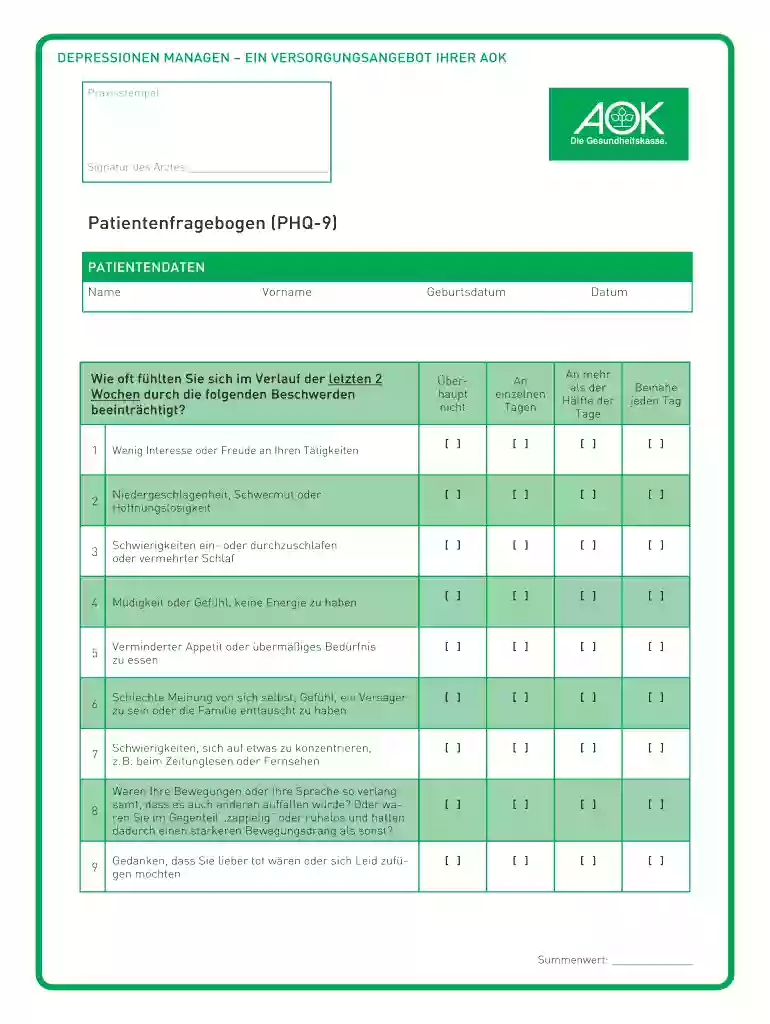
The Patientenfragebogen (PHQ-9) is a self-administered tool used for screening, diagnosing, monitoring, and measuring the severity of depression. Its primary aim is to assess various mental health symptoms over a specific period. This form consists of nine questions that align with the criteria for diagnosing depressive disorders in the Diagnostic and Statistical Manual of Mental Disorders (DSM). The PHQ-9 allows both healthcare professionals and patients to understand the patient's emotional well-being and provides a quantitative measure of depression severity.
Key Components
- Nine Questions: These focus on different depression symptoms, such as lack of interest, sleep disturbances, and thoughts of self-harm.
- Scoring System: Responses are scored on a scale from zero to three, based on the frequency of symptoms, with the total score indicating severity.
Importance
Understanding the PHQ-9 allows for better communication between patients and health practitioners, guiding treatment plans and interventions effectively.
How to Use the Patientenfragebogen (PHQ-9)
The PHQ-9 is user-friendly and designed to be completed within minutes, providing a quick yet accurate assessment of depression symptoms.
- Patient Completion: Patients should complete the form based on their experiences over the preceding two weeks.
- Response Options: Each question has four response options, ranging from "not at all" to "nearly every day."
- Scoring: After completion, each response is tallied to produce a final score, aiding in the assessment of depression severity.
Tips for Completion
- Patients should reflect honestly on their recent feelings and behaviors to ensure accurate results.
- It may be beneficial for practitioners to offer guidance and clarify any uncertainties during the process.
Steps to Complete the Patientenfragebogen (PHQ-9)
Completing the PHQ-9 form is straightforward and can be done independently by the patient before a consultation or with the assistance of a healthcare provider.
- Read Each Question Carefully: Consider each symptom described and how often it has occurred in the past two weeks.
- Select the Appropriate Frequency: Choose from the four frequency options for each question.
- Calculate Total Score: Sum each response's score to obtain the overall depression severity score.
- Discuss Results with a Healthcare Provider: Use the results to discuss possible next steps, including treatment options or further assessments.
Common Usage Scenarios
- Initial Consultations: Often used in initial assessments to understand current mental health status.
- Follow-up Meetings: Useful for tracking changes in symptoms over time.
Important Terms Related to Patientenfragebogen (PHQ-9)
Understanding key terms enhances the effective use of the PHQ-9 and supports better outcomes in mental healthcare.
- Depression Severity Levels: Ranges from minimal to severe, based on the total score.
- DSM Criteria: Diagnostic protocol used for identifying mental health disorders.
- Symptom Frequency: Indicates how often each particular symptom is experienced.
Related Concepts
- Screening vs. Diagnosis: Screening identifies potential concerns, while diagnosis involves confirming a disorder.
- Follow-Up Assessments: Re-administering the PHQ-9 to evaluate treatment progress.
Legal Use of the Patientenfragebogen (PHQ-9)
The PHQ-9 is widely accepted and compliant with mental health screening regulations. It is designed to integrate seamlessly into clinical practice without violating patient rights or regulatory standards.
Compliance
- Confidentiality: Patient responses are protected under privacy laws, ensuring sensitive information is confidential.
- Usage in Clinical Settings: Legally validated as a reliable tool for clinicians to use in various patient assessments.
Considerations
- Healthcare providers should ensure that its implementation adheres to relevant legal standards and patient consent protocols.
Examples of Using the Patientenfragebogen (PHQ-9)
Clinical Settings
In a clinical environment, a psychologist may use the PHQ-9 to determine the baseline mental health state of a new patient. This forms the foundation for creating a personalized treatment plan.
Educational Institutions
University counseling centers might implement the PHQ-9 to assess and support students facing emotional or mental health challenges.
Real-world Scenarios
- Employee Assistance Programs: Employers may use the PHQ-9 to assist employees struggling with mental health issues, thus promoting workplace well-being.
- Public Health Studies: Researchers may deploy the PHQ-9 in population studies to gather data on mental health trends.
Digital vs. Paper Version
The PHQ-9 is versatile, available in both digital and paper formats. Each format suits different settings and user preferences.
Digital Version
- Accessibility: Easily accessible via smartphones, tablets, or computers, and can facilitate remote assessments.
- Integration: Can be embedded within digital health platforms for comprehensive patient management.
Paper Version
- Traditional Use: Common in face-to-face clinical settings where digital access may be limited or patient preference dictates its use.
Differences
- Scoring and Data Storage: Digital versions may automatically score and store data, reducing manual errors and facilitating long-term tracking of patient progress.
Integration with Health Technology
The PHQ-9 is compatible with various healthcare software platforms, ensuring seamless integration within electronic medical records (EMR) systems. Healthcare providers benefit from streamlined data management and improved patient care.
Supported Tools
- Telehealth Platforms: Facilitates remote patient assessments and follow-ups.
- Medical Record Systems: Allows clinicians to track patient progress over time, aiding in decision-making and treatment adjustments.
Benefits
- Efficiency: Reduces administrative tasks by automating scoring and data entry.
- Enhanced Analytics: Provides opportunities for data analysis to support research and evidence-based practices.
Key Elements of the Patientenfragebogen (PHQ-9)
The PHQ-9 encompasses specific elements crucial for its functionality in assessing depression.
Core Features
- Nine Item Scale: Correlates directly with depression diagnostic criteria.
- Scoring System: Scores range from 0 to 27, indicating varying levels of depression severity.
Importance of Each Element
- Every question relates to a distinct symptom, contributing to a holistic view of the patient's mental health.
- The scale's design ensures that a wide range of depressive symptoms are covered, facilitating thorough diagnostic evaluations.
Practical Implications
Understanding each element helps guide effective communication with healthcare professionals, enabling informed clinical decisions based on patient-specific data.