
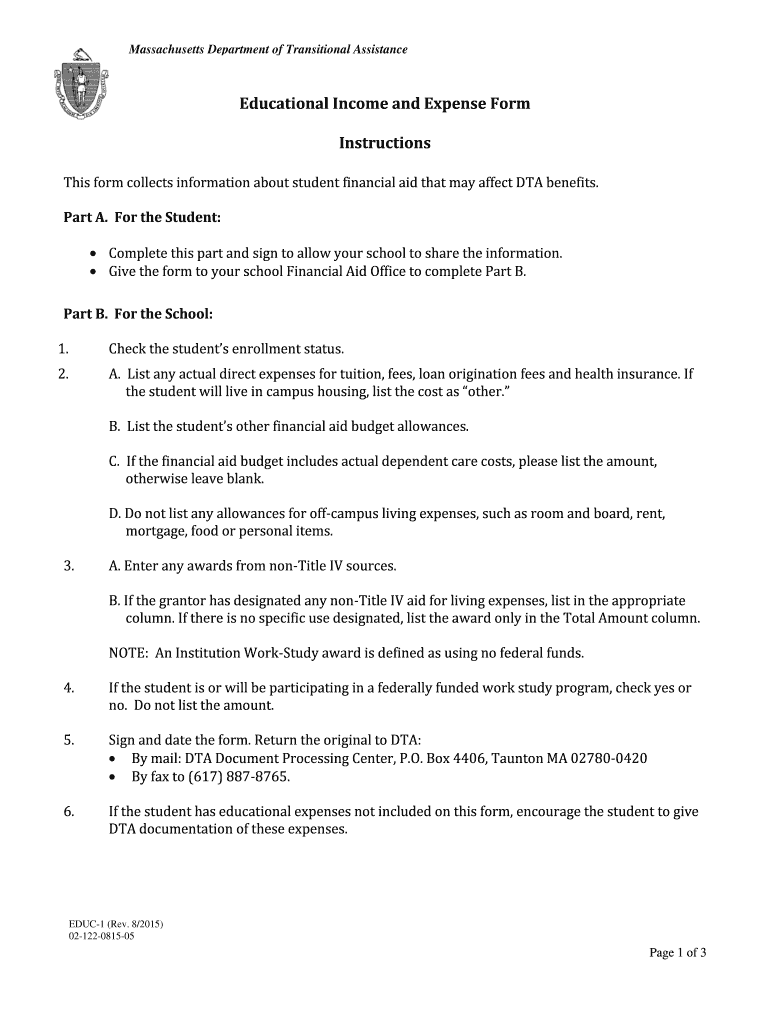







Definition and Purpose of the Massachusetts Educational Income and Expense Form
The Massachusetts Educational Income and Expense Form is a critical document used by students to report financial aid information that may influence their eligibility for benefits under various state programs, such as those managed by the Massachusetts Department of Transitional Assistance (DTA). This form gathers details about different sources of educational income and essential expenses, helping government bodies determine the appropriate level of aid or support for eligible applicants.
Different components of educational financial aid, such as scholarships, grants, and student loans, are considered educational income, while tuition fees, textbooks, and on-campus accommodation can be listed as educational expenses. The specific purpose of this form is to ensure that all relevant financial data is captured and assessed in a standardized format to maintain streamlined consistency in benefit evaluations.
Obtaining the Massachusetts Educational Income and Expense Form
The Massachusetts Educational Income and Expense Form can be obtained through various channels depending on one's convenience. Typically, the most straightforward method to access this form is through the official website of the Massachusetts Department of Transitional Assistance (DTA). Applicants can download a digital copy of the form from there, ensuring they have the latest version at their disposal.
Additionally, individuals can visit a local DTA office in person to request a physical copy, an option particularly useful for those who prefer face-to-face interaction or lack internet access. It’s important to verify whether there are any specific requirements or additional documentation needed when picking up the form directly from a DTA location.
Steps to Complete the Massachusetts Educational Income and Expense Form
-
Gather Necessary Information: Prior to filling out the form, collect all pertinent documents such as financial aid award letters, tuition bills, and receipts for educational expenses. These form the basis of accurately completing the form.
-
Entering Personal Information: Start by providing personal details, including your full name, Social Security Number, and contact information. This section is crucial as it links the form back to you specifically.
-
Documenting Educational Income: List all sources of educational income — this can include scholarships, grants, work-study earnings, and student loans. Ensure figures are accurate and clearly differentiated to avoid any misinterpretation.
-
Outlining Expenses: Enter all educational expenses incurred during the relevant period. These include tuition fees, textbook costs, necessary equipment, and any additional costs directly tied to your education.
-
Review and Submit: Once all information is entered, review the document thoroughly to ensure accuracy. After verification, submit the form through your chosen method, whether online, via mail, or in person at a designated office.
Who Typically Uses the Massachusetts Educational Income and Expense Form
The Massachusetts Educational Income and Expense Form is predominantly used by students who are applying for or currently receiving state assistance through the Massachusetts DTA. This includes:
- Undergraduate and Graduate Students: Those enrolled in higher education institutions who require financial support.
- Vocational or Technical Students: Individuals pursuing non-degree certificates or trade-specific education pathways.
- Non-Traditional Students: Part-time students or those returning to education after a significant lapse could also be eligible for benefits tied to this form.


Key Elements of the Massachusetts Educational Income and Expense Form
- Income Section: Captures detailed information on all educational income streams. It's crucial to differentiate between taxable and non-taxable income to reflect an accurate financial picture.
- Expense Documentation: Provides a breakdown of all educational costs, ensuring the expenses listed align directly with educational needs and requirements.
- Certification and Signature: The form concludes with a section for certification where the applicant affirms the accuracy of the provided information, typically requiring a signature to validate authenticity.
Legal Considerations with the Massachusetts Educational Income and Expense Form
This form acts as a legal document when filed, necessitating precise and truthful information from applicants. Misrepresentation or inaccurate reporting can result in penalties, denial of benefits, or obligations to repay aid received. It’s important for users to understand the legal implications of submitting this form and adhere to all specified guidelines to avoid complications.
State-Specific Rules for the Massachusetts Educational Income and Expense Form
Massachusetts imposes specific guidelines and criteria tailored to its educational and assistance programs to ensure fair and equitable distribution of benefits. Key state-specific considerations include:
- Eligibility Requirements: These criteria must be met to qualify for state-provided educational benefits.
- Submission Deadlines: Massachusetts sets specific timelines for submission, critical for ensuring timely processing and benefit allocation.
- State Variations in Support: Compared to other states, Massachusetts may offer unique financial aid packages or requisites for this form that participants need to be aware of.
Form Submission Methods: Online, Mail, and In-Person Options
- Online Submission: Fast and efficient, allowing users to complete and submit the form electronically via the official DTA website.
- Mail: Suitable for those who prefer traditional methods or lack internet access. Ensure all pages are securely attached before sending.
- In-Person: Available at local DTA offices, offering a more personal touch where queries can be addressed immediately.
Penalties and Compliance for Non-Completion
Failing to complete or misrepresenting information on the Massachusetts Educational Income and Expense Form can lead to various repercussions, including:
- Loss of Benefits: Immediate disqualification from receiving state aid or assistance.
- Financial Penalties: Potential requirements to repay misallocated funds if incorrect information led to excessive benefits.
- Legal Actions: In cases of fraud, there may be more severe consequences involving legal proceedings.
A thorough understanding of these penalties underscores the importance of diligence and accuracy when completing the form.




